
Bill Simons
Do I have golf cred or not? After all, I was born just over a mile from one of the most storied golf clubs in America: Winged Foot. Now that’s a big deal. Many encouraged my mother to become a pro golfer. I’m pals with one of America’s leading golf writers, Art Spander.
And, yeah, I briefly interviewed Tiger at the US Open and Jack Nicklaus and Fred Couples at Wimbledon. Plus, golf and tennis are cousins: individual, international sports straight out of a Victorian era mindset and well manicured country clubs – members only, please.
But come on, I’m a tennis writer, not a golf scribe. Then again, I know a thing or two about individual sports, New York happenings and rowdy crowds – think 27,500 Spanish loyalists letting loose at a Seville soccer stadium. For years, I was told I should start a golf magazine. I didn’t.
But that’s not going to stop me from writing about this weekend’s astonishing Ryder Cup, the most controversial event in the over 700-year history of a sport that prides itself on the flawless dignity and unwavering discipline of both its players and its fans: “Remember, Timothy, gentlemanly play is all that matters.”
•••••
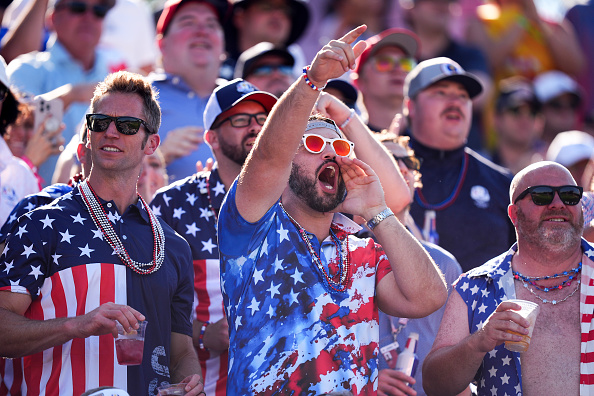
At the fabled Bethpage golf course in the heart of Long Island, the full-throated “F–k you, Rory!” chants were unrelenting. For three mean-spirited days, they rained down on the pride of Ireland, Rory McIlroy. A small part of the well-lubricated crowd of 50,000 (which some labelled a mob) shouted expletives. Homophobic zingers rang out, along with put-downs of Rory’s Irish heritage, his height, a muffed short putt at crunch time at the 2024 US Open and his marital struggles. Veins bulging, fingers pointing, the throng tried to get under the skins of McIlroy and the Euros.
Never mind that Rory began the week by saying America was the best country in the world, a female emcee was soon booted out after she actually used her mic to rile up the crowd with the “F–k you, Rory!” chant. Someone tossed a beer at the head of Rory’s wife. McIlroy finally relented and gave the finger to the crowd and told them to go f–k themselves. The police were called in and McIlroy’s Saturday partner, the burly Irishman Shane Lowry, had to be restrained from charging the crowd. Five fans were ejected.
Of course, trash talking and unfiltered rowdiness are part of the DNA of sports. Decades ago, I took my deeply religious mother to a Yankee game to meet my fiancée for the first time. In the first inning, as I winced, wafts of marijuana smoke came our way, and then the Yankee Stadium faithful broke out into a hearty chorus of, “Boston sucks!” Similarly, if you don’t hear, “Ref, you suck!” chants at an NBA game, you ought to demand a refund. Before you venture out to a Raiders game, it’s best to review your health insurance.
Letting it all hang out and spicy confrontations are a part of Ryder Cup history. In 1999, a premature American celebration led to a heated controversy. Plus, the testy Brit, Colin Montgomerie, was verbally accosted about his private life. Celebrated captains have been dismissed, teammates have been brought down. Gamesmanship has been commonplace. Caps and caddies have sparked confrontations in a loud, raw event steeped in nationalism.
Still, this weekend’s Ryder Cup was something else: an out-of-control, volume is a virtue drama that now begs many questions. Just what exactly is over-the-line fan behavior? When does fair-enough gamesmanship become below-the-belt psychological warfare? When does callous vulgarity become outright abuse? Where was messaging from officials that called for civility?
Reminders of past chokes or shortfalls are fair game for a throng, right? But what about verbal attacks on wives and family members? At what point do crowds have to let athletes do their jobs? Atmosphere yes, interference no. Performers have to perform. Rock ‘n’ roll sidebar: the Who’s Peter Townshend famously kicked an intruder off his stage. Cries of “Judas!” and ruthless boos directed at the suddenly electric Bob Dylan did not age well. Hoops fans can holler during a critical foul shots. But, goodness, don’t shout out as a tennis player is about to serve or crank a down-the-line backhand. And don’t yell during a golfer’s backswing. And putting is a celebration of athletic precision. Why ruin it?
In all of sports, home field advantage is an intriguing twist, a much-debated intangible. Playing the Davis Cup at some neutral Spanish city near Gibraltar is about as exciting as a vanilla milkshake. The Packers’ Lambeau Field in frigid Green Bay or Duke’s unrelenting Cameron Indoor Stadium are daunting venues. But even there, the playing field isn’t completely tilted. Putting your thumb on the scale undermines both the premise and the beauty of sports.
Athletes from Jimmy Connors and Larry Bird to Michael Jordan and Draymond Green have been masters of the curious art of trash talking. Some players are booed every time they touch the ball. That’s fair – right? But references to family matters, race or gender preference don’t cut it.
In tennis, certain crowds, beginning with Brazil’s and Argentina’s, plus many Eastern European fan bases, can go over the top. Be careful if you put Djokovic down. Brazilians were ruthless with American Mal Washington and Brit Jack Draper. The French are hardly welcoming to Americans. Long before he became a zen master, the young Davis Cup player Andre Agassi quipped, “I hope we crush the Paraguayans like the insects they are.”
In American sports, fans from Boston to Philly are a no-holds-barred species. And increasingly over the years, we’ve seen that at the US Open, where night matches often spiral down into after-midnight taunt fests, dysfunctional dives are part of the US Open’s Big Apple brand.
Historians remember well the riot that almost broke out at the Ilie Nastase-John McEnroe fiasco in 1979. Connors’ operatic, x-rated, “You are an abortion!” romp to the 1991 semis made the event a must-watch happening. Since then, implosions, explosions and “I’m a bigger jerk than you!” verbal clashes have been (excuse the mixed metaphor) par for the course.
NASCAR fans crave crashes, hockey crowds enjoy brawls, US Open throngs don’t object to mental calamities. There’s never been a final quite like Serena’s meltdown in 2018. This year, the ever-so-mellow Daniil Medvedev, gave us a six-minute temper tantrum over a faux catastrophe and smashed his rackets to smithereens.
We could go on, but clearly the US Open is getting more toxic. And while the well-heeled, strawberries-and-cream spectators at Wimbledon do enjoy their Pimms, and champagne corks do pop onto proper Centre Court, the US Open increasingly celebrates their new trademark drink, Honey Deuce, and the fact that it earned them $17 million last year. Far more than ever, 34-year-old stockbrokers from Brooklyn and their gals don’t hesitate to be obnoxious.
Why? Blame it on social media that so magnifies loud obnoxious voices, COVID or, according to some claims, a political leader who rose to the top based on grievances and a daily attack mindset that they say has been a gut punch to civility that long ago bled into our culture.
And, dare we note, whether you deeply admire or intensely loathe Donald Trump, there just hasn’t been a more polarizing American figure in centuries. Plus, the man does light the spotlight and the glitz of sports events. In just the last six weeks, he’s visited four happenings in the New York area alone: a FIFA soccer final at the Meadowlands, the US Open men’s final, a Yankee game and the Ryder Cup. And another note: the president just warned that he might pull 2026 World Cup matches out of cities like Seattle and San Francisco if they were deemed to be unsafe.
When he came to the US Open, Air Force One flew low, just above Ashe Stadium. The Open became an armed camp, with many hundreds of weaponized Secret Service and enforcement agents all over. There were up to 90-minute delays to get into the venue. Some booed the man in the Rolex Suite, others cheered. The USTA told the media not to show any reactions.
Last week, the president said he was going to the Ryder Cup because his presence would lead to a US win. American players like Bryson DeChambeau and Scottie Scheffler were proud and delighted that he was on hand. But, after the Europeans survived an astounding comeback surge by America to score a 15-13 win, European fans and their elated team taunted America’s president singing, “Are you watching, are you watching, Don? Are you watching, Donald Trump?”
Speaking of watching, many were aghast as they took in the at-your-throat theater of the Ryder Cup and wondered whether the spectacle was a reflections of our world.
Headlines read, “The US Lost This Ryder Cup Before It Started,” and “The Cascading Failures of Bethpage.” Britain’s often critical Guardian claimed, “US Fan Ugliness Was Merely a Reflection of Trump’s All-Caps America.”
Yes, in the bigger picture, the Ryder Cup can be viewed as merely an apolitical competition, and the fan behavior as just that of drunken New Yorkers who took patriotism too far.
American captain Keegan Bradley said the fans were passionate and he’d heard that the last Ryder Cup in Rome was pretty violent, too. “The fans of New York have been pretty good,” he observed. “You’re always going to have a few people cross the line, and that’s unfortunate. I was happy to see our players trying to quiet down some people…Ryder Cups are wild.”
McIlroy’s perspective was different: “Golf has the ability to unite people. Golf teaches you very good life lessons. It teaches you etiquette. It teaches you how to play by the rules. It teaches you how to respect people. Sometimes this week we didn’t see that…This should not be acceptable in the Ryder Cup.”
Fox commentator Brian Kilmeade said “the fans behavior was a disgrace” and former Ryder Cup captain and eight-time major champ Tom Watson posted, “I’d like to apologize for the rude and mean-spirited behavior from our American crowd…I am ashamed of what happened.”
Others also saw the Cup as yet another reflection of how toxic our culture has become, and a small but troubling mirror of our world.