


Bill Simons
For years, the prevailing storyline of men’s tennis was three simple words – the Big Three. Now Roger Federer is about to enter the Hall of Fame. Rafa Nadal is a dad on the sidelines. And Father Time is tapping, not so gently, on Novak Djokovic’s 39-year-old shoulders.
Last year, as the French Open approached, the tennis world was busy handing its future to Carlos Alcaraz. The dazzling Spaniard, who seduced us with his joy, seemed destined to become the sport’s next enduring monarch – an explosive blend of Nadal’s fury, Federer’s artistry and something altogether his own. During last year’s clay season he seemed like the game’s natural heir.
He won the 2025 Masters in Monte Carlo and Rome, while his ace rival, Jannik Sinner, was returning from a drug suspension that divided tennis. Some claimed it was a punitive overreach by zealous officials. Others insisted it was too light a slap on the wrist and the process had been corrupt.
A cloud of moral ambiguity hovered. But moral ambiguity has a way of fading fast in this game. Plus, suspensions can derail careers – just ask Simona Halep or Maria Sharapova.
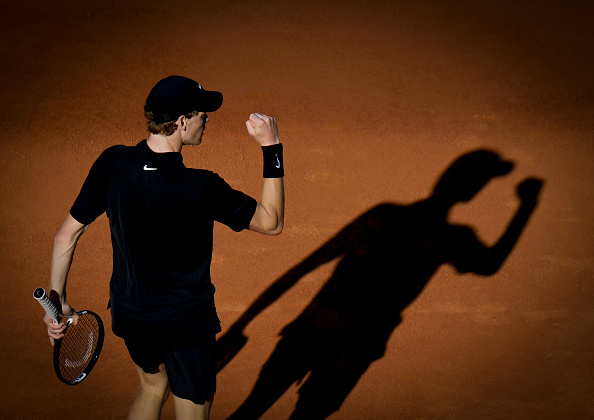
But, last May, Sinner didn’t miss a beat. The world No. 2, who by then had won three Slams, got back into the swing of things as fast as Italians break into arias. He reached the Rome final and seemed poised to gain his first French Open. There he faltered on three championship points and squandered his 2-0 set lead as he lost to Carlos in the greatest Roland Garros finale ever.
It was a devastating defeat. But the 24-year-old, who’s more like a stoic Swede than a combustible Italian, is made of steel. He bounced back to win Wimbledon, the China and Vienna Opens, the Paris Masters and the ATP Finals. Then, after losing his Aussie Open battle to Djokovic, he unleashed a torrid run like few others in history.
Sinner answered all the questions the Indian Wells desert had to ask. He tamed raucous Miami, collecting the Sunshine Double without losing a set.
The seaside breezes of Monte Carlo, the altitude of Madrid and the home pressures of Rome barely fazed him. He lost just one set in each of the three venues and, almost quietly, dominated – as Rafa used to. Like Djokovic, he set records with unblinking efficiency. He won a record six straight Masters. At 24, he became the youngest man to win all nine Masters. He’s won 34 consecutive Masters matches and 17 straight clay matches.
What’s fascinating – and perhaps unsettling for many a tennis romantic – is that Sinner’s dominance wasn’t built the way Federer’s, Nadal’s or even Alcaraz’s was built. It wasn’t dazzling. It wasn’t theatrical. It wasn’t accompanied by non-stop mind-boggling highlight reels or emotional crescendos.
It was clinical. That’s what’s made this stretch so startling.
From Indian Wells through Rome, Sinner essentially turned the Masters circuit into an assembly line. It was said that Roger Federer made his rivals look like Buicks. Sinner makes many of his foes – Alexander Zverev, Daniil Medvedev, Casper Ruud – look like Chevys.
Match after match, elite opponents walked onto the court knowing almost exactly what was coming — the suffocating depth, the laser backhand, the machine-like balance, the refusal to donate errors – and they just couldn’t stop the walls from closing in.
The exasperated Zverev, the greatest player to never win a Slam, observed, “He doesn’t give you any space or any time. Right now, he’s just too good for me.”
The German, who was brushed aside by Sinner 6-1, 6-2 in the Madrid final, reduced tennis to a handy paradigm. He claimed there are three tiers in the game. Jannik stands alone at the top. Then Carlos, Novak and himself form a second level. And then there are aspiring hopefuls in a third tier.
When reflecting on Sinner and Nadal, Patrick Mourataglou gushed, “Their ability to play every shot from January 1st to December 31st with 100% commitment, concentration, intensity…is so rare.”
John McEnroe went further, claiming that Sinner could have beaten Nadal on clay. Today, The TNT broadcaster said the French Open comes down to the whole field versus Sinner – and he was going with the Italian. He then gave us a hot take: “The best bet to beat Jannik is the weather.”
As for the once ascendant Alcaraz, the Spaniard confided that Sinner pushes him to “be better every day.” Carlos, who left his longtime coach Juan Carlos Ferrero in December, lost to Jannik in the Monte Carlo final and then was sidelined by a wrist injury that will keep him off the tour at least through Wimbledon.
In Carlos’ absence, Jannik is said to have a 70% chance to triumph in Paris. No kidding. His top foes have hefty gaps in their resumes. Zverev, tennis’ eternal resident in the Top Five, remains fragile on the game’s biggest stages. He’s lost his last nine matches to the Italian.
Three-time French Open champ Djokovic is arguably the second or third greatest clay court player in history. But in his only clay court match this season, he lost in the Italian Open to a qualifier, Dino Prizmic. Daniil Medvedev has come up short in 10 of his last 11 meetings with Jannick. Three-time Slam finalist Casper Ruud was doing swell against Sinner in the Rome final for 12 minutes. But tennis matches generally run longer than a dozen minutes.
Still, as we approach the start of the French Open, questions abound. How many times will Sinner lose his serve? Will he drop a set? Will he continue the astounding run he and Alcaraz are on? They’ve won six straight Slams. Will Jannik’s season prove to be iconic, like McEnroe’s in 1984, Federer’s in 2006, Nadal’s in 2010 or Djokovic’s in 2011 and 2015?
And then there’s the 800-pound gorilla in the room. Yes, Sinner is a big, bold, baseline blaster. He is calm, consistent and mercilessly competitive. His court positioning and timing amaze. He’s a boa constrictor who suffocates with power and precision. His tennis geometry astounds. He’s willing to grow (his improved drop shots should be banned). He’s a pro’s pro who’s becoming comfortable with his expanding celebrity. Who else has a cushy Gucci contract and has given his racket to the Pope?
But he has little of the boundless variety and inspiring magic of Alcaraz. Imagination isn’t Jannik’s strong suit.
Sinner emerged from the mold that gave us the brilliant but sometimes somber icons Ivan Lendl, Stefan Edberg, and even Pete Sampras, who told us, “I’m just a tennis player – nothing less, nothing more.”
Unlike Kyrgios, Roddick, Agassi and Connors, Jannik’s hardly a quote-meister. The charisma train only stopped briefly at his station. His matches are hardly soul-deadening. Goodness, he’s the best in the world and has a decade of prime years in front of him.
Yet, something is missing. Beyond Italy, he doesn’t ignite stadiums that often. Many ask, “Where’s the wow factor?” Yes, for sure, he’s a good guy of humble origins. Still his critics can be severe. He’s had great good fortune: his drug suspension was modest, his prime foe is suffering a major injury, the GOAT is old and the challenger class these days has few threats like Andy Murray, Stan Wawrinka or Juan Martin del Potro.
But come on – Sinner is a tennis genius. Still, watching his matches can be like watching a silent virtuoso slowly tighten the jaws of a giant vise – as the whole stadium comes to realize that the outcome has already been engineered.
















Dear Bill Simons: I am so happy that I finally looked up and found Inside Tennis on line this year. I have missed the IT magazine so much since last year. I love your articles and have enjoyed every single one since I last received your magazine. I’m not sure that I need to subscribe to Inside Tennis to receive all of your articles or if I can just go online and read them. Please let me know if there is a process I should follow in order to be sure to get your magazine. Again, I miss the magazine format SO MUCH but am happy to read all of your WONDERFUL AND INDEPTH articles on line. Diane Holt
Thanks so much. Just go to Insidetennis.com. With appreciation, Bill