


Bill Simons
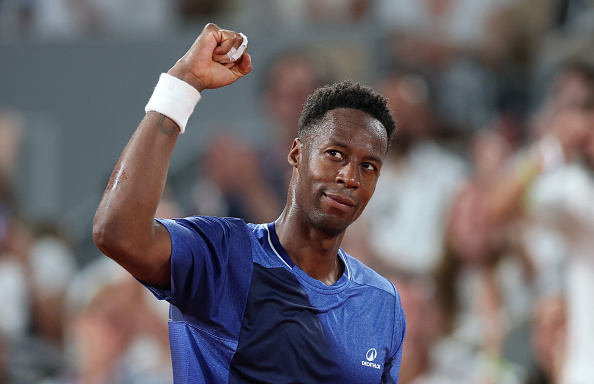
A while ago, Venus Williams told us, “This old girl still has a lot of tricks up her sleeve.” Today, all of Roland Garros – all of tennis – was hoping the sport’s magician-in-residence Gael Monfils still had a few tricks left up his sleeve.
TNT was hopeful, saying tonight’s Monfils vs. Hugo Gaston’s first-round match “will be more than tennis – it will be art.”
But more often, Court Philippe-Chatrier seemed like a Mash unit, as the two Frenchmen bent over in pain, sat down, ran off court, taped their limbs and tried to control their gut as the diminutive Gaston, with quiet confidence, used his guile to race to a two-set lead over the second oldest warrior in the ATP.
Yet the No. 118 in the world hadn’t won a match since November, and Monfils had more Grand Slam wins than any other Frenchman, and was tied with Yannick Noah for the most French matches won at Roland Garros.
Certainly, the greatest entertainer of our era not named Kyrgios would not go quietly into the Parisian night.
Gael didn’t disappoint.
Again we relished his lanky poetry. His wife Elina Svitolina seemed to pray for a miracle, Parisians shouted. Their roars reverberated throughout the sleepy back alleys of the Bois du Boulogne. Athletic and inspired, Monfils seemed to plead with his 39-year-old body. He tapped into his mettle, a dazzling winner one moment, a baffling error the next – and fought back to even the battle at two sets all. What a drama would unfold.
But the theatrical wonder we all hoped for didn’t end with a roar – it ended with a whimper. The 5’ 8” David (Monsieur Gaston) downed the 6’ 4” Goliath (the beloved Monfils) 6-2, 6-3, 3-6, 2-6, 6-0.
It seemed cruel that such a bright star as Monfils would lose his last set 6-0 – to a countryman, no less. But Gael and all of French tennis are adept at handling shortfalls and heartaches. And, oh, how the French know how to seamlessly morph pain into pleasure. Without taking a breath all of Stade Philippe Chartrier was celebrating France’s most likable player since Yannik Noah.
As Svitolina wept, Gael told her, “Without you, I might not be here tonight. You erased the doubts I had and gave me my daughter.” One star after another lauded Monfils. On a video message, Rafa Nadal recalled playing with him as a young teen. And Novak Djokovic told the Frenchman that he was one of the most likeable guys on the tour. “Nobody doesn’t like you – that’s your biggest victory, and that’s why your legacy will stay forever.”
THE STANIMAL’S LAST STAND: There were few shadows today on Court Simonne-Mathieu. But we did recall that no player persevered in the shadow of another quite like Stan Wawrinka labored in the shadow of his fellow Swiss – the beloved Roger Federer.
After all, trying to gain fame as a Swiss player in Roger’s era was like being a court musician when Mozart was soaring. But Wawrinka, with his mischievous twinkle, played his second-fiddle role with grace, humor and quietude. Plus, thanks to his thunderbolts, he had a fabulous Hall of Fame career of his own.
As he played today for the 21st and last time at Roland Garros, we recalled that he won all three major finals he reached: the 2014 Aussie Open, the 2015 French Open and the 2016 US Open. Each time he downed the reigning world No. 1 – Novak or Rafa. Plus, he was a Davis Cup champion, and, with Roger, won Olympics doubles gold.
Long ago, he reached No. 3 in the world. But now Stan’s war-weary face has deep lines. In October, he’ll retire in Basel. Today, he fought for three hours before falling to Dutchman Jesper De Jong, 6-3, 3-6, 6-3, 6-4.
Still, as the farmer’s son retreats from the game, questions linger. Is his tattoo that says, “Ever tried. Ever failed. No matter. Try again. Fail again. Fail better,” the best tat the game has ever seen? Which of his three nicknames — Stan the Man, the Stanimal or the Bison — is the best?
And what about his build? His linebacker chest was one of the game’s great physical presences, and, with his celebrated one-handed backhand and powerful forehand, he delivered a one-two baseline punch that few could match.
Perhaps most importantly, has anyone in recent years shown more moral guts than Stan? Amidst the problematic Justin Gimelstob controversy, when the then-powerful insider became involved in a violent Halloween brawl in LA, Stan stood up and spoke out at a time when the sport had retreated.
The Swiss wrote in The Times of London, “There is no place in our sport for those who behave like Justin.” He added, “I want to be represented by people with clear, strong ethical values…This is a situation where silence amounts to complicity.”
Tennis will never know how Stan would have done if he hadn’t been injured so often, and, worse yet, if he hadn’t played his entire career as one of the foremost foils – along with Andy Murray – for Roger, Rafa and Novak. He suffered a dismal 12-65 record against the Big Three.
Still, we know one thing. Wawrinka was one heck of a Stanimal, and tennis will miss the man – Stan the Man.
THERE’S A HOLE IN THE ROOF – SO LET’S PUT A POOL TABLE IN THE BASEMENT: An NFL quarterback who can scramble out of the pocket and then hit his man 30 yards downfield might demand a $60 million contract. An NBA hoopster who can drain three-point shots might go for $40 million.
Then again, if you win the French Open, you only bank peanuts – a measly $2.9 million.
So it’s understandable that players in a sport that’s thriving are asking for more money. And if you’re not a bigwig with big stakes in a big tournament, there’s a decent chance you might be sympathetic with the pros, especially since they emphasize that they’re really fighting for more revenue for lower-ranked players and for a hefty pension fund.
But there’s a problem. Tennis players really don’t have an effective union. They’re individual entrepreneurs from around the world who are about as organized as free-form anarchists.
Anyway, just before the French Open, they decided they’d had enough. They had to do something – it was time to charge the barricades. Aryna Sabalenka even whispered the “B-word:” boycott.
Instead, the players’ up-against-the-wall tactic was to do less press – just 15 minutes from each player for the worldwide media.
Say what?
If ever there’s been a misdirected, counterproductive move, it’s this. It’s like someone saying, “Gads, we have a hole in our roof, let’s put a pool table in the basement.” So why were players taking a modest jab at the lowly media when clearly it’s tennis bosses who are the folks to address – not the stay-in-the-press-room-until-1-AM press grunts who have no skin in the game?
Sure, some, like Coco Gauff, said, “We don’t have anything against reporters.” And the ever-popular Jessica Pegula quipped, “It was easy to get players to not do a lot of media.”
Then, with no sense of irony whatsoever, she added that fans want to hear from the top players, and that, “The more media coverage we get, the more the ecosystem of the sport is going to grow.”
No kidding.
That was the comment that made my head spin. The message was clear: let’s boycott the media – even though we need the media to get our message across.
Anyway, the 15-minute boycott didn’t have a heck of a lot of impact, and tennis news coverage marched on. I might be the only one in the press corps who feels the players owe us in the fake media a nice little apology. But the phrase “dream on” comes to mind.
UKRAINE’S WAR AND TENNIS’ FADING MEMORY: Years ago, players wore blue and yellow ribbons, Ukrainian flags flew over tennis stadiums, and the No. 1 player in the world led rallies in support of Ukraine. Reporters constantly pressed Russian and Belarusian players about the brutal invasion their leaders had unleashed.
But things change. The news cycle marches on. People tire of war, and other conflicts – from Gaza to Iran – seized the headlines.
Still, the battle in Ukraine grinds on.
Sunday morning, at 8 AM, just before her morning match, Marta Kostyuk learned that a missile had landed right by her family’s home in Kyiv, where her mother, sister and aunt lived. Marta was shaken. She mused, “One hundred meters closer and I wouldn’t have had a mother and a sister.”
Kostyuk has long been one of tennis’ most outspoken players on behalf of Ukraine, so after her victory she told the French crowd and reporters about the attack. She added that Ukrainians remain angry, determined and resilient.
Then, in a sorrowful reflection, she suggested that the tennis world has largely moved on from the war.
“I’m still trying to do what I can, but people move on. There are a lot of wars in the world. You cannot force people to give their help. But this is what matters to me most.”
TURBULENT TIMES FOR TAYLOR: Taylor Fritz doesn’t have the most intriguing game in the world, and he’s not the most charismatic player ever to pick up a racket. But you’ve got to love the guy. Few tennis warriors have been more professional. The man has one of the highest tennis IQs you’ll find in any locker room, and, in the era since Andy Roddick and John Isner, he was long the go-to guy of American tennis.
Taylor reached the US Open final, and repeatedly camped out in the Top Ten. Still, even if you’re not a dirt meister, it has to sting to lose to the No. 148 player in the world, Stanford product Nishesh Basavareddy, who in four sets dismantled him with 27 drop shots.
Worse yet, Taylor has been on a losing streak. At the Miami Open, tendonitis in his knee flared up and he lost his mobility. Then he lost his high-profile girlfriend, social media influencer Morgan Riddle, after nearly six years together.
The good news? He lost 12 pounds. But then he lost in the opening round in both Geneva and Paris, and, in a while, he could lose his perch in the Top Ten.
Then again, the grass season is just around the corner. Last year the pride of California tennis reached the Wimbledon semis.
QUEENS WHO’VE LOST THEIR CROWNS: The once-ascendant superstar of Chinese tennis, Zheng Qinwen, is known as “Queen Wen.” The 2024 Aussie Open finalist, who once was No. 4 and is now No. 56, lost to Poland’s Maja Chwalinska, who is ranked No. 114. In tears, the Queen suggested, “I need to start all over again.”
Similarly, the 2021 US Open champ Emma Raducanu has earned a fortune in top-tier endorsements, but has endured many a battle: invasive paparazzi, rotating coaches, recurrent injuries and repeated, gut-wrenching losses.
In her first-round match, she again failed to summit Sierra. She lost her first set 6-0 in 25 minutes to No. 39 Solana Sierra, who ultimately prevailed 6-0, 7-5.
In tears, the high-profile Brit, who’s now No. 64, offered a rueful reflection: “It’s very difficult. I think you need a lot of resilience. I’m trying my best each day, and I think that’s all I can ask of myself.”
S–T -HAPPENS: Karen Khachanov was on a run. His foe had the runs. Deep into his match against the Russian, the 21-year-old French wildcard Arthur Gea suddenly informed the chair umpire, “I’m gonna s–t on the f–king court…I cannot wait. It’s not a joke.” Clearly Gea lost his cool and he lost the match. But ultimately he didn’t lose his lunch.
THE GREAT EQUALIZER: Clay neutralizes power – right? Massive servers Reilly Opelka and Giovanni Mpetshi Perricard both lost their first-round matches. Then again, Ben Shelton won.










Will definitely miss Gael and Stan too. Thanks Bill for an article chock-filled with details, not only about Gael and Stan but all the others too. I can’t get enough of your awesome writing.