
Bill Simons
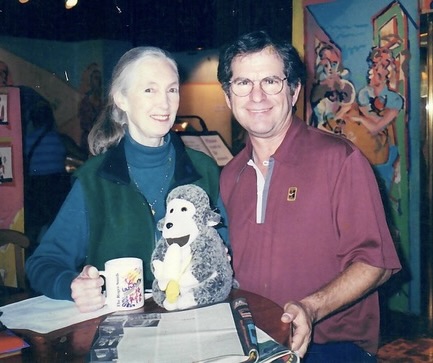
Over 44 years, I’ve accumulated incredible memorabilia: notes from presidents, letters from Nelson Mandela’s office, my Buckingham Palace press pass, assorted awards and shiny trophies. But none have been as impactful as the heartfelt, handwritten letter I got from visionary Jane Goodall just after we met in Manhattan during the 2000 US Open. It read:
“Dear William, or do you prefer Bill?
“It was so wonderful to bump into you in the Roger Smith Hotel restaurant, and thank you so much for the copies of the two articles you wrote on your safari and on bullfighting. Both were very moving. You have a big heart and you care about the things which are so important to me.
“I’m back in the UK for 10 days and have to be in London for two of the remaining six. Then it’s off to Germany for a Roots and Shoots youth summit, then I go to the USA for five non-stop weeks, then straight to Japan, Hong Kong, China, Cambodia and Taiwan. Then five days in the UK, before going to Tanzania. It’s crazy, n’est pa?
“Anyway, I do hope we can work out some kind of plan to help the Jane Goodall Institute raise some money via tennis.
“Any ideas you have will be most exciting. Do keep in touch. I hope that our paths will cross again soon, and in the meantime, all power to you.
“Together we can make this a better world for all living things.
“Love, Jane”
Soon after, I met her again in California, near my home. I hung out with her, did an interview and attended her talks. I suggested an initiative with the Prince racket company and tried unsuccessfully to get the Los Angeles ATP tournament to have a Jane Goodall fundraising day.
Jane told me, “Humans and chimps alike have five universal expressions: fear, disgust, happiness, surprise and anger.”
“So,” I asked, “is there a connection between human sports and animal behavior?” She replied: “Chimpanzees invent all kinds of games and make all kinds of sounds when playing. In the animal world, play is rewarded with a flush of happiness. It brings opiates and is a kind of brain fertilizer.”
She noted that play is a way for many animals to learn life skills without paying a price. Play stokes imagination, combats boredom, teaches about taking turns and establishes social hierarchies. It’s all important practice for facing inevitable dangers. Jane added that 20% of youngsters’ energy is devoted to it. “Play signals that nature’s wisdom is being enacted.”
She once saw a juvenile chimp throw a fruit the size of a tennis ball into the air, “and, to our amazement, he caught it! He then spent the next 10 minutes trying to repeat the performance, going after the ball every time it rolled off into the undergrowth.”
Goodall shared how chimpanzies, our closest cousins, each have individual personalities, and share with us the critical qualities of empathy, grief and loyalty. She observed, “We are both fellow prisoners of the splendor and travail of the Earth.”
She once asked a probing question: “How should we relate to beings who look into mirrors and see themselves as individuals, who mourn companions, and may die of grief, who have consciousness of self? Don’t they deserve to be treated with the same sort of consideration we accord to other highly sensitive beings?”
I chuckled when I read that Jane “was a competitive and powerful tennis player, though she would occasionally groan loudly at a bad shot.” Plus, she reportedly admired the endurance required to play five-set matches. But I never got to ask her about the faux controversy over her playing tennis on Good Friday.
•••••
There’s always a tennis connection. Yesterday, when it was announced that Mary Carillo had been nominated to get into the International Tennis Hall of Fame, I recalled the time I got pissed at my friend and fellow media geek.
Decades ago, Carillo hosted a daily recap of the US Open. So each night I’d pump up the volume in my New York hotel to relish her every word. But one morning at breakfast, the woman who was staying in the room next to mine gently asked me to cool it with all the TV noise.
I foolishly joked to myself, “This is all Carillo’s fault.” Then I was delighted to discover that the woman who’d rightfully scolded me was none other than Mary Lewis, Goodall’s assistant.
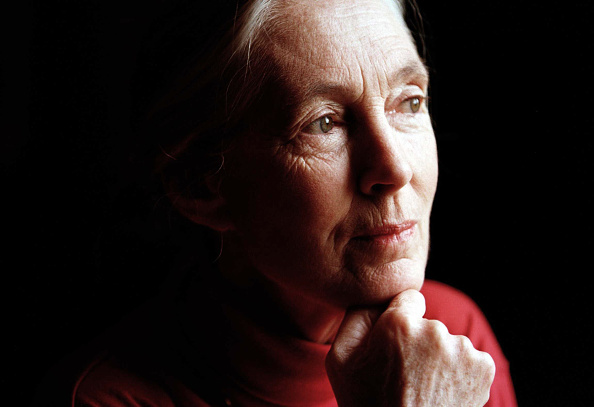
Eureka! To me, this was like bumping into Ghandi’s personal aide or Mandela’s gatekeeper. Better yet, the great lady herself soon dropped by for her morning tea. I was smitten. Gentle voice, glistening eyes, silver pony tail, engaging curiosity – I soon was in an easy conversation with a singular icon: the world’s foremost animal rights advocate and arguably the most revered environmentalist since Rachael Carson.
As a child, Jane was just another kid with a stuffed monkey, playing with earthworms and dreaming of Tarzan and Dr. Doolittle by the quiet creeks of coastal Bournemouth. Long preoccupied with both distant Africa and all creatures, little and large, the wide-eyed English girl soon became a secretary who saved all her money to gain passage on a freighter to the continent she dreamed of – Africa.
There, amazingly, in Kenya in 1960, Dr. Louis Leakey, the world’s leading student of human evolution, noted Goodall’s observational genius and took a chance on a rookie with no resume, no pedigree and few fears. He figured the imaginative 26-year-old would be free of the intrusive straitjackets of academia, and asked her to conduct a radical experimental project with wild chimps in the Tanzanian outback.
There, Goodall’s gifts came to the fore: curiosity, patience, passion, wisdom, intuition, empathy and unflinching courage. Never mind leopards. Malaria be damned. With just her mother lending a hand, Jane ventured into a daunting mountainside jungle and began a seemingly futile effort to befriend a troop of 30-40 chimps.
After tedious months of abject failure, her zen-like patience bore fruit. Gradually, the once invisible and at times hostile chimps let Goodall into their long-hidden world.
Soon Jane’s work would transform our core understanding of ourselves. Until then, we humans insisted, “Hey, look at us – what distinguishes us is that we’re the only species with the smarts to use tools.”
Wrong! Goodall’s work made clear that chimps adeptly create, adapt and use tools. Jane moved the goalposts. Her mentor Dr. Leakey famously concluded, “Now we must redefine tool, redefine man, or accept chimpanzees as human.”
Not surprisingly, the work of a woman who shattered long held beliefs despite not having a diploma drew a torrent of criticism from the scientific establishment. Critics complained that instead of objectively numbering the chimps she encountered, Goodall empowered them with names like David Graybeard.
The preeminent biologist Stephen Jay Gould scoffed: “When we read about a woman who gives funny names to chimpanzees and then follows them into the bush, meticulously recording their every grunt and groom, we are reluctant to admit such activity into the big leagues.”
But soon Goodall would become a superstar in the majors. Cover stories in the National Geographic gave us endearing, irresistible photos of the trim blonde pioneer hugging apes. Eventually she’d be honored by Britain’s queen and America’s president, by the UN, and be nominated for the Nobel Peace Prize.
Always a restless, inquisitive soul, Goodall would go on to get a Cambridge Ph.D. and become a tireless road warrior, who for five decades traveled the world 300 days a year. Her concerns seamlessly expanded from animal rights and habitat preservation to the global environment, the ravages of war and probing conversations on hope and meaning.
She wrote a whopping 32 books and spoke on an array of issues, from fossil fuels, melting glaciers and atomic weaponry to the impact of materialism and the horror of terrorism, and how we must uproot its causes. She noted how people can be manipulated, how our hopes can be battered.
Still, Jane contended that if we can all live lightly on this earth, we can be redeemed by the resilience of nature.
I never met Nelson Mandela. But I heard Martin Luther King speak. I’ve met the Dalai Lama and more than my share of sages. I’ve had about five in-depth conversations with Billie Jean King and I twice interviewed Arthur Ashe, who Mayor David Dinkins said, “was just a plain better person than the rest of us.”
Let’s put it this way: there are some who are just transformative figures. And Jane’s sublime, selfless footprint brings to mind an observation from Albert Einstein (who was on the cover of Inside Tennis).
When reflecting on Gandhi, everyone’s favorite genius suggested that, in generations to come, people “will hardly believe that such a one as this ever, in flesh and blood, walked upon this Earth.”
Goodall herself simply said, “I was brought to this world to get a message out.”
So I had an idea. Wouldn’t it be something to get the foremost female thinker sports has given us, Billie Jean, together with the most prominent visionary to emerge out of the modern environmental movement?
So, in the Wimbledon Tea Room, I approached Billie Jean with the idea of doing a joint interview with Goodall. She quipped, “Oh, yeah – the gorilla lady.” I gently corrected her: “No, Goodall worked with chimps. It was Dian Fossey who was the gorilla lady.”
Anyway, BJK agreed to the concept, and I broached the idea to the Jane Goodall Institute. But I ran into some speed bumps. My failure to persevere and get these two pioneers together remains one of the greatest shortfalls of my career.
Still, I know my friend Jane wouldn’t want me to stress. My home celebrates her with a large portrait – my library is brimming with her books. I remember her numerous calls to action, her hope and compassion. She told us, “The flame of pure spirit is within us.”
I was blessed, for I met Jane. She was my friend. And, surely, those wild chimpanzees hidden high in the mountains above Lake Tanganyaka sensed, too, that this woman was their friend.
Now and for generations to come, men, women and children – all lovers of this Earth and its creatures – will celebrate Goodall’s grace, her fearless grit, her cutting-edge insights, her tireless zeal and her transformative vision.