


It’s been a long, wild and spectacular ride.
For 46 years, I’ve covered tennis. Over these decades, I’ve reflected on just about everything the game has offered: its quirks and kindnesses, its luck and cruelty, its culture, psychology, and even its spirituality.
I’ve watched it grow and thrive. Its athleticism still thrills me. Its life stories still inspire. I’ve sat in its grand stadiums and seen exquisite moments of triumph and poignant loss.
In its uncanny way, tennis still reveals so much about being human. The game still has magic. It’s my lens on life.
But something has changed.
A Johns Hopkins graduate student recently told me he was doing his thesis on whether the charm and intimacy of tennis in the 1960s and ’70s still lives in the game today.
I began thinking about it. Wimbledon, of course, remains Wimbledon. But when I tried to come up with American examples of that old intimacy and charm, I struggled.
Then Mary Carillo asked me whether I still found tennis charming.
“Sure,” I reflexively replied. But afterward, I thought about it. Actually, a fair dose of the charm is gone.
The game has reached stratospheric heights. Tennis is more global, athletic, sophisticated and lucrative than we could have imagined decades ago. The USTA has become an extraordinarily successful sports organization, and the US Open is one of the greatest annual sporting events on the planet.
Still, I mourn what has disappeared.
America – and California in particular – has lost one wonderful tournament after another. The Davis Cup has been transformed almost beyond recognition. Yannick Noah once lamented, “Sorry, Mr. Davis, we’ve sold out your soul.”
Sometimes, when tennis seems to be losing its way, I circle back to the man I consider the conscience of our sport.
I ask myself: “What would Arthur Ashe think?”
And these days, I find myself asking that question a lot.
Writer Lisa Dillman once suggested, “The U.S. Open seems like one big marketing opportunity, interrupted by a tennis match once in a while.” Mary Carillo reminded us that, “No matter how cynical you become it’s impossible to keep up.”
Which brings us to the 2026 US Open.
To be clear, the tennis remains fabulous.
Fans marvel at Tommy Paul flicking an impossible around-the-net winner. Gael Monfils turns back the clock. Alexander Zverev survives nearly five hours of battle. Carlos Alcaraz flashes his smile and shotmaking genius. Novak Djokovic reminds us that mortality comes for every champion.
That’s why we’re here.
But increasingly, there’s something else going on around all that tennis.
Rather, recent headlines have asked whether the US Open can go on like this, whether the so-called People’s Open has a people problem.
Clearly, it’s time to ask some uncomfortable questions.
Is the Open simply experiencing the growing pains that accompany extraordinary success, or has something more fundamental changed?
Have we entered a whole new world? Has the Open gotten too big for its britches?
Is today’s Open simply tennis reflecting the culture around it – a post-COVID, money-driven world preoccupied with return on investment, quarterly reports, ever-rising valuations and “How big is your SEP IRA?”
And what of the harsher political culture surrounding us, where power and control are increasingly celebrated, empathy is said to be quaint, and truth itself takes a daily battering? Institutions do not exist in a vacuum. Tennis doesn’t either.
Just whose US Open is this?
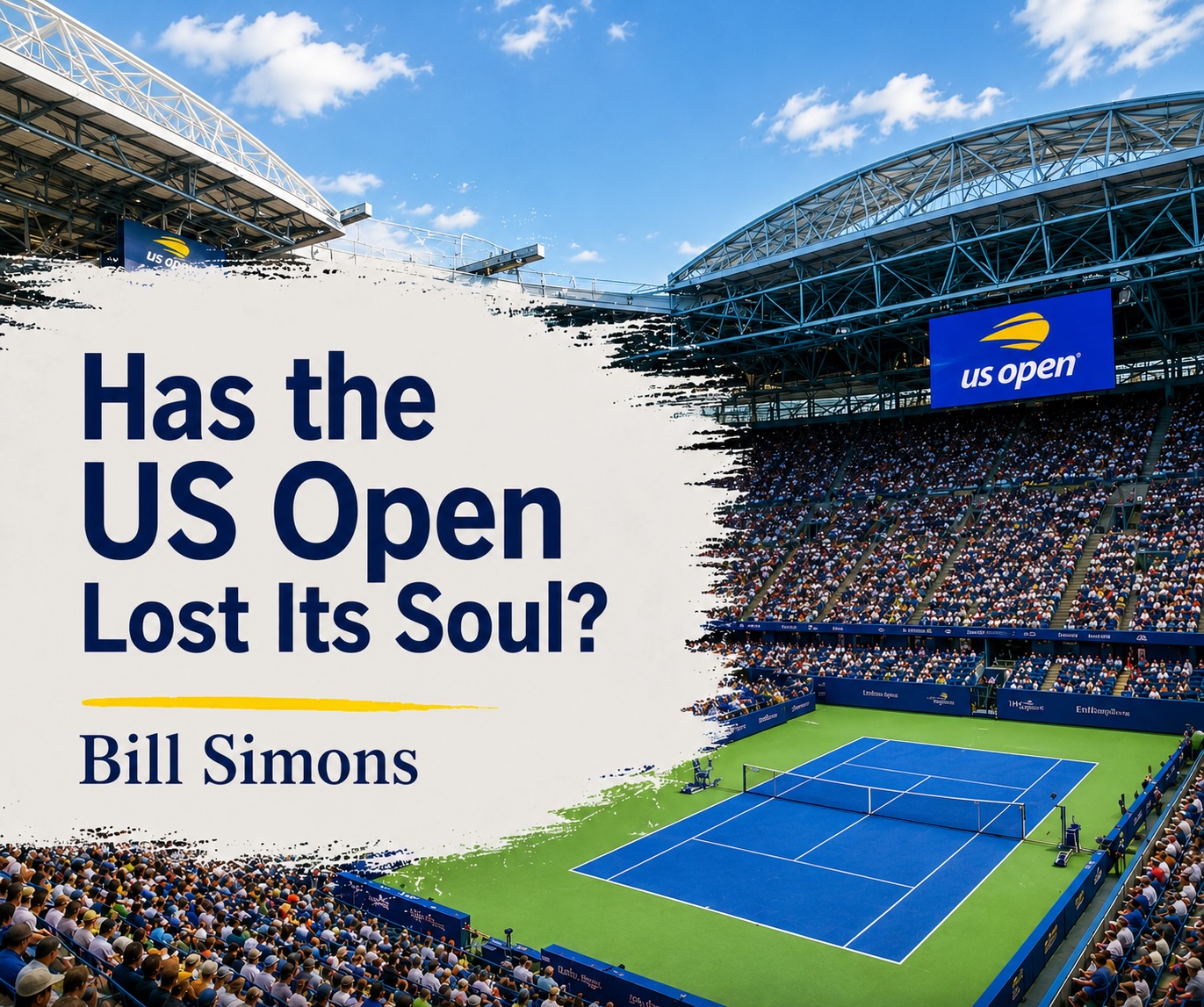
For starters, follow the seats.
The USTA is in the midst of an ambitious $800 million transformation of Arthur Ashe Stadium and the National Tennis Center. There will be genuine improvements. Anyone who has spotted the aging, mold-infested infrastructure beneath Ashe knows that renovation is needed.
The USTA is financing the project itself, without taxpayer money, and its innovative roofs and the new Grandstand and Louis Armstrong Stadium have shown that smart investment can dramatically improve the fan experience.
Give the USTA a lot of credit.
But thousands of seats in Ashe’s upper reaches are disappearing, while premium seating closer to the court expands. New luxury suites, clubs, restaurants, bars and hospitality areas are coming.
The new Ashe Stadium is being designed with the understanding that hospitality is a lucrative revenue engine. Much of the stadium’s vast interior – the press rooms, player lounges, player dining spaces and interview rooms – is being gutted and reconfigured, with plans for nine high-end hospitality and dining venues.
Hospitality is no sideshow anymore. It’s become central to the business plan.
And all this is happening in a stadium named, with telling irony, for Arthur Ashe – a Black champion and humanitarian who spent his life thinking about access, opportunity and those without power.
For generations, checking out the US Open was one of the great bargains in sports. Take the 7 train, buy a grounds pass, wander about and wind up a few feet from world-class tennis.
Today, a $65 grounds pass can quickly appear on the official resale market for multiples of its face value.
Other Grand Slams have put caps or substantial guardrails around resales. The US Open has taken a different route, partnering with Ticketmaster and allowing a Wild West secondary market. The USTA receives a cut of those resale transactions.
Hungry?
Six chicken nuggets cost $26.
Want caviar with them? Now we’re talking three figures.
Of course people are paying. That’s precisely the point.
Demand for the US Open is extraordinary. Corporations want suites. Wealthy fans want courtside seats. Sponsors want exposure. Celebrities want to be seen.
The US Open isn’t merely a tournament anymore.
It’s a New York happening and increasingly a business hub. It’s a place to woo clients, impress partners, network, be seen and indulge in a bit of ego gratification. Sip a Honey Deuce. Spot a celebrity. Close a deal. And watch a little tennis, too.
What’s wrong with that?
The Open is the USTA’s economic engine. Its wealth funds tennis programs across America. The organization’s mission is to grow tennis and inspire healthier people and communities.
But that’s precisely why the questions matter.
The USTA isn’t Madison Square Garden. It isn’t a hedge fund. It’s not just an entertainment corporation charged with extracting the maximum return from every square foot of valuable New York real estate.
It is the not-for-profit national governing body of the sport we love.
So, must maximizing revenue always be the goal?
One New York Times opinion writer suggested another path: deliberately accepting a smaller bottom line – less revenue in exchange for lower-cost tickets, greater prize money and more profit-sharing with the athletes who create the spectacle.
It’s a provocative idea. Imagine that. An enormously successful sporting institution deciding that it has enough.
Imagine measuring success not simply by whether next year’s revenue exceeds this year’s, but by whether more ordinary families can afford to come, whether players receive a fairer share and whether the national governing body fulfills its broader public mission.
Would that be bad business?
Or enlightened stewardship?
The contradiction at today’s Open is almost architectural.
At the edges, accessibility is flourishing.
Fan Week is an extraordinary success. About 300,000 come through the gates. Kids see champions practice. Fans watch qualifying matches. Federer filled Ashe. Serena returned. The radically reinvented mixed doubles championship showcased many of the game’s biggest stars.
Give the USTA credit. Much of it is imaginative, lively and free.
The Open’s showmanship can be great fun. Federer’s drone tribute dazzled New York. Still, amid all the spectacle, it’s fair to ask occasionally whether some resources could have more lasting impact elsewhere.
Where relatively little is at stake, the doors are thrown wide open. Where championships are decided and history is made, bring your wallet.
The modern US Open may be becoming more democratic around its edges. At its core, it’s more exclusive.
Money raises other questions.
The Open has gone all in on the booming world of sports betting, even as tennis players themselves are forbidden to gamble and continue to endure vicious online abuse.
Betting now penetrates virtually every level of pro tennis. You can wager on obscure first-round matches at distant sites watched by only a few fans. To some, gambling increasingly feels like an infection. What’s next – betting on senior tennis?
Now the US Open has embraced this murky world through its new relationship with Kalshi, the much-debated prediction-market company. Ben Rothenberg recently documented how gambling has embedded itself in a sport that places enormous emphasis on competitive integrity.
The always measured Jessica Pegula captured one aspect of this disconnect, noting that players can’t profit from betting sponsorships while tournaments can – and gamblers punish players with a torrent of online abuse.
Meanwhile, the athletes themselves have been asking the Grand Slams for a greater share of the extraordinary revenue they generate. This year’s Open is offering record prize money. That’s significant, and deserves applause.
But the larger question remains unresolved: What percentage of the wealth generated by tournaments should go to the people actually playing them? NBA players receive roughly half of basketball-related revenue. Tennis players reportedly receive under 20% of Grand Slam revenues – and pay their own considerable expenses.
And money isn’t the only currency here.
Access is another.
For decades, reporters sat close enough to the court to hear the grunts, feel the tension and grasp the subtle emotional rhythms of a match.
While the other three Slams and most major American sports provide fine press seating, at the US Open – and Indian Wells – those seats have steadily vanished.
This year, reporters have been relegated far from the action, near the nosebleed section. There are no desks, no power and few ways to track the nuances of a match.
The contrast with Wimbledon can be startling. In London, the press seating is superb and the working atmosphere is collegial and cooperative. “How can I help you?” is a mantra. Smiles are common. What a privilege to be part of the tennis circus.
Dare I report that at the US Open, there’s a different vibe. Hard-working media endure long waits, inadequate facilities and shrinking access, with little sense that decades spent telling the tournament’s stories are valued. Some privately call the atmosphere toxic. After five decades covering forehands at this event, is it okay to admit that this hurts?
All the while, roughly 100 influencers have been credentialed, as the Open aggressively pursues new audiences.
Pegula objected after seeing influencers using selfie lights and taking pictures while players were competing. She called some of it “a bit disrespectful” and wondered whether things had gotten to be “a little…too much.”
Reaching young fans is critically important for tennis’s future – and, in many ways, central to the argument I’m making. What good is “growing the game” if the next generation is increasingly unable to afford entry to its grandest American stage?
Traditional reporters – the people whose job is to observe closely, preserve history and sometimes ask uncomfortable questions – are being moved farther away.
Influencers are being invited closer. Clicks matter. Access matters. Control matters.
Players themselves are increasingly becoming carefully protected and curated brands. One-on-one access has dwindled. Press conferences are shorter. Follow-up questions – which often provide the richest insights – are often forbidden. The spontaneous conversations that once gave tennis much of its texture are increasingly rare.
Then there’s the spectacle itself.
Celebrity culture has long been part of the Open’s fun. New York without celebrities? Forget it.
But now, seemingly every face from TV, fashion or TikTok is flashed onto the giant screens. There are drone shows and ever more elaborate productions. New USTA CEO Craig Tiley told us the US Open is becoming “the tennis Disneyland.”
Daniil Medvedev had a different take. “Tennis Disneyland – this word I don’t like,” he said. “It’s still a sport where we fight, in a way, for our life.”
Maybe that’s the tension at the heart of all this.
Sport or spectacle?
Tournament or entertainment complex?
Public mission or profit center?
People’s Open or Premium Open?
Perhaps this is simply the modern world.
Athletes are brands. Fans are customers. Stadiums are revenue centers. Journalists compete with influencers. Tickets become financial instruments. Every square inch has to be monetized.
Business culture tells us that growth must be endless. Our political culture increasingly suggests that power is its own justification. Technology tells us that more razzmatazz is always better. Social media knows that outrage wins. Entertainment understands it must be a spectacle.
The US Open isn’t creating this culture in a vacuum. It’s reflecting our world with unusual clarity.
This is America. Follow the money.
So maybe I’m a dreamy idealist, mourning a world that isn’t coming back.
I remember the intimacy of Forest Hills. I remember the rambunctious early days of Flushing Meadows, when Connors was bigger than life. I had lunch with Martina, chatted with Aretha, JFK Jr. asked me for change, and I – a lowly reporter – even spoke with Carter, Bush, Clinton and Trump.
The old US Open was far from perfect. It could be chaotic, rude, dysfunctional, smelly and gloriously absurd.
But it was alive.
It was loud.
It was messy.
It was democratic.
It was the People’s Open.
Now, the Open is bigger than ever. Richer than ever. More technologically sophisticated than ever. More successful than ever.
And that’s why this moment deserves scrutiny.
Institutions don’t lose their souls only because they fail.
Sometimes the greater danger comes when they succeed beyond their wildest dreams.
Success brings money.
Money brings power.
Power brings control.
And eventually, an institution can become so consumed with growing, monetizing, protecting and controlling what it’s built that it forgets what the whole enterprise was for.
I’m not saying the US Open has reached that point. I’m asking whether it’s getting close.
And, yes, as I write this, another uncomfortable thought crosses my mind.
Will asking these questions cost me my credential?
After decades of covering this sport – after writing countless words about the USTA, the US Open and the people who made American tennis what it is – I would hope not.
But the fact that the thought occurs to me says something, too.
I’ve spent much of my life chronicling this game, and I’ve asked difficult questions. Those two things shouldn’t be incompatible.
Criticism isn’t disloyalty. Asking difficult questions about something you love is precisely what loyalty requires.
Arthur Ashe understood that.
So did Billie Jean King.
After all these seasons, I still love this game.
Its athleticism thrills me. Its stories inspire me. Its uncanny ability to reveal character still astonishes me.
I don’t want tennis to go backward. But growth isn’t merely about getting bigger. And progress isn’t measured only in revenue, attendance, clicks, hospitality suites or Honey Deuces sold.
So, as the People’s Open races headlong toward the age of the Premium Open, maybe we should occasionally stop counting the money, look around Arthur Ashe Stadium, and ask the question the man whose name is on the building might have asked:
“Who is all this for?”
And, even more fundamentally: In becoming one of the greatest sports spectacles in the world, can the US Open make sure it doesn’t lose the very thing that made it great?















Best thing I’ve read on the Open to date. Tremendous insight and passion. We’ll done my friend!
Thank you for your passion and love of this beautiful game, Bill. Last year our Tennis Program Manager and a good friend attended on this first Saturday with a grounds pass for $160 each. They didn’t go today because $400 each was the best they could get.
And thank you for continuing to write the most insightful, thoughtful and entertaining tennis articles. I open with curiosity each as they come to our email. Keep asking the probing questions and writing for all of us to enjoy.