
NOVAK FALLS IN FIVE TO FATHER TIME AND NAVONE: The documentary called him the wolf man in winter. But since Wimbledon, Novak Djokovic has seemed like a lost man in summer. In Cincinnati he lost quietly, and tonight he fell in five, often agonizing, sets to the No. 48 Mariano Navone.
And once again, somewhere in Perth, minister Margaret Court could, dare we suggest, let up on her prayers. Serena Williams never did match her record of 24 singles Slams, and tonight, Novak, for the 12th time, failed to surpass her mark.
Never mind that, going back to 2006, the Serb had won 78 straight first-round matches. Never mind that a member of the Big 3 had made it to every second round of a Slam since 2003, and at the start of the match, John McEnroe claimed, “Navone can’t hurt him. He’s no good on hard courts. He’s never been on a court like Ashe. He’s so tight.”
But Navone, who’d never won a five-set match, became the second Argentine to beat Djokovic in a Slam this summer. For some reason, the 39-year-old master of detail chose to wear black on a hot, humid New York night. His back went out. He upchucked in a corner of the court. He bent over in agony, and the man of steel briefly wept – how poignant.
The GOAT hadn’t lost any of his 19 first-round matches at the Open. Then again, Mariano’s pal, Father Time, is undefeated. Navone was down two sets and a break, but fought back to prevail 7-6(5), 5-7, 4-6, 6-2, 6-1, in 4:36. Nole will fall out of the Top Ten for the first time since 2018.
The victory by the Miami resident, who lives in a mecca for retirees, prompted questions. Will the GOAT appear again in New York? Will he ever break Court’s mark? Why does the great man go on?
After all, he recently told us, “It’s true wisdom to know how to let go, to liberate yourself – because there’s no stronger feeling in life than freedom.”
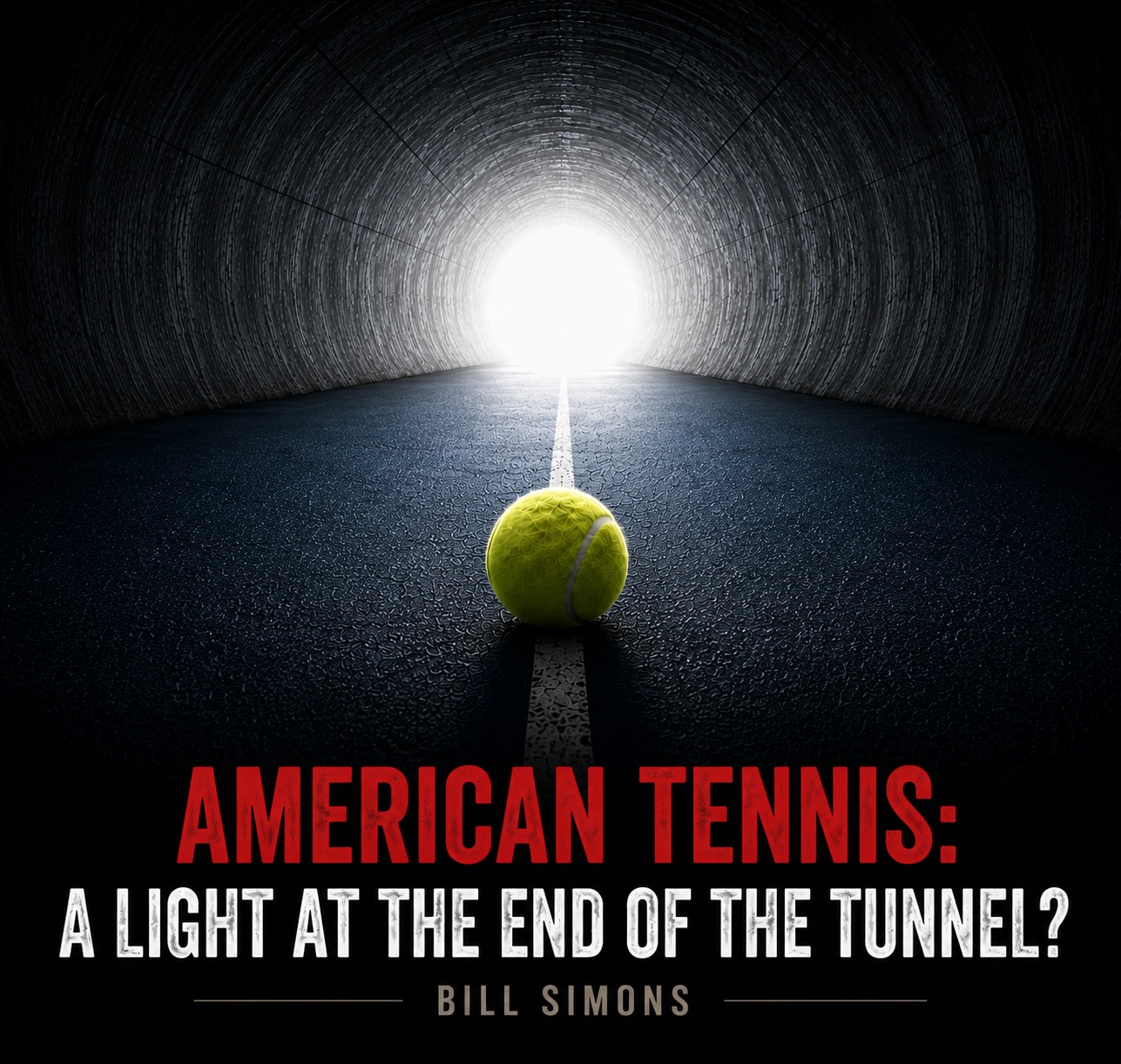
AMERICAN TENNIS – A LIGHT AT THE END OF THE TUNNEL? In 2003, Andy Roddick, his face full of astonishment and disbelief, dropped to his knees after winning the US Open. America had a great young champion, and it was presumed that the hard-serving Texan would carry the mantle for a good while and continue our country’s remarkable lineage of champions.
Who knew we’d taken our icons for granted?
Then came 23 long, tedious years, and 91 Slams – count ’em – without an American man winning a major.
Way back when, tennis fans would ask, “When is tennis finally going to become an open sport, so all the great players can play the same tournaments?” It was a tedious storyline. But even more dreary has been the threadbare narrative of America’s disheartening, “Where have all the Jimbos gone?”
Sure, for years, John Isner nobly led the pack, a sturdy presence near the top of the game. More recently, it’s been a strength-in-numbers affair. How wonderful there’s been a cadre of appealing Americans navigating the Top 20.
At every Slam not located in Paris, hopes rose. “This could be our time,” we kept telling ourselves.
Americans often imagined deep runs into the business end of Slams – until, suddenly, all the air would go out of the Yankees’ tires. Again and again, the red, white and blue faded in the quarters, the semis – or, once in a while, the final.
But this year’s US Open is different, right?
Jannik Sinner, the best player on the planet these days, is sidelined with a knee injury after winning his fifth Grand Slam title at Wimbledon. Carlos Alcaraz is coming back from the frightening and at times mysterious wrist injury that has kept him out for four months. His long locks have drawn rave reviews, but his mixed doubles outing with Serena Williams hardly inspired awe. His rust was as thick as his hair.
Then again, this is Carlos Alcaraz. He is the betting favorite to win. But if somehow he comes back from more than four months on the sidelines and wins seven best-of-five matches to claim another US Open, he might, then and there, be anointed as a certified tennis Houdini.
No. 1 seed Alexander Zverev impressed mightily this year, finally breaking through to win Roland Garros, and then reaching the Wimbledon final. But the Big Apple has brought him big heartaches, and his summer play has been modest.
And speaking of modest, there was one more than modest shock today. The GOAT fell today.
So, yes, there are openings at the Open.
Of course, the draw is filled with appealing non-American prospects. French Open and Wimbledon quarterfinalist Felix Auger-Aliassime has enjoyed a lively resurgence, and is back at No. 4 in the world. Another Rafa from Spain, 19-year-old Rafael Jódar, has exploded out of the University of Virginia ranks and into the big time. Now widely feared, he won Marrakech, reached the Washington final and soared all the way to No. 13.
Then there’s the surging 22-year-old Frenchman, Arthur Fils, who just won Cincinnati, beating Frances Tiafoe in the final, and who has risen to No. 11.
Still, it can be argued that this is the best shot that American men – who’ve scored dandy results this summer – have had in memory.
Taylor Fritz, the 2024 US Open finalist, is experienced, committed, competitive, hard-hitting and wise. This summer, the Californian beat Jódar to win Washington, his 11th ATP title and is the No. 4 favorite.
Ben Shelton is now America’s top-ranked man at No. 9. Earlier this year, he absorbed some humbling Slam disappointments, including a brutal five-set first-round Wimbledon loss after holding match point. But he arrives in New York playing some of the most complete tennis of his career. He’s won four titles this season, and just successfully defended his Canadian crown, beating fellow American Brandon Nakashima in the Montreal final without dropping a set all week.
Frances Tiafoe, always dangerous in New York, is back up to No. 12, and just went on one of the best runs of his sometimes glorious, sometimes exasperating career. He reached his second Cincinnati final in three years before falling to Fils.
Veteran Tommy Paul, the No. 20 seed here, and a former Australian Open semifinalist, is already through to the second round, after beating Coleman Wong in four sets. In Cincinnati, Paul scored a tasty win over US Open top seed Zverev before reaching the quarters.
And don’t forget there are two more great Southern Californians.
Brandon Nakashima has been one of the hottest players of the entire North American summer. Since beginning to work with former Tiafoe coach, Wayne Ferreira, he’s surged to a career-high No. 17. With his punishing backhand, he’s reached the Washington semifinals, the Montreal final and the Cincinnati semifinals.
Then there’s 20-year-old Learner Tien. Quiet, crafty and seemingly unflappable, the Californian reached the Australian Open quarters and the Montreal semis, and has climbed to No. 15. He’s the No. 14 seed here.
Count them: Shelton, Fritz, Tiafoe, Tien, Nakashima and Paul. Six seeded American men. No wonder Americans are feeling it. This could be our year. Could there actually be light at the end of this very long tunnel?
Cynics will point out that America’s Slam drought has become one of those endlessly recycled sports-slump stories.
After the Red Sox sold Babe Ruth to the Yankees following the 1919 season, the supposed Curse of the Bambino descended on Boston. The Sox didn’t win another World Series for 86 years.
So American tennis has 63 years to go before matching that. But maybe this is the year we can finally stop counting.
And there would be something particularly poignant about an American breakthrough in New York this September. The men’s semifinals fall on September 11, as the nation marks the twenty-fifth anniversary of 9/11. Two days later, on September 13, somebody will stand in Arthur Ashe Stadium and lift the US Open trophy.
For the first time in a while, it’s not that hard to imagine that somebody being an American.
In a similar vein, the women’s tournament also feels remarkably open.
World No. 1 Aryna Sabalenka seemed to be powering along with her usual intimidating force, starting early this year, completing the difficult Indian Wells-Miami Sunshine Double. Then, after winning 15 straight matches, came a remarkable speedbump loss in the Madrid quarterfinals. American Hailey Baptiste saved six match points and stunned Sabalenka.
Something seemed to change. Since then, Sabalenka, who’s won the past two US Opens, has looked far more vulnerable, suffering a string of perplexing losses.
Elena Rybakina, now No. 2, had righted her ship and was again looking formidable, only to suffer an ankle injury in Cincinnati. Her health remains one of the tournament’s significant questions.
Iga Swiatek, who for so long was one of the most imposing forces in women’s tennis, has endured something resembling a mid-career crisis. Her confidence and mental strength seemed to be wobbling.
Then, suddenly, there she was again.
Swiatek played gloriously in Toronto, dismissing Rybakina 6-2, 6-3 in the final, to win her first title of the year. She comes to New York ranked No. 8, but nobody in their right mind is counting her out.
Likewise Coco.
Gauff’s once troubled serve has improved mightily. The world’s wealthiest female athlete hadn’t won a title all year until she put everything together in Cincinnati, where she raced past friend and fellow American Jessica Pegula, 6-2, 6-4, to claim the title.
Then there’s the pride of Buffalo.
Pegula was once pigeonholed as the gritty, admirable battler who couldn’t get beyond a Slam quarterfinal. Those days are gone. The 2024 US Open finalist is now ranked No. 3 and enters virtually every tournament as a legitimate threat to win. Her compact, flat ground strokes and almost metronomic ball striking are particularly dangerous on a New York hard court.
She began this US Open by dispatching Elena-Gabriela Ruse 6-3, 6-2.
So, on both sides of the draw, the familiar certainties have gone missing.
For American tennis, that may be very good news indeed. There is indeed light at the end of the tunnel.
GO FIGURE: By the end of the Open, Rybakina, Pegula and Gauff could all dislodge Sabalenka from the top of the rankings.
BEST MATCH ANALYSIS: Reflecting on the million-dollar payday she and Jakub Mensik scored by winning the US Open mixed doubles title, the Czech Karolina Muchova offered a penetrating analysis: “I think in the end, the matching outfits made the difference.”
THE EASIEST BET IN TENNIS HISTORY: It was said that voting Federer into the International Tennis Hall of Fame was the easiest tennis decision ever. After Federer’s wonderfully weepy acceptance speech, we wonder whether betting that Roger would cry during the ceremony was the easiest wager of all time. Never mind that the odds were already about 90%.
THE “I’VE HAD IT AND I’M NOT GOING TO TAKE IT ANYMORE” AWARD: Gauff and her mom Candi came down hard on long-forgotten friends and relatives who suddenly emerge at US Open time. Coco said, “People come out of the woodwork” – with folks she hasn’t heard from in years suddenly asking, ‘Can I have eight tickets to your match in your box, please?'” Mama Gauff finally hit her limit: “Unfortunately, I will not be able to hook you up with a ticket.” And then came her priceless bit of tennis etiquette: “Never ask for more than 2 tickets.” Coco’s verdict? “Honestly, it was needed.”
THE BOSS MAN COMETH: How’s this for a Slam record? Craig Tiley, the South African native, former University of Illinois coach and Australian Open chief, became the USTA’s CEO this summer. He’s now the first person to oversee two Slams – the Aussie Open and the US Open – in one season.
DON’T YOU DARE CALL THE US OPEN MICKEY MOUSE: The US Open has become a three-week sports and entertainment juggernaut that could make $615 million this year. There’s more razzmatazz to come. Craig Tiley said the US Open “will become the tennis Disneyland.”
THE MOST SINGULAR AMERICAN: Bud Collins dubbed Billie Jean King Mother Freedom. Others called her the Unsinkable Billie Jean, the Joan of Arc of tennis, the Old Lady, or simply BJK. But Mary Carillo struck a chord when she began her Hall of Fame induction speech by calling the feisty, truth-telling fireman’s daughter “the most singular American I know.”
THERE’S SOMETHING FISHY ABOUT TENNIS: Hall of Famer Mary Carillo revealed yesterday that she only got interested in tennis when, at six, she won a fishing contest. Her prize? A tennis racket. Naturally.
After all, Miloslav Mecir, Michael Chang, Rafa Nadal and Tommy Paul are avid fishermen, John Isner once had an endorsement deal with Bass Pro Shops, and Danielle Collins is a fisherman’s daughter. Tennis has even produced some serious deep dives. Mardy Fish, reflecting on his crippling anxiety disorder and people’s reluctance to discuss mental illness, said, “I am here to show anxiety in a whole different register.”
But enough depth. Here are perhaps the two stupidest fish jokes Inside Tennis has ever printed: What do you call a fish with no eyes? A fsh. Two fish swim into a concrete wall. One turns to the other and says, “Dam!”