
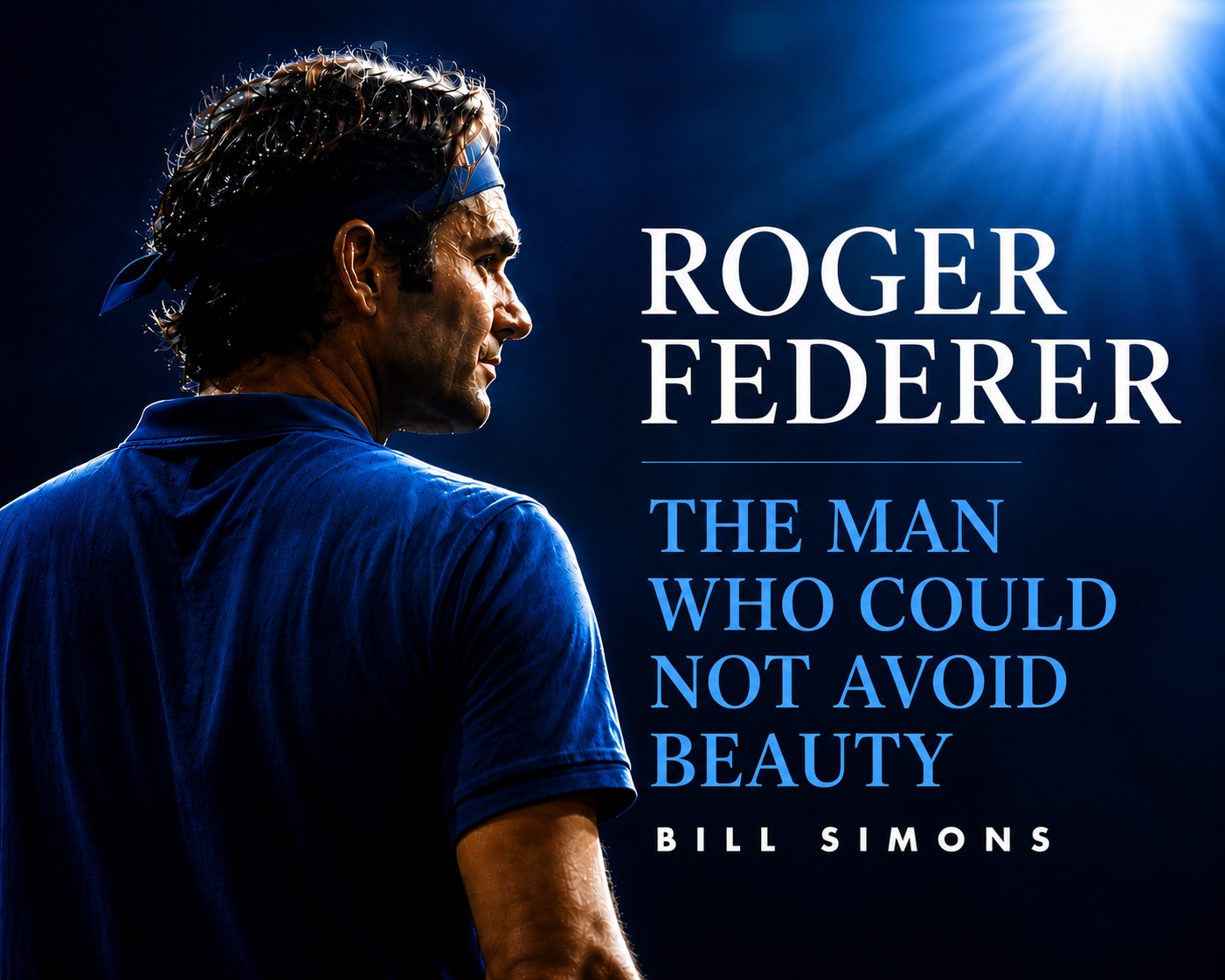
Watching Roger Federer play was to glimpse a world briefly arranged as it should be.
Power softened into art. The ball did not seem struck so much as released, as if Federer were less an athlete imposing his will than a steward of balance returning things to their place. In an era of grinding force, he offered a dangerous idea: that greatness could look easy, that beauty might be a form of truth.
For decades, Roger’s presence was all over tennis. Lloyd Carroll once noted, “The aura of Federer hovers over the US Open.” In truth, it seemed to hover over the entire game.
Across the game’s grand stages and its distant corners, even on its practice courts, believers gathered as if tipped off that the Messiah would be hitting crosscourts at 11:30. Roger was the rare champion who could cause a stampede without playing a match.
We know his numbers: 103 titles, 20 Slams, 237 consecutive weeks at No. 1, 23 straight major semifinals.
And we know the chapters, too.
The teen who shattered windscreens and was forced to scrub toilets. The junior prodigy in Florida – peroxide hair and restless talent – emerging from a lonely spell at a Geneva academy where everyone spoke French and he did not.
Then Wimbledon 2001. On Centre Court, a raw, still long-haired Roger Federer dethroned Pete Sampras – the king of grass, the four-time defending champion, the man who then owned the place. It was the most stunning changing-of-the-guard match the sport has seen, a moment that made unmistakably clear that history was no longer waiting.
But it was a triumph that came before a crushing loss. The next year he found himself wandering the streets of Toronto through the night. His beloved mentor – his father figure – was gone. Peter Carter, the Australian coach who had recognized his fragile genius and helped steady it, had died in a car accident in South Africa. The loss hit hard. Federer was still a boy, really – restless, gifted, searching – and suddenly untethered. For a time, the game receded. What remained was absence, and the quiet work of finding his way back.
In 2006, he wept when Rod Laver handed him a trophy Down Under. Two years later at Wimbledon, he fell in the dusk to Rafa in the greatest match of all time.
Still, across three generations, he inspired wannabes and left his foes dumbfounded. In his shadow, seemingly mighty athletes appeared ordinary. “Roger made Roddick seem like a Buick,” quipped one observer.
Sue Mott claimed, “Dictionary writers will soon be asked to absorb the verb ‘to Federer,’ meaning, ‘to demolish with gasp-inducing precision.’”
“To root for Federer,” The New Yorker said, “is to root for a Platonic ideal. It is like rooting for truth.”
Truth is a big word for a sport built on missed lines and bad bounces. But once you watched Federer long enough, you understood why otherwise sane adults spoke of him in theological tones. A sign at the Miami Open read: “Commit your sins when Federer is playing. Even God is watching.” Jim Courier, famous for his celebratory dive into a Melbourne river, said he wouldn’t do that again – because Federer might be walking on its waters.
The man generated metaphors the way most players generate sweat. And he did it with a curious, almost existential calm – grunt-free, with little angst – a monarch comfortable on his throne. “I can’t imagine anyone waking up every morning being so content with everything,” his wife Mirka once noted.
Roger was a rarity: a genius who had figured out not just the game, but how to move through the tennis circus – airports, broadcast booths, corporate suites, parks full of kids, the sensation of being adored by thousands – while still needing to be human. He spoke longingly of his urge for normality.
All the while, he navigated press conferences in English, French, and Swiss-German, hobnobbed with the mighty, chatted with Tiger Woods about the loneliness at the top, compared tennis and hoops with Michael Jordan, and once sat at the Queen’s side at a proper English lunch.
As James Blake recalled, after Roger beat you senseless on court, he was just “one of the guys” in the locker room.
He helped kids in dusty Africa and wowed the glitterati in Monte Carlo. Stamps and streets bore his name; tournaments gave him cows.
What he gave us was something rarer: the hope that beauty might prevail. He once said, “I always liked figure skating. I like beauty in motion.” And so do we.
Rafa’s muscles glistened. Novak is a sublime craftsman. But Roger was the game’s artist in residence.
His strokes were liquid. His staccato steps, quick reverses, flash accelerations, and slides were balletic. “Federer moves like a whisper,” said Nick Bollettieri. Imagination was his ally, creativity his friend. He teased gravity. His balance never teetered. He floated.
The man inspired wordsmiths. Jon Wertheim noted, “He fires winners off both flanks with no discernible bias. He massages his volleys, pummels overheads, picks half-volleys off his shoes, and guides them to nooks and crannies of the court that most other players have yet to discover. His serve is Samprasian, a silky delivery predicated more on placement than on power. He covers the court as if it were glazed.”
Here was beauty on a very public canvas. His forehand pinned and pounded. He loved to attack. He punished with quiet glee – just ask the generations he bruised.
He made tennis feel necessary.
Nadal’s forehand was a wicked lance. Isner’s serve was an unkind blur. McEnroe’s volleys were poems that stung. But there was a reason Roger’s backhand is the most celebrated shot tennis has given us. At first a kinetic crosscourt whisper, then a dagger down the line, it was unleashed with deceptive ease. Powerful – yes. Surgical – yes. Inventive – yes. But it was its elegance – fluid and sublime – that demanded awe.
David Foster Wallace told us that Federer defied gravity, coaxing the ball to hang in space for a curious half-second. He never seemed rushed.
Then Eleanor Preston dared to say out loud what many were thinking: “Is it possible that Roger is the most perfect tennis player — the most perfect man — in the history of everything, ever?”
It was a joke – but it wasn’t.
Because Federer seemed to embrace so much – business and pleasure, excellence and ease, ambition and joy. His cool, glittering urban brand was as safe as it was chic. He walked away from Nike, invested tens of millions in a Swiss shoe company, and did something rarer still: he reimagined the sport itself, creating the Laver Cup, a fresh idea in a sport that rarely unbuckles.
A billionaire who made all the right moves, he ran his career with boardroom savvy, without ever losing the impish kid who giggled with Rafa and wept at ceremonies.
Still, for all the rapture, even Einstein had off days.
Dare I say, Roger could be smug. He could be dismissive. He enjoyed control. He relished attention.
He knew exactly how good he was. After a win over Djokovic, he shrugged, “Novak had his chances today – many of them. You could sing a song about it.” Asked whether Lleyton Hewitt should change his approach, Federer replied, “He could – but then again, he could run into the knife more brutally.” Even Federer’s fans carried a certain ’tude: “Roger that!”
And before a final against a young Andy Murray at the Australian Open, he offered an unsparing jibe: “I know he’d like to win the first Grand Slam for British tennis since – what is it – 150,000 years?”
Charm, yes. Wit, absolutely. But there was steel underneath.
Roger Federer did not rise to the summit by accident. He understood exactly who he was and made no apologies.
Still, what lingers is not the trophies or the quiet acts of domination, but the feeling he left behind.
Federer did something no statistic can quantify and no ledger could reveal. He made people happy. He made tennis feel generous. As he dazzled us, he made us feel lucky to have witnessed something so rare it subtly shifted our sense of athletic grace.
There was nothing quite like sitting in my Wimbledon press seat, no more than thirty yards away from him, watching the maestro dance about Centre Court – gliding, disguising, as if the grass itself were conspiring with him. Gasps filled the arena. You felt, almost without realizing it, that something finer was being offered.
Federer reminded us that mastery could whisper.
He was not perfect. He lost matches he should have won. He blinked in moments that still ache. He never won Olympic singles gold. Ultimately, did he really solve Rafa or Novak – even after holding match points late in his career?
He could be imperious. He could be human.
But perfection was never the point.
What mattered in watching him play was remembering why the game exists.
Elizabeth Wilson claims that tennis shares more DNA with dance than any other sport, its magic born of the tension between art and competition. If that’s true – and it is – then Federer was its purest expression. He played tennis as music written for the body, as geometry infused with joy, as movement that carried meaning.
David Foster Wallace wrote that great athletes “catalyze our awareness of how glorious it is to touch and perceive, move through space, interact with matter.” Federer did that better than anyone. He made us see the ball differently. He made us see effort differently. He made us see time differently.
Difficulty hardly fazed him. Gravity felt negotiable. Even time seemed to bend around him.
And when the end finally came – as it always does – what surprised us was not how much he had won, but how much we missed him. Not the trophies, but the hush. Not the numbers, but the shared intake of breath just before he served, when an entire stadium leaned forward at once.
Years ago, he said, “If my career ended today, I’d be happy.”
Millions might have begged to differ.
After all, we doubt we will again see an athlete who so seamlessly fuses skill and grace, power and restraint, discipline and joy – someone who could not avoid beauty, even when beauty was the harder choice.
Before us stood the Mozart of Centre Court. Picasso in sneakers, brush in hand.
And if immortality has any real appeal, it is this: that every so often we are granted a glimpse of something so right, so luminous, it feels – just for a while – as if it might last forever.