
Bill Simons
Tennis is both cruel and amazing.
Two players from vastly different backgrounds stand alone on gritty back courts or on the grandest stages the game offers with the understanding that there are many ways to prevail.
Take Coco Gauff. She has lightning speed, a warrior’s fighting spirit and an ability to shake off errors like a defensive back who’s just given up a touchdown.
She’s still so young, but it seems she’s been in the tennis conversation forever. Yes, coming into Wimbledon, she hadn’t gotten beyond the fourth round there, and hadn’t won on grass in two years. Her forehand tends to sit up on the surface. And just three months ago, she’d lost to her foe, Karolina Muchova.
The Czech comes from an extraordinary tennis heritage, which has given us icons from Martina Navratilova and Jana Novotna to Petra Kvitova and Barbora Krejcikova.
Muchova doesn’t have Gauff’s wheels. She’s not as resilient. The sight of a former boyfriend once brought her to tears. She’s battled severe wrist injuries. She’d fallen in the first round at Wimbledon four times in a row. Today’s semifinal against Gauff was her first time playing on Centre Court.
Yet she’d scored impressive wins this past fortnight, including her masterly defeat of the surging Naomi Osaka. Many feel she’s the most imaginative player in the women’s game. Her creativity, spontaneity and variety appeal.
Nine years ago, Serb Janko Tipsarevic showed off his celebrated tattoo, “Beauty will save the world.” Many an artistic soul applauded that sentiment.
Muchova is an artistic soul. Emerging out of old-school Moravia in the far east region of the Czech Republic, where long ago she idolized Roger Federer, she’s now the WTA’s prime answer to the Swiss magician.
Today the No. 10 seed sprinted out of the gate. Despite pedestrian serving stats, she fended off five break points and took full advantage of a dozen Gauff errors to race to a convincing 6-2 opening-set win.
The rout was on – right?
But, come on. This is Coco Gauff.
The comeback queen had already scored 18 come-from-behind victories in majors.
No, this wasn’t Muhammad Ali’s famous rope-a-dope that entrapped George Foreman. And it’s rude to compare an athlete to a racehorse. But the thoroughbred Golden Tempo thrilled us this spring with his out-of-nowhere comeback wins at the Kentucky Derby and Belmont Stakes.
And, as if on cue – as she so often does – Coco elevated her game.
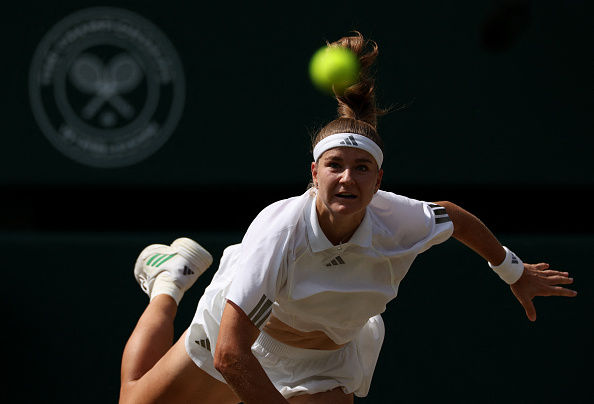
Her anticipation was uncanny. She dashed about Centre Court, cut down on her errors, unleashed winners and imposed her game on the overmatched Czech to capture the second set, 6-1.
Coco was in full ascendance. Her third-set record in Slams stood at 25-7. Only Steffi Graf and Wendy Turnbull had done better.
But Muchova was the bigger, stronger athlete, and she was hardly a newcomer. She’d reached the 2023 French Open final. And, once again, we saw her magic. Subtle flicks, leaping volleys, severe slices, serve-and-volley raids. She attacked and held serve.
But Coco didn’t blink. Quick to the net, she repeatedly went to Muchova’s backhand. She had break point openings – but couldn’t close.
As the two traded serves in a sublime deciding set packed with tension, astounding shot-making and nervous shifts of momentum, one sensed that Gauff had the edge.
Earlier in the tournament, she’d spoken of destiny – that feeling of ease, confidence and determination that had carried her to her US and French Open titles.
Call tennis a symphony. Or perhaps it’s a novel.
At its best, the game captivates us as it ebbs and flows, teasing our expectations and demanding greatness.
In the deciding tiebreak between the granddaughter of a civil rights pioneer and the daughter of an Eastern European soccer player, tennis lovers got exactly what they craved – compelling tension.
Never mind that Muchova was wincing, short of breath and clutching her side. She surged to a 4-1 lead in the final-set tiebreak, before muffing a half-volley into a wide-open court.
Using speed as her weapon, Gauff fought back. But Muchova’s full-stretch diving volley and whatever-it-takes mindset kept her in front. Still, Coco hung in.
We read the tea leaves. Gauff appeared fresher. We knew her grit. Imperfect, come-from-behind wins are her brand – just ask Solana Sierra, Belinda Bencic and Jessica Pegula. Simply put, Gauff can be a pain in the neck.
The pain in Muchova wouldn’t go away. Neither did her will. But Gauff’s ferocity, a time violation warning and being allergic to grass were a bother.
Then, at 8-all, Muchova shanked a backhand long.
Match point Gauff. This was her moment. One point from her first Wimbledon final.
Confidently, the Floridian stepped forward and hit a brave serve. Muchova’s return floated back, short and timid.
Now Coco had options. In a nanosecond, we flashed on the two maddenly different sides of her that have defined her career: bold and fearless one moment, hesitant and uncertain the next.
Coco could have patiently worked the point and hit a forehand to the corner to try and Czech-mate Karolina.
But, in big moments, drop shots often sing a siren song. There’s no greater temptress in the game. Live by the sword, die by the sword. And, under pressure, delicacy often takes a vacation.
From afar, it sure is easy to say the right play was to hit a topspin forehand deep into the corner, forcing Muchova into survival mode.
Yet, here’s the cruel part of the game – Coco blinked. Her limp drop shot died in the middle of the net.
Sometimes great stars make great errors. Andy Roddick had an open court against Federer. After her flash error, all Gauff could do was smile through her pain. She was in an awkward place. Before she’d hit a gabillion drop shot winners. But the ball’s dicey bounce fooled her. She admitted that maybe she panicked.
Now Muchova, who has long idolized Federer, suddenly had her opening. She feathered a brilliant lob winner.
Still, Coco countered. She answered with a laser forehand winner that brought Muchova to her knees.
But the Czech, who was in ascendance, struck another forehand winner. And, on her second match point, she ran the game’s greatest scrambler from corner to corner, until the virtually helpless Gauff dumped a running forehand into the net.
Moments after Muchova’s 6-2, 1-6, 7-6(10) win, broadcaster Richard Connelly captured the moment: “What a staggering display of resilience, under the most intense pressure imaginable. What magnificence.”
Will Gauff’s muffed drop shot haunt her forever? Of course.
But the young American, who is only 22, is famous for her comeback ability. Gauff has already told the press that this year’s Wimbledon was a good step forward. Plus she has a world of challenges ahead of her.
And Muchova has a challenge, too. Saturday, in the first all-Czech final in Slam history, the 29-year-old will face the powerful 21-year-old, Linda Noskova, who in just 79 minutes dismissed Ukrainian Marta Kostyuk 6-4, 6-4.
Amazingly, Muchova and Noskova are friends, were doubles partners at the Paris Olympics, and both are from Moravia, a Czech region where forests, folk music and centuries-old customs still shape daily life. And Saturday, Muchova and Noskova will carry Moravian pride onto Wimbledon’s most storied lawn, where one of them will write yet another Czech story for tennis history.
HOW SWEET IT IS: Friday, Novak Djokovic and No. 1 Jannik Sinner will face off in a dream semi. And the upstart Brit, Arthur Fery, will try to topple the hottest player in tennis, Sascha Zerev.
FERY COMPARABLES: Sports often draw on comparables. Here are a few for Wimbledon semifinalist Arthur Fery:
Andy Murray: Like Murray, he’s hoping to become the next British man to win Wimbledon.
Emma Raducanu: Like the US Open champion, he’s trying to become the second British wildcard to win a Slam.
Goran Ivanišević: Like Goran, he’s seeking to become a wildcard Wimbledon champion.
Henri Leconte: Another wildcard who reached the Wimbledon semifinals. But Fery was born in France and then moved to Britain, while Leconte was a Frenchman who lived for a while in London.
Andre Agassi: Hugs the baseline, takes the ball on the rise, steals time from his opponents.
Michael Chang: Diminutive, thoughtful, California credentials, capable of deep Slam runs.
Kei Nishikori: Compact, quick and blessed with a superb backhand.
Cam Norrie: A globetrotter. Born in South Africa, raised in New Zealand, represented Britain and polished his game in American college tennis – not unlike Fery, whose French roots eventually led him to Britain and then Stanford.
Lest we forget, there’s another London athlete with roots in three nations who’s been in the news lately – the eye of a storm soccer player Folarin Balogun.
Roger Federer: Both enjoyed conversations with a queen – Federer with Queen Elizabeth II, Fery with Queen Camilla.
Arthur Ashe: Fery hopes to become another Arthur to win Wimbledon. BTW: Way back when, Arthur Gore was the championship three times.
Mardy Fish: A player whose name also delighted headline writers throughout the universe.
BIRTHDAY BOYS AND GIRLS:
• Arthur Fery is dreaming of winning Wimbledon on his 24th birthday – Sunday.
• Pam Shriver’s July 4th birthday always arrives during Wimbledon.
• Rafa Nadal’s June 3 birthday comes during Roland Garros.
• Jimmy Connors’ September 2 birthday comes during the US Open.
• Carlos Alcaraz’s May 5 birthday frequently falls during the Madrid Open.
• Arthur Ashe’s birthday is July 10, which is almost always during Wimbledon.
• Roger Federer’s August 8 (8/8) birthday inspired the name of his management company, TEAM8.
• Novak Djokovic’s May 26 birthday sometimes coincides with the start of Roland Garros.
QUOTE OF THE DAY: Andy Roddick noted that, just five weeks ago, Alexander Zverev finally won his first Slam. Now he’s in the Wimbledon semifinals, facing the No. 114 player in the world. He observed: “You work 25 years of your life to get a five-week run that defines your life.”
GO FIGURE: Pole Maja Chwalińska was No. 114 when she made this year’s French Open final. Now No. 114 Arthur Fery has reached the Wimbledon semifinals.
TO EACH HIS OWN: Arthur Fery has raved about his three years on the Farm at Stanford – the education, the friends and the coaching. Another Wimbledon semifinalist, Alexandra Stevenson, once explained why didn’t attend Stanford: “There were too many people in Birkenstocks and it was too naturistic.”
A CHANNEL APART: Unless you’re European, you may not appreciate the love-hate relationship between Britain and France – two great nations separated by a narrow channel.
Arthur Fery, whose parents are French and who is a dual citizen who now represents Britain, was quizzed about his loyalties after his latest victory. Ten years ago, he viewed himself more as a Frenchman. Now he says he’s a Brit.
All this brought to mind my favorite London bumper sticker: “Support British Agriculture.” Unfortunately, it was stuck on the back of a Peugeot.
MORE KUDOS FOR PARENTS: The other day we applauded Jannik Sinner’s parents for declining Wimbledon Royal Box invitations.
Now, another salute. Coco’s father, Corey, long one of the central figures in her tennis life, skipped Wimbledon this year so he could help Coco’s brother settle into his first year of college.
HISTORICAL UPDATE: The last time Gauff and Muchova played in a Slam semis – the 2023 US Open – an environmentalist glued himself to a seat high in Ashe Stadium. Today, at Wimbledon, many a champagne bottle popped. But there was no glue and no protests.