
Bill Simons
The coal miner’s daughter had hit rock bottom. Depressed and going nowhere fast, she associated tennis with tears. While the career of her fellow Pole Iga Swiatek soared, Maja Chwalinska was lost on the backroads of the game. At times she couldn’t even get out of bed. She took a break – you can’t let a game drive you crazy.
Then she returned, and this year had modest goals. The 24-year-old just wanted to break into the Top 100. She’d won only one Grand Slam match in her career. In Paris, she just wanted to get through the qualifying tourney.
Little did she know that she’d be swept up in a tournament that would knock tennis off its rocker, an implausible exercise in crazy that everyday would rattle our cages.
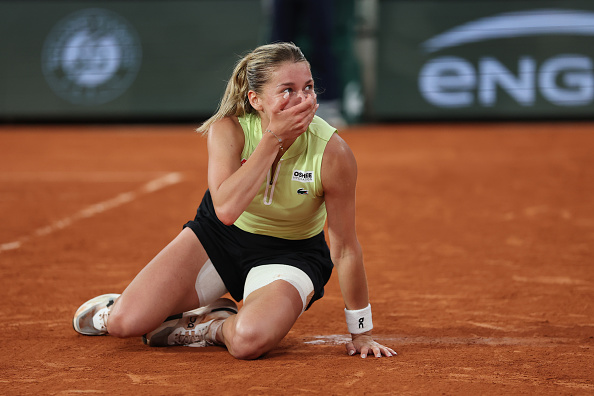
Yes, Sinner, Sabalenka and the GOAT were all gone. Yes, bold Italians and obscure wannabes dazzled. But Maja Chwalinska, the world No. 114, who beat Sabalenka-slayer Diana Shnaider 7-6(4), 6-3 today to become the first qualifier to ever reach the Roland Garros final, is a singular marvel.
Her forehand isn’t a thunderbolt. Her serve is modest. Her shoulders don’t impress. But she runs, she dashes, she anticipates. Her lobs are on a string – her drop shots are delicious and delicate. She moves like lightning. She’s fun and plays, may we say, with an almost intoxicating freedom – nothing to lose.
She’s the lowest ranked player to ever reach the French Open final. It’s reasonable to ask, “Where have you been?”
In a game where warriors roam the baselines and blast away, Maja dares to differ. Guts and guile, savvy slices, subtle touch and southpaw sizzle. Give that lady a Ph.D. – her IQ is off the charts. She’s calm in the storm. Defense to offense – no problem. Composure is her friend. How does she battle with such ease?
Never mind that here in Paris she was worried how she could possibly pay her hotel bill. Never mind that unless she gets a wildcard, she’ll have to play the qualifiers to get into Wimbledon. And never mind that her 80-mph second serve sometimes seems to go backwards.
At Roland Garros, Maja dropped just one set as she skipped through the draw. She dismissed the queen of China, Qin Zheng, Belgium’s six-time Slam doubles winner Elise Mertens, the pride of Greece, Maria Sakkari, the French hopeful, Diane Parry and the considerable Russian, No. 24 Anna Kalinskaya.
But experts figured Russia would now flex its muscles. Sure, Putin’s big guns may have been countered in Ukraine. Russian men – Medvedev, Rublev and Khachanov – may have misfired in Paris. But the increasingly poised and powerful 19-year-old Mirra Andreeva, who’s No. 8, brushed aside Ukraine’s Marta Kostyuk 6-1, 6-3 to earn a spot in the final. Now it seemed that the world No. 25 Shnaider, who had beaten Aryna Sabalenka and Madison Keys, would prevail, and give the world an all-Russian final.
But, here’s a secret: the popular Polish name Maja means “born in May.” And clearly Chwalinska’s career was reborn in May and has thrived in June.
Midway through the tight first set, she sprinted to one shot after another. While dashing all over the court, she was seemingly overwhelmed, but magically delivered a flawless stab lob for the ages. Radio Roland Garros was incredulous: “Oh, no, stop it! I can’t believe. She just stuck her racket and the lob went over Shnaider’s head – absolute genius. The dream is on!”
And the dream continued. Chwalinska prevailed in the first set, brushed aside an inner thigh injury and dance on to score her shock victory.
Now, can Cinderella stick the landing? The third highest ranked player in Poland always seems to hit the right shot at the right time. Can the 5’ 5” dynamo again get the right result at the right time?
Saturday, can she pull an Emma Raducancu, and become just the second qualifier to ever win a Slam? Can she possibly beat the young, but vastly experienced Andreeva?
For now, she insisted, “I just want to breathe.”
But hold on. From the start, Roland Garros has brought to mind that classic new wave French flick, “Breathless.” And these days there’s no one who is more new wave than Maja Chwalinska.