

Bill Simons
Now that Ben Shelton has become the first Black to reach the US Open since Arthur Ashe in 1972l, we look at the most vivid moments in Black tennis history.
1. ALTHEA: The sharecropper’s daughter and pride of Harlem, Althea Gibson broke tennis’ color barrier at the US National Championships in 1950. Seven years later, the Jackie Robinson of tennis became the first Black player to win Wimbledon.
2. ASHE’S BIG APPLE WIN: Arthur Ashe won the inaugural US Open in 1968, becoming the first Black man to win a Grand Slam singles championship.
3. VENUS RISING: Fourteen-year-old Venus Williams walked onto a court in Oakland in 1994 for her pro debut. She won a match and opened a million doors. Tennis would never be the same.
4. SERENA AND VENUS: Richard Williams made perhaps the most outlandish prediction in sports history: his kids – Venus and Serena – would wake ’em up at the country club and revolutionize the game. You might say they did.
5. I’LL MEET YOU AT ASHE: In 1997, after an intense lobbying campaign, the world’s largest tennis stadium was renamed for Arthur Ashe. His legacy endures.
6. THE FIST: In 1975, against the heavily favored Jimmy Connors, Ashe produced a tactical masterpiece to win Wimbledon. Then, at his moment of triumph, came his unforgettable, defiant raised fist.
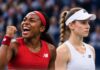
7. COCO POPS: A green 15-year-old newbie named Coco Gauff walked onto Wimbledon’s grass and beat her childhood idol, Venus, as one generation seemed to hand the sport to another. Now the game’s most beloved woman, young Ms. Gauff has won two Slams and many hearts.
8. KING RICHARD: The Oscar-nominated movie King Richard, starring Will Smith, brought Richard Williams’ game-changing vision to the big screen. Call him an against-the-grain genius or a mischievous rascal, tennis has had only one King Richard. We won’t have another.
9. THE RAGE IN ARTHUR’S SOUL: After years of being denied a visa, Ashe went to apartheid South Africa in 1973 and became the first Black to play the South African Open. He insisted he would not compete before a segregated crowd. On the Johannesburg tarmac, poet Don Mattera slipped him a poem, “Anguished Spirit – Ashe,” honoring not so much Ashe’s quiet philosophy as the rage in his soul.
10. THE DOCTOR IS IN: As Jim Crow ruled the South, every summer Dr. Walter Johnson turned his backyard court in Lynchburg, Virginia, into a hub for a wide array of Black prospects, including Ashe and Gibson.
11. FROM GIGGLES TO GOWNS: Naomi Osaka emerged as an innocent, became a warrior for racial justice and mental health, and then a fashion icon sporting astounding gowns. And, yeah, along the way she won four Slams and became No. 1.
12. FRENCH TENNIS WILL ALWAYS HAVE NOAH: Amid frenzy and joy, Yannick Noah won Roland Garros in 1983. Hugs abounded. More than four decades later, a Frenchman hasn’t won it since.
13. TENNIS FOR EVERYBODY: Ashe joined Charlie Pasarell and Sheridan Snyder in 1969 to create the National Junior Tennis League, built on a simple, transformative idea: combine tennis and education for kids in the inner city who otherwise might never get near the game.
14. LA MONF: Gaël Monfils never won a Slam, but for two decades, the mischievous Parisian was tennis’ entertainer-in-chief – explosive, inventive, joyful and very much his magical self.
15. KATRINA’S STORM: Former touring pro Katrina Adams became the first Black president of the USTA – and the first former pro player to have the job.
16. TAYLOR MADE: Side-eyes from parents, body shaming from the USTA, taunts from Jelena Ostapenko – who cares? With a twinkle in her eye, Taylor Townsend has delivered a certain South Side ‘tude to our game, climbed to No. 1 in doubles, and won five Slams.
17. OH CAPTAIN, MY CAPTAIN: Noah did something no one else has: he coached his teams to championships in both the Davis Cup and the Billie Jean King Cup.
18. LET’S GET ORGANIZED: Shut out of the white tennis establishment, Black businessmen and educators founded the American Tennis Association in 1916 – America’s oldest Black sports organization.
19. OF BIG FOE AND BIG BEN: Now, Tiafoe and Ben Shelton meet in the first Grand Slam men’s semifinal between two Black Americans and just earlier this summer in Cincinnati, Arthur Fils beat Tiafoe in the first Masters 1000 final between two Black players.
20. TENNIS’ MAYOR: Many a Black American mayor has been into tennis: think Atlanta’s Andrew Young or Oakland’s Lionel Wilson. But no mayor loved the game more than New York’s David Dinkins, who played three times a week, helped big-time to secure the US Open’s future in Flushing Meadows, got the invasive jets rerouted from above the grounds and is the only politician we know of permanently honored at a Grand Slam site: David Dinkins Circle.
21. GOOOOD NIGHT! James Blake and Andre Agassi battled deep into the New York night, in an extraordinary five-set 2005 US Open quarterfinal that became the signature match for compelling late-night tennis.
22. HOPPING HARLEM: In Harlem in 1940, Grand Slam champion Don Budge faced Los Angeles’ Jimmie McDaniel, America’s leading Black player, in a groundbreaking interracial exhibition at the Cosmopolitan Tennis Club.
23. SLOANE ALONE: Fresno product Sloane Stephens, with Chicago’s Kamau Murray in her corner, won the 2017 US Open over Madison Keys. Eight years later, Keys won the Australian Open. Like so many African-American tennis stars, Sloane and Madison have also done extraordinary charity work off court.
24. ZINA ZOOMS: Zina Garrison toppled Monica Seles and No. 1 Steffi Graf to reach the 1990 Wimbledon final, before falling to Martina Navratilova.
25. BOB BREAKS A BARRIER: Bob Ryland emerged from segregated tennis to become a pioneering Black professional. Ryland, who lived to be 100, inspired Ashe. Arthur inspired millions.
26. WASHINGTON AT WIMBLEDON: MaliVai Washington reached the 1996 Wimbledon final, becoming the first Black American man since Ashe to reach a Grand Slam singles final.
27. GAME MEETS GAME: In the most iconic meeting between a global humanitarian and a trailblazing athlete, Nelson Mandela met Ashe in New York in 1990.
28. EVERY MOVEMENT NEEDS ITS SOLDIERS: Not every pioneer gets a stadium named for them or lifts a Slam trophy. Black tennis advanced because generations of players, coaches and quiet and not-so-quiet rebels pushed hard.
There was Philadelphia’s Rev. W.W. Walker, who organized America’s earliest Black tennis tournament; Ora Washington, an eight-time ATA singles champion; Virginia Glass, who devoted decades to the game and became the ATA’s first female president; Leslie Allen, a breakthrough tour champion; Lori McNeil, a US Open semifinalist who stunned Graf at Wimbledon; Henry Talbert, the pioneering administrator and longtime USTA Southern California executive; Chanda Rubin, who rose to No. 6 and is a superb broadcaster, Rodney Harmon who was the USTA’s first Director of Player Development and Canadians Felix Auger-Aliassime and Victoria Mboko, plus countless parents, teachers, coaches and community organizers whose names never made the headlines.
They were the soldiers of the movement.