
Bill Simons and Vinay Venkatesh
NEW YORK
A couple of days ago, the big US Open question was whether Carlos Alcaraz could take the space out of Jannik Sinner’s game. Today, the talk was about how the air space over the US Open had shut down, except for one plane.
Long ago a tennis-friendly mayor did all he could to stop loud planes from flying above the tournament. Today, a golf-loving president in Air Force One flew low just over the world’s biggest tennis venue.
It wasn’t a complete shock that Donald Trump was coming to the US Open. He’s long been going to a string of sports events, including the Super Bowl. He’s planning for a MMA bout at the White House. And, until he was booed in 2015, Trump was a can’t-miss fixture here at the Open.
When Justine Henin played the 2001 Wimbledon final, Belgium’s Prime Minister, Prince, Princess, Deputy Prime Minister and Ambassador to Britain were all watching from the Royal Box. Writer Stan Hey adeptly noted, “It would be a good day for invading a small country, if you have that in mind.”
This is to say that royals, rogues and politicians – the good, the bad and the ugly – have long interfaced with sports and tennis, and often used athletics to empower themselves.
Nelson Mandela got a tennis court built in the yard of his prison. He painted watercolors with tennis themes, hung out with many tennis luminaries, and used rugby to bring his divided people together.
When President Clinton dropped in on a French Open match, Andre Agassi’s game fell apart. Princess Di loved tennis, and played regularly with Steffi Graf. Sweden’s King Gustaf is in the Tennis Hall of Fame. Never mind that Marat Safin was called Marat Stalin. Mao played tennis on his Long March. In 1936, Hitler called German Gottfried Von Cramm at Wimbledon, encouraging him to beat American Don Budge. Soviet boss Nikita Khrushchev asked, “What’s Wimbledon?” Russian President Boris Yeltsin probably loved tennis more than any other world leader. George Bush, Sr. briefly left the keys to the nuclear arsenal at a tennis court. Belarusian boss Alexander Lukashenko has used Aryna Sabalenka’s success to boost himself. You get the point.
Today the man who has changed the landscape of this world changed the tenor of the US Open. Triple security points were everywhere. I wore clean socks, but no one had to take off their shoes. I flashed back to the 2000 Open, when I actually scurried past Secret Service officers and chatted with President Clinton.
That was not to happen today. The Secret Service scoured every corner and hidden stairway of Ashe. Sections of the stadium were frozen. Traffic was snarled – too bad my helicopter was in the shop for repair. Ashe Stadium filled oh, so slowly. It took some 90 minutes to get in, plus the USTA threw shade on the First Amendment as they instructed broadcasters to saniitize the events and not show fan reactions to the president.
But, despite a 45-minute delay, the day proved to be about two young tennis rulers who have of late controlled the game with an iron fist.
•••••
Let’s get one thing straight. In tennis, rivalries are everything – the foundation, the glue, the not-so-secret sauce of the game.
In the sport’s heyday, rivalries led to bitter, no-holds-barred, fangs-out battles. Martina Navratilova’s coach told her to hate Chris Evert. McEnroe said Connors was an asshole. Agassi and Sampras couldn’t get through a benign fundraising exhibition without getting at each other’s throats.
The Big 3 Rivalry was a fairly affectionate trifecta. We got a rotating circus of wonder as the three traded off Slams, even though a few intruders occasionally had the audacity to shake things up.
When Roger Federer said, “There will never be another rivalry like mine with Rafa,” the tennis congregation nodded in unison – “Of course not.” The Big Three are immortal.
But not so fast – enter Sincaraz. Jannik Sinner and Carlos Alcaraz seamlessly stepped up to create an astonishing, impenetrable duopoly like no other. How lucky tennis has been – right?
The duo have won the last eight Slam titles. And get this: in the last 17 tournaments they both entered, they won 16 of them – amazing.
The US Open was no different. One cynic muttered, “Why even bother playing the early rounds? Just pencil those two guys into the final and let ’er rip!”
Once again at the Open, Sincaraz proved they’re in a stratosphere by themselves. Veterans like Djokovic and Zverev, as well as young flashes like Ben Shelton and Joao Fonseca, just can’t loosen Sincaraz’s grip.
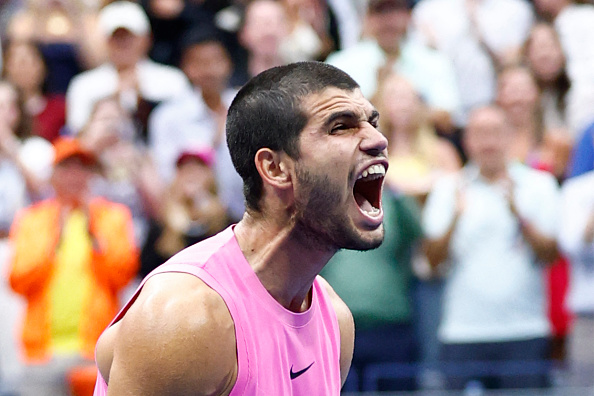
Sinner is just 24, Alcaraz is 22. Their rivalry could crackle for the next decade and a half. Yet, the difference in their star power is vast. Alcaraz smiles, he loves to entertain, he unleashes magical winners that leave thousands in a tizzy. Carlos is must-watch tennis. He transcends the sport. Andre Agassi noted, “His balance is there, his strength is there, his ability to move forward and cover drop shots, the athleticism. He carries it all.”
Some claim that, these days, more than any other player, he’s carrying the sport. He raced to the final without losing a set. After falling to Alcaraz in the semis, Djokovic looked like he needed a nap.
Sinner is the perfectly constructed, long, lanky, nearly flawless player from the mold of Ivan Lendl and Pete Sampras. Serious, on-message, and all over his foes. Ben Shelton noted, “When you are playing him, it feels like you are on 2x speed.” Sasha Bublik said the Italian was created by AI.
Years ago, a Sports Illustrated headline cruelly called Lendl, “The Champion Who Empties Stadiums.” Sinner is the only player we know who’s been reduced to contending, “I’m not a machine.” And we saw that in the first game of the final. Simply put, the Aussie Open and Wimbledon champion could not stay with tennis’ great athletic wonder.
For young Carlos, imagination is a weapon. Power is his ally. One moment we see a spectacular dropshot that only a wizard could pull off, next he gives us a running forehand that’s perfect for a highlight reel.
Now there’s no longer a US Department of Defense. But Alcaraz’s defending amazes. His racket speed and control impresses. His instinct rarely betrays him. He has a sprinter’s speed and staccato reflexes that any goalie would admire. His 132-mph serves are not the fastest in the game. But they’ll do.
Sinner had been said to be the best hardcourt player in the game. Incredibly, he’d won 27 hard court Grand Slam matches in a row. Today, at times, he returned brilliantly. And, after taking the second set, prevented his Spanish foe from becoming the first man to win the Open without losing a set.
Briefly, Carlos’ inventive combination punches misfired. But as the singer Sting looked on in admiration, Alcaraz’s unforgiving bite again stung the gifted Italian. Similarly, as Bruce Springsteen took in the master class, Pat McEnroe shamelessly observed, “Sinner is being bossed around.”
The frequently dominant Italian had been hoping to become the first man to meet the Pope and win a Slam in front of a president in the same season.
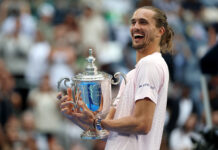
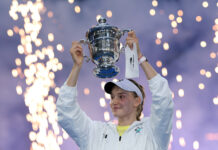
Today, Carlos hit an amazing, twisting overhead. But the 2:42 final that the Spaniard won, 6-2, 3-6, 6-1, 6-4, had few twists. For long stretches Alcaraz played virtually error free tennis. He said he played a perfect match. After his Wimbledon loss to the Italian, he confided that he’d studied Sinner’s game intensely. The Open was the best tourney he’s played, and his level was consistently high. Sinner admitted his own play had been predictable.
Now Carlos, who’s won six Slams and is 46-2 since April, has a dominating 10-5 head-to-head record against his prime foe. He’s won seven of their last eight matches, has a 7-2 lead on hard courts, regained the No. 1 ranking and is $5 million richer. In January at the Australian Open, he hopes to gain a career Grand Slam.
In the end, the buzz was not about the president of the United States, who was not mentioned in the awards ceremony, didn’t meet with either finalist and was booed when he was briefley pictured during the national anthem and for thirty seconds throughout a untelevised changeover. Rather it was about the man who over two weeks ago shocked us with his buzzcut and today was a buzzsaw, who at times made an incredibly gifted and classy foe look like a lumberjack.
For years, we relished the Big Three. More recently, it’s been the Big Two. But after today’s demolition derby, Alcaraz’s fans wondered if tennis could soon have a “Big One.”