

Bill Simons
There are reasons tennis is the sport of a lifetime, the healthiest game of all – the king of racquet sports. But you need skills.
Sure, pickleball is easy. Grab a racket, learn a few rules and begin cracking that ball.
But it’s not so fast with tennis – easy entry it ain’t. This isn’t checkers – coaching is essential.
We saw it at the Laver Cup, where Andre Agassi out-coached Yannick Noah. Even one of the world’s greatest players, Roger Federer, says he’s relying on teaching pros to teach his kids.
So, in August, the USTA, with all its resources, jumped in big time to create an entirely new coaching group – USTA Coaching, which will work with teaching pros, parents, clubs and manufacturers as it tries to educate and upgrade tennis teaching.
USTA Coaching CEO Craig Morris is thrilled with the launch of the group., which has caught fire. Much of its wide-ranging programming is already in place, and out of the gate, a whopping 6,000 have gotten the message and have already signed up.
Craig noted that the USTA is trying to get 35 million people to play tennis by 2035. Coaching, facilities and players are the three key elements. “The USTA has made a lot of good changes, but this one is the one I’m incredibly passionate about.
“People who deliver tennis are foundational to the growth of tennis, whether it be magazines or the people who drive it. So the USTA needs to have a relationship with the people who deliver tennis. We need to invest in them, to reward them, to recognize them. This is a really major decision, for the USTA to protect the growth of the game. If we don’t have as many people delivering tennis, the game can’t grow – it just shrinks. Inspiring the next generation of coaches at all levels is really fundamental to the mission.
“It’s like Disney, which has a three-legged business model. There are the finances, the guests, and the cast members. And the cast members are the most important, because they create and give the experiences for the guests, and then the guests spend money.
“Tennis is a people business and a service, and the people who deliver that are the coaches – so they are foundational to everything. Coaches are pivotal: great coach, great experience, correct? Crappy coach, crappy experience, correct?”
Of course, there’s one glitch in this giddyup. For decades, there have been two coaching groups in place in the US – the RSPA (which long was known as the USPTA), and its perennial rival, the PTR.
Morris contended, “It’s really important for the USTA to protect American tennis, because right now there’s no one organization in America waking up thinking about the tennis coaching industry. Other groups are global, and American tennis is only a part of their programs. It’s really important to say, ‘If you want to protect the growth of tennis in America, you have to protect the delivery system.’ That is our responsibility, because there’s no one organization focusing on that.”
It’s important to remember that the USTA, which runs the US Open and an array of leagues, has far greater resources than the RSPA and the PTR.
All this comes at a time when many tennis teachers are aging out. So, we asked Craig, why would a parent encourage his college age kid to become a tennis pro instead of landing a cushy tech job?
Morris explains, “Here’s an industry in which your son or daughter, who loves the game, can do something they’re passionate about, can be outside, can be servicing people, but also can be using technology and business skills to drive their own business and potentially generate hundreds of thousands of dollars in an endeavor they love.
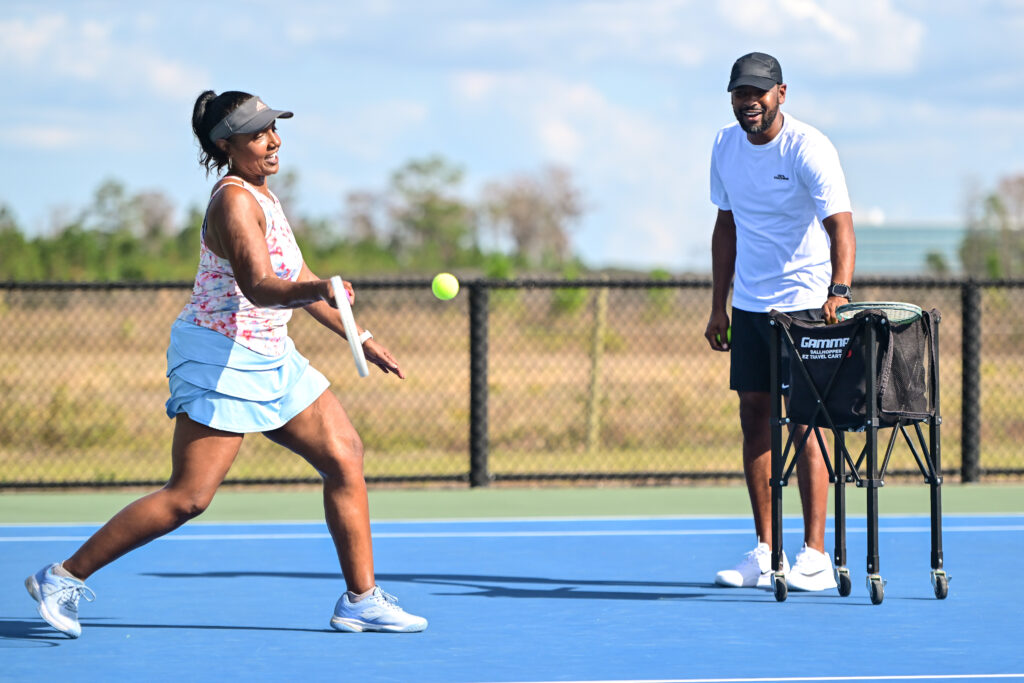
“As an industry, we need to make sure that people understand this. We are going to be recruiting young coaches and very much involving parents.”
Morris explained that USTA Coaching will reach out to all teaching segments: community and club teachers and high performance coaches. Education will be key.
Shortly, around the country, 46 education centers will open, where there will be face-to-face events at all levels of coaching. And on November 12, a Learning Management System (LMS) will be launched. Plus, there are plans to host a teaching conference at the 2026 US Open, which will be great for networking.
Already, USTA Coaching is working with the tennis industry. Many clubs have said they will become USTA Coaching approved facilities, with all their teachers in the group.
There also will be an online store with hefty discounts. For the first time ever, the Big Three of the racket industry – Babolat, Wilson and Head – have all agreed to work with the USTA and will offer 20-50% discounts.
One senses that USTA Coaching is an all-in effort: a sharp website, a job board, a commitment to work with parents and schools, which, Morris says, “are often the first touch point and where the pathway kicks off.
“Accessibility is key. We need to engage with PE teachers and middle and high school coaches. Plus, we’ve got to have coaches that look like the community. We need women, Hispanic, Asian-American and Black coaches.”
Morris also reflected on the nature of coaching. “There’s the science of coaching – the swings, grips and bio-mechanics. But there’s also the art of coaching, where you create an environment where somebody can feel connected to the game, feel the social interaction, have fun and enjoy the whole experience of the sport and become the best player they can be.”
No matter where you are on your journey, whether you’re a parent or a high performance player, USTA Coaching wants to give you what you need. Creating a local and eventually a national community is going to be important. After all, tennis coaches inspire people to love the game.
For information go to USTACoaching.com.