

Bill Simons
New York
The tennis ball doesn’t know whether you are white, black or brown. So, color doesn’t matter in tennis – right?
Seventy-five years ago, Althea Gibson stuck her adventuresome toe in the deep white waters of our sport. With guts and grit she integrated tennis. Then Arthur Ashe opened things up substantially. The Wimbledon and US Open champ was elegant, wise and easy for many to embrace.
Later, two famously unapologetic sisters who came out of Compton were, for some, not all that easy to take. With beads in their hair, Ms. Venus and Ms. Serena pushed the envelope. They were so fabulous that they made people open their eyes and accept the arrival of black culture into what had been an elite world.
Now, a giggly, fashion-happy 21-year-old who’s subsumed in popular culture is impressing us with her athleticism and enchanting us with poise and charm. Coco Gauff is right out of central casting, a near perfect young star who hits out and speaks out. She has to work on her serve, but not her appeal.
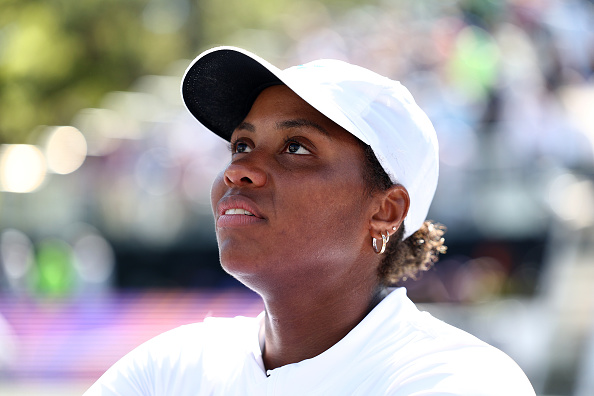
And then there’s Townsend, who’s the Taylor of the town. That is to say, even more than Venus’ doubles play, Taylor Townsend is the story of this US Open. En route to the fourth round, the No. 143 in the world beat No. 27 Jelena Ostapenko and No. 5 Mirra Andreeva.
We know Townsend is a working mother, a proud Aires and one of two US Open players left who’s in both the singles and doubles draw. And she’s candid and articulate like few others. In an astounding article in the Players Tribune awhile ago, she spoke out on race, culture and body-shaming in a way no other tennis player has ever done.
Taylor explained, “I’m not from some rich family…I’m not white…I’m not your typical tennis kid. I also remember…wanting to be my own person…I’m not the ‘next’ ANYBODY!! I’m Taylor Townsend!!! From the South Side of Chicago!!! And one more thing: I’m not thin, and I’ve never been thin…I liked the way I looked.”
In 2012, Townsend came to our attention when the USTA (which she is very positive about these days) intervened and said that she was too fat to play the Open. But, hold on. She just wanted her due. She was the top junior in the world – why wouldn’t she get a wild card? But the tennis bosses said, “No way, kid. That wild card isn’t for you. Go off to Florida for a training block. Others will get it. Deal with it.”
Taylor recalled, “I was No. 1 in juniors as a Black girl from the South Side. I was so proud of that. I was so proud of who I was, and what I’d achieved…I had it in my head, I might be an outsider in this sport, I might not be like all these other tennis kids. But I got to No. 1. Now they’ll be proud to have me. Now I’ll be treated like a part of American tennis. Now I’ll be one of them.
“It doesn’t exactly work that way, though, does it. As a matter of fact…It worked pretty much exactly the opposite. It worked the way things usually work in a country that hates fat Black women.
“I don’t think that’s a controversial opinion, by the way. To me, America hating fat Black women – it’s just part of life. It’s in the culture. It’s in the healthcare system. You see it in Hollywood, you see it in sports. You don’t have to look around very hard. It’s everywhere.
“And it’s especially everywhere in the world of tennis. I mean, think about it: They didn’t just alienate me for not fitting the mold of what a tennis player should look like – they punished me. They took away something I’d earned. I was fat, and I was Black, so they took away my dream. Or at least they tried.”
It didn’t work. Flash forward 13 years, and Taylor, who’s won the 2024 Wimbledon and 2025 Australian Open women’s doubles crowns and is now No. 1 in doubles, had to deal with something else. A petulant Latvian with ‘tude and a pout got in Taylor’s face. Pissed off that, despite being the No. 25 seed, she’d lost to No. 143, Jelena Ostapenko barked at Taylor, “No class! No education!”
Speaking of education, here’s some background on Townsend. Taylor recalled that, as a five-year old, she could “still remember the first time I was playing and heard one of the moms say, ‘Look at her. She’s too big.’
“The thing is – you don’t even really understand what people are saying around you at that age…It’s really just like this split-second of a moment in your head…where maybe you’re kind of scared or self-conscious. And you don’t even really know why, if that makes sense.
“I decided I wasn’t gonna let myself be embarrassed anymore – I wasn’t gonna let myself be humiliated by this rich, white tennis world that I had spent my entire childhood scraping and crawling and bending over backwards to fit into.
“You know that there’s something ‘different’ about you…and that it’s not good. You know the grown-ups can sense it…and they don’t like it. As a child, you have this amazing ability to shrug stuff like that off – but also to carry it forever.
“And this was tennis, this was a very white world. Those little moments, they get under your skin and they stick with you and you never really forget.”
When Townsend moved to Atlanta, she started to feel “this weird kind of vibe…when you walk into a room, and you can tell you’re not really supposed to be there. Or that people don’t really want you there. There’s just this tension. It’s heavy.”
When she and her sister started to win on court, she recalled that tennis parents “reacted to these two little Black girls taking over tennis in Georgia, of all places?…No one was outwardly saying anything like racist. But even still, man, when you walk into a room, or when you’re in a big crowd you feel it…There was a lot of resentment.
“Parents started coming out with all these excuses….about why I shouldn’t be playing against their kid…They’d ask for my birth certificate…[and say] “Oh, no, she can’t be 11. She’s too big. She’s too developed.”
“They felt their kids were getting robbed of an opportunity. They weren’t getting the ‘country club tennis experience’ they had signed up for. Tennis was supposed to be ‘their’ sport. And yet here was their kid, getting beat by a big Black girl.
“I’d always try to downplay it…But I cried sometimes late at night…I couldn’t wrap my head around it – so much that was just leaving me feeling bad and confused.
“The major thing that’s difficult to explain to people who’ve never experienced racism is that it’s not the stuff you understand that hurts the most. It’s the stuff you don’t understand.
“When…you’re getting singled out, whether it’s by another parent, a teacher, a store manager, a cop, or whoever, you really don’t get it…Nine times out of ten, you think it’s just you.
“That’s heavy. You walk around carrying this invisible weight – this pressure on your whole spirit – because the worlds you’re trying to fit into are rejecting you…and you think it’s your fault. Then you add sports into the mix…and it just becomes that much more complicated and that’s much more ugly.
“Of course, I wondered where I fit in. I cared what people thought, even if I said I didn’t…But it just felt like no matter what I did, it was never enough.
“And then eventually you stop caring…You accept that you can’t hop out of your own skin. You accept that – whether you want to or not, and whether it’s hurtful or not, this is how it’s gonna be.”
Townsend likes to describe herself as “that girl from the South Side who just wanted to play.” Unabashed and unafraid, she refers to herself as “Thick and Black and proud and excellent.” The mother of a four-year-old son, she speaks of the magic of mothering, how she’s been working hard on her growth and how her purpose in tennis is to leave a legacy.
After her doubles win today with Katerina Siniakova, Taylor said, “Everything happens for a reason…The hard things that I’ve had to endure…the trials and tribulations throughout have prepared me for this moment…This is helping me to be able to learn how to engage and then when I need to be quiet.”
Today Ostapenko wrote, “English is not my native language, so when I said ‘education,’ I was speaking only about what I believe is tennis etiquette, but I understand how the words I used could have offended many people.”
Taylor appreciated the apology and added, “That’s fine. That’s cool. At the end of the day, I think that it’s a learning lesson for her…You cannot push your expectations on other people…She expected for me to react in a certain type of way, and I didn’t, and it infuriated her, which led her to say things that are hurtful, that are belligerent, that are offensive, not only to me, but to the sport and to a whole culture of people that I try to do my best to represent.
“It’s nice that she apologized. You know, this isn’t the first, second, third, fourth time.
“I’m proud to be in the position that I am. I’m proud to honor my culture. I’m proud to be here as an American…[and] to get the love and support that I’ve gotten from the crowd…I’m just enjoying the ride.”
Today Taylor said she believes in destiny. So do we.
– Also Reporting, Lucia Hoffman