

Bill Simons
Wimbledon
The tennis player is in the arena in front of the huge crowd, alone, exposed and eager to gain glory.
Just two brief days ago, Amanda Anisimova was elated when she downed the No. 1 player in the world, Aryna Sabalenka to gain the No. 7 in the world ranking. What an inspiring achievement.
People were amazed by her dazzling double-fisted backhands – so clean, so fierce – perhaps the best in the game. Fans loved her narrative. How brave that she managed to persevere and gain such excellence after the tragic loss of her dad and coach.
But today’s Wimbledon final was a gut-wrenching loss that brought this game’s other devastating losses to mind.
Natasha Zvereva, who was dismissed 6-0, 6-0 in the 1988 French Open final, is remembered to this day for saying, “I’m tired. I need a mental institution break.”
In 1999, after the then dominant Martina Hingis lost the French final and then fell to No. 129 Jelena Dokic in the opening round at Wimbledon, writer Ian Woolridge claimed, “The sheer enormity, the staggering implausibility…this hard to ignore defeat heaps humiliation on the shame she already felt.”
Perhaps most significantly, in 1992, when Jana Novotna blew a 5-2 third-set lead over Graf and then wept on the shoulder of the kindly Duchess of Kent. The London Times’ Simon Barnes noted that, “Novotna played a game of tennis for everyone who has ever made an absolutely ghastly mistake. Or, to put it another way, for the entire human race.”
In some ways, Iga’s romp today was a shock. She hadn’t won a tourney since the 2024 French Open. She served a month suspension for improper use of a sleep mediction. She’d never gotten beyond the quarterfinals at Wimbledon. Her ranking had dropped to a very un-Iga like No. 8. The expectations were modest, she was under the radar. She lost the first game of her opening match against Caty McNally.
But Iga said, “I’m an intense person. My mind likes to be busy.” After a too early loss at her beloved Roland Garros, she had time and headed to Mallorca to spruce up her grass court game.
It worked. Step by step, here at Wimbledon, the woman whose staccato stutter steps bring to mind Ginger Rogers, stepped her way through her user-friendly draw. She was on fire.
And today the WTA’s beat down artist was nothing less than a ruthless executioner. From start to finish, tennis endured a relentless demolition derby. Playing her first at Wimbledon and sixth overall Slam final (all of which she’s won) the WTA’s master chef cooked up a devastating double bagel, downing the Floridian in just 57 minutes, 6-0, 6-0. Against Amanda and Belinda Bencic she won her last 20 games.
Radio Wimbledon summarized the rout. “Amanda’s being bludgeoned from pillar to post. There’s not a bead of sweat on the Pole’s brow. It’s like she’s playing a first-round match. Amanda can’t catch a break – in more ways than one. She’s lost all belief. This final is running away from her.”
Wimbledon’s Centre Court crowd sat in proper disbelief. “How sad!” sighed one fan from Sussex. The good and great in the Royal Box grimaced. Amanda would say her lack of physicality was key to her loss. She was making mistakes she rarely suffers.
In her first Slam final, Anisimova started slow, tight and stiff. But the 23-year-old had overcome so much on tennis courts and in life. American fans chanted, “Let’s go Amanda! Let’s go!” The slightest of openings drew hope-against-hope cheers. But there would be no get-up-and-go from Anisimova today. Nerves morphed into panic. She struggled simply to play points. Gaining a breakpoint was beyond her command, Her forehand was punished, her serve was wretched.
Hapless and in hope of a miracle, she looked at her box. Hands on hips one moment, bashing the ball in frustration the next, she was enduring a dark nightmare on tennis’ dreamiest court. If this had been a boxing match, they would have thrown in the towel.
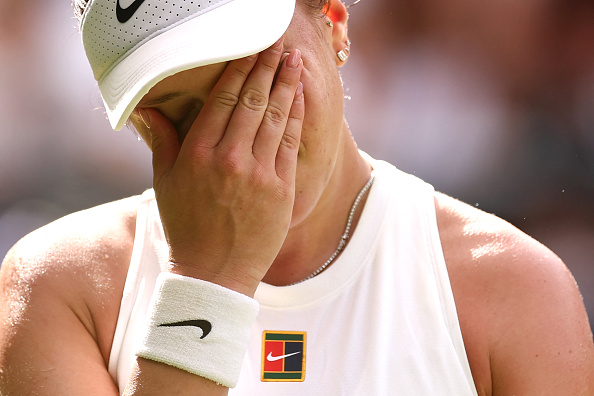
After the beatdown, Amanda put her head in her towel and wept. Then, not unlike the Duchess of Kent, who had comforted Novotna 32 years ago, the vastly popular Kate Middleton, the Princess of Wales, offered comforting words. “Keep your head up.”
Then, Amanda recalled, “I was getting so overwhelmed with emotion. I was just trying to hold it together…I was trying to remind myself, this is an incredible moment..I tried to swallow all the tears and just speak from my heart.”
Amidst tears, she turned to the first Polish champion in Wimbledon history and told Iga how much she’d inspired her. She continued, telling the crowd, “Even though I ran out of gas today, and wish I could have put on a better performance. You guys have been incredible. It’s been a privilege to play here. I’m never going to forget this.”
Then came a sublime moment. She turned to her mother Olga, who had come from Leningrad to New Jersey in 1998, who had gone with her young daughter to show up at 4:30 AM at the Bollettieri Tennis Academy in Florida, and, most importantly, who had comforted her when the family was hit hard by the passing of their 52-year-old patriarch, Konstantin, who’d been found alone in his Miami apartment, the victim of a cruel heart attack.
Weeping inconsolably, Amanda thanked her mom for flying in for the final, saying, “She’s the most selfless person I know. She’s done everything possible to get me to this place…I love you so much!”
The fallen warrior added, “I’m going to keep putting the work in. I hope to be back here one day.”
Three years after Jana Novotna suffered her heartbreaking loss, the Czech returned to Centre Court and lifted the Venus Rosewater Dish in triumph. And we imagine that today, fans from Russia to London and from Jersey to Florida hope the appealing Anisimova can rebound. Then again, Amanda is a profoundly resilient young woman, very reflective, and fond of quoting the words of thinker Marianne Williamson, who tells us, “Pain can burn you up and destroy you, or burn you up and redeem you.”
Amanda told Inside Tennis that she loves that quote, and added, “It’s definitely something that I try to live by…I got back to the locker room…[and told myself], ‘This is probably going to make you stronger.’…Honestly, this is a fork in the road…[and] I’m going to choose the path of working towards my goals of trying to improve.”