
Bill Simons and Vinay Venkatesh
Paris
Rafa Nadal insisted today that at the end of the day, “Tennis is just a game.”
But not really, Rafa. And the celebration of you that thrilled your legions of fans around the world proved you wrong. For today, the French Open’s tribute to a singular Señor reminded us of how a simple sport played with ball and a racket amplifies our lives.
We saw not just a celebration of a man, but a celebration of all the aspects of our lives that test and reward us: tenacity, loyalty, resilience, longevity, suffering, achievement, humility, trust, collaboration, family, belief and heart.
No other athlete has done in one venue what Nadal has done at Roland Garros. And, we believe, no other farewell, not Andre Agassi’s touching farewell address, not Serena Williams’ boisterous New York goodbye, not Andy Murray’s poignant departure last summer at Wimbledon, not even Roger Federer’s lofty, teary exit at the 2022 Laver Cup can really match today’s heartrending farewell to a man who inspired so many for so long.
If nothing else, the French insist on being stylish. Plus, they bristle at the very notion of conformity. Yet today, virtually everyone in Stade Roland Garros sported casual, almost dorky burnt orange t-shirts with one message: “Merci, Rafa.”
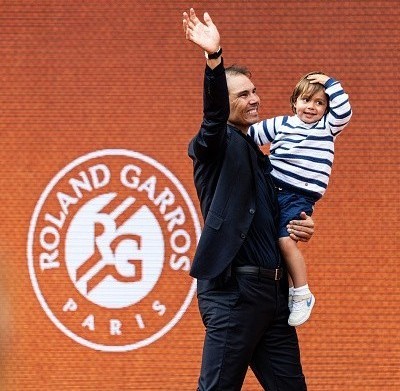
After a considerable wait, the Spanish conquistador emerged in a stunning black suit, with a radiance that seemed to spit at the countless injuries that long hobbled him.
From the outset, an appreciation video seemed to check off all the Nadalian details we’ve grown to love over his 20 years as a warrior. In a flash, we saw the full spectrum of his story and his glory: his war-weary hands, his almost comical twitches, his hyper pre-match warm ups, his compassionate pats on the backs of ball girls, his fussing over bottles, his dripping sweat, his pulverizing forehands, his earth-shaking slides, his stunning statue here at Roland Garros, his (best since Jimmy Connors) fist pumps, his triumphant spread eagles on court, his hugs, his disbelief, tears, kisses, and his inspiring humility.
Soon we saw an array of the people who helped make this man. Little-known support workers at Roland Garros, his patient coaches and physios, his sister and cousins, his beautiful, loyal wife. His 95- and 92-year-old grandmothers displayed the beauty of our elders. And little Rafa junior, just two, was a total delight, in the tradition of Kim Clijsters’ awestruck daughter, Jada.
Rafa offered generous thanks to so many. If there ever has been a champion who’s a product of family, and the “It takes a village” ethos, it’s Rafa. In particular, he paid tribute to the foremost uncle in the history of coaching. Rafa’s Uncle Toni, noted Christopher Clarey, continually told Nadal, “Tennis is tough, It’s brutally difficult. It should be, and you should embrace it.”
Rafa turned to his uncle, saying, “You are the reason I’m here. Thank you for devoting a big part of your life to me. To make me suffer, to make me love, to push me past my limits…You have sacrificed so much, and have been the best coach I could have hoped for.”
Somehow, as French tears flowed and proud flags waved, we thought of the words of Spain’s former Davis Cup captain: “We Spaniards have to be humble. It’s transcendental. We have to suffer, maintain and be quiet.”
Yes, the early evening featured a steely grey sky. But Rafa, who is famous for his relentlessly positive outlook, once told us, “Life is so much better with sunshine…I try to play with happy colors.”
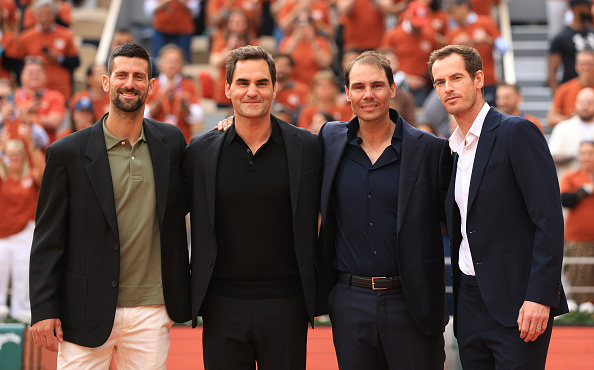
And perhaps the happiest moment of the day came when Rafa’s extraordinary rivals, an elegant Swiss man named Roger, a relentless Serbian craftsman named Nole and a sublime, hilarious and sometimes sullen Scotsman named Sir Andy all came out on court to embrace Rafa.
If ever there were a spine-tingling on-court remembrance, it was today, along with the day at the Laver Cup when Roger was hosted in the air. Rafa said it was “a message to the world” that the Big Four could be such fierce rivals, and yet have such deep respect for each other.
But, of course, today was all about a man whose muscles had muscles, who, in his own glistening way, was an athlete and cultural figure in a universe of his own. No wonder they named an asteroid after him. And a plaque featuring his footprint was permanently place by the side of the Court Centrale net.
Ultimately, what set this man apart was his fierce will, his refusal to lose. For Nadal, the battle was always within – to play himself, not his opponent. He told Inside Tennis that the key to his success was his unwavering determination to improve.
Every practice, every match was a fresh challenge, whether he was a raw rookie, a defending champion, or a worried elder deep in his twilight.
Today, our minds were flooded with flashbacks from the dawn of his career, when he humbled an unsuspecting Andy Roddick in the Davis Cup in Seville, to his win in the dusk at Wimbledon, where he downed Roger in the greatest match of all time.
As Rafa finally left Courte Centrale, with its velvety carpet, questions still did linger. What would have happened if he’d remained a right-handed player? What if he hadn’t been so devastated by so many injuries, and hadn’t missed 17 Slams? Will any man approach Nadal’s mind-numbing mark of 14 French crowns? Will his involvement with the problematic Saudi Arabian regime undermine his sublime reputation in any way? Could Nadal coach ATP hopefuls, say, his compatriot, Carlos Alcaraz? Will he remain front and center in the tennis world, or recede? How will he ultimately be compared with Djokovic and Federer? And just how did he combine such ferocity with deep, often tender humility?
But that’s enough questions. After all, there’s no question that today was an uplifting ceremony of a man, his family, his triumphs, and a sport that – dare we say – is far more than a game.