
Bill Simons
Years ago, on the opening night of Arthur Ashe Stadium, after Whitney Houston belted out her epic song, “One Moment in Time,” African American tennis star Leslie Allen suggested Arthur Ashe was looking down from heaven and smiling.
Today I had a hunch that, up there, Ashe again may have been checking out the action.
It seemed that just for one afternoon, tennis time had stopped – for one moment in time.
After all, with his huge strokes blazing, America’s best player, the world No. 8, the unafraid Ben Shelton, had ended Carlos Alcaraz’s 13-0 Grand Slam winning streak over Americans at 3:33 AM, in the greatest quarterfinal since Sampras outgunned Agassi in 2001. Then he took out Frances Tiafoe, in the semis, to become the first Black American man to reach the US Open final since Ashe in 1972, and the first Black American man to reach a Slam final since MaliVai Washington made the 1996 Wimbledon final.
And, as the whole tennis world knew too well, the 23-year-old Shelton was now in place to end the wretched 23-year Grand Slam drought of American men.
Yet, as we said yesterday, we weren’t telling the Floridian, “Hey kid, pull a rabbit out of your hat.”
Shelton doesn’t wear a hat.
We weren’t telling him, “Show us some special trick you have up your sleeve.”
His muscles have muscles. Naturally, he doesn’t wear sleeves.
All we were saying was, “No pressure, Ben – but the weight of your nation is on your shoulders.” And, please, end our long banishment into the tennis outback. Our drought has been soul-deadening.
After all, we are America – “USA! USA!” And everyone knows that nobody shuts out America for 24 years in a row.
But maybe it was too much to ask.
Shelton is still young. We still see a charming boy in his face. He’d already scored two mighty victories – with little rest. Maybe it was too much to ask the former high school quarterback to throw one more Hail Mary.
The bookies said he had only about a 37% chance to win, and he was facing the man who’d been saddled with the dubious label, “the best player to have never won a Slam.” But after Sascha won the French Open this year he was transformed and became the hottest Grand Slam player on the planet.
For years, destiny seemed to be telling the guy to get lost. Traumatic collapses in Slams. A serve that had its own will. A forehand that too often went on vacation. An ankle that buckled at Roland Garros and, yes, domestic abuse charges that, to be euphemistic, were deeply troubling.
The veteran could be charming. His humor was wry, his locker room popularity was clear, his work to counter diabetes impressed.
He just couldn’t win on the big stage.
John McEnroe commented that Zverev “plays not to lose.”
Then he won the French Open and, relishing his newfound freedom, made it to the Wimbledon final.
At the US Open, he came within two points of losing in the first round, and said he’d “played like shit.” He laughed it off, survived back-to-back five-setters, and then found himself in fantastic form and loving his sport. And what luck – he hadn’t faced a Top Twenty foe since Paris.
As foes like Taylor Fritz and Learner Tien fell, the self-assured Zverev brushed aside his modest opponents. Here was a man in ascendance. The big names of the game – Djokovic, Nadal, Federer, Alcaraz, Sinner – weren’t in his way.
His only obstacle was a charming kid who looked like a tight end and had a pretty, celebrity girlfriend. But no problem. Sascha had beaten Shelton five straight times without much of a fuss. He’d won the last 12 sets they’d played, and Ben’s lefty forehands played right into his strength – his mighty backhand.
Plus this wasn’t the old Zverev. This was Alexander the Great – infused with belief. The German hadn’t dropped a set since the second round. He was into his sixth Grand Slam final – and his third in a row.
From Paris to Rome to New York, the 29-year-old veteran had long felt the sting of hostile crowds. He knew that only a brave few would back him in New York. But the German embraced the moment. More with awareness than hostility, he said, “I hope to make the American dream not come true.”
But Shelton, who’s been increasingly calm and aware, seemed unfazed. He didn’t offer any guarantees, like Broadway Joe Namath once did, but he projected a quiet joy: “I’m playing against the No. 1 seed, in a Grand Slam final, playing against a Grand Slam champion, trying to get my first. It’s a lot of reasons that this is an enjoyable moment for me.” Surprisingly, all the beautiful people in Ashe Stadium were quick to settle in. But Ben didn’t.
Like so many playing their first Slam final, he got off to a shaky start. Andy Roddick told us, “There is no way to talk sense into your nervous system.” With three errors and a double fault, he dropped the first game. And then things didn’t get much better. Zverev had said you can’t think during play, you just have to flow.
And flow he did.
Relaxed and playing within himself, he served big, played fine defense, absorbed Ben’s force, dominated rallies and knew when to hit out. Nervous Ben couldn’t consistently open the court. His serve didn’t impose, his forehand rarely exploded, his net charges often were futile.
He had a couple of modest openings, but they vanished quickly. And when Zverev held serve for the 56th straight time against Ben, he won the first set 6-3.
As actor Adam Driver watched, 29,000 Ashe fans were muted. They knew who was in the driver’s seat.
But, not to worry. John McEnroe pointed out that the Knicks had come from 29 points behind against the Spurs. And, in his run to the final, Ben had come back to win three times after losing the first set. Plus, Zverev has a history of devastating collapses.
But the first-set winner at the Open has won 30 of the last 33 Open finals.
As Zverev injected himself with insulin on changeovers to deal with his diabetes, Shelton hoped to inject energy into the match.
It was hard. Sascha’s gamesmanship was clear. He bounced the ball incessantly before serving.
The battle did tighten as Shelton began to hold with ease and Zverev’s level dipped slightly. After a key Shelton volley winner, the crowd at last exploded. But in the second set, the German exploded. He unleashed an inspired backhand laser and blasted a 147-mph serve as he raced to a 7-2 lead in the one-sided second set tiebreak.
Fans asked, “Where are Shelton’s explosive forehands, his uncanny anticipation and his imposing athleticism, that dazed Alcaraz and Tiafoe?”
Defeat was looming. But after 2:49 of near futility, in a flash, Ben stepped in and raised his aggression – and Sascha blinked. Groundie errors and a botched volley, at long last, gave the American break of serve and the third set, 7-5, breaking Zverev’s streak of 66 straight service games won.
Match on – right?
Wrong.
Ben took a breath. The German counterattacked and took advantage of a Shelton double fault to score a key break, to start the fourth set.
Ben fought back gallantly and came close to breaking again. While Shelton’s force again faded, Zverev’s focus was fierce, his decision-making superb. His 130-mph serves, his unflinching stamina, experience and athletic shotmaking paid dividends.
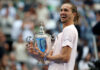
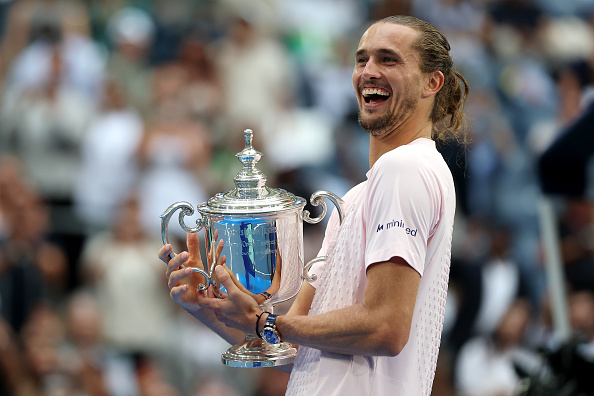
And after 3:32, Sascha stepped up to serve in hopes of becoming the first German since Boris Becker to win the Open. His maroon shorts drenched with sweat, he bounced the ball 13 times and unleashed a 137-mph serve to win 6-3, 7-6(2), 5-7, 6-2, claiming his second Slam in three months.
Soon he turned to Ben and told him, “I would bet all my money that you will lift this trophy one day.” He apologized to the fans for keeping them up so late earlier in the tournament, and added, “I know that 99.9% of the people wanted Ben to win, so I’m sorry.” He then thanked the most important person in his life, his mother, who, when a doctor told her that her four-year-old son had diabetes and his life would be very limited, replied, “My son will be whatever he wants to be.” Sascha added, “It takes an unbelievably strong woman to do what she did.”
He then spoke of all the work that he and his team have done over the years and said, “I think 2026 is the outcome of all these years…We had so many heartaches…I think God has seen our heart.”
And today New York saw a German’s heart.
It was one moment in time. It just wasn’t the one American fans yearned for.
So, after our best 23-year-old couldn’t break a 23-year curse, we imagined that up above, Arthur Ashe just sighed: “Oh, well – our moment will come.”
STANFORD-BOUND MARCEL LATAK WINS US OPEN JUNIORS: It’s been a dandy summer for Stanford tennis. Cardinal Arthur Fery was a Cinderella at Wimbledon. Coach Dick Gould was honored with some pomp and circumstance at the Open. And yesterday, Stanford-bound Chicagoan Marcel Latak saved three championship points against Brazil’s world No. 1 junior, Guto Miguel, and prevailed 15-13 in the decisive breaker to become the first American boy in 11 years since Taylor Fritz to win the US Open juniors.
En route to the title, Latak beat half the top seeds. By the way, incoming Stanford freshman Katherine Hui won the girls’ title in 2023.
DOUBLE TROUBLE: It’s been quite a year for American Christian Harrison and Britain’s Neal Skupski. The duo beat Germans Kevin Krawietz and Tim Puetz 6-4, 7-6 to win the US Open men’s doubles, adding to the Australian Open crown they won in January. Better yet, they didn’t drop a set in New York, becoming just the third men’s team in the Open Era to win the US Open without losing one.
SHELTON ON A “STUPID RULE”: Ben Shelton wasn’t thrilled about waiting through Alexander Zverev’s endless pre-serve bouncing: “He never does less than ten bounces…I shouldn’t have to sit at the line if he’s bouncing the ball 20 to 25 times.” Shelton added that while servers should have freedom before first serves, second serves need a time limit: “For our sport, for the fans, I think it’s tough to be sitting there that long…I think that it is a stupid rule.”
Also reporting Vinay Venkatesh