
Bill Simons
Tennis loves contrasts.
Lefty against righty. Power against touch. Youth against age. Fire against ice.
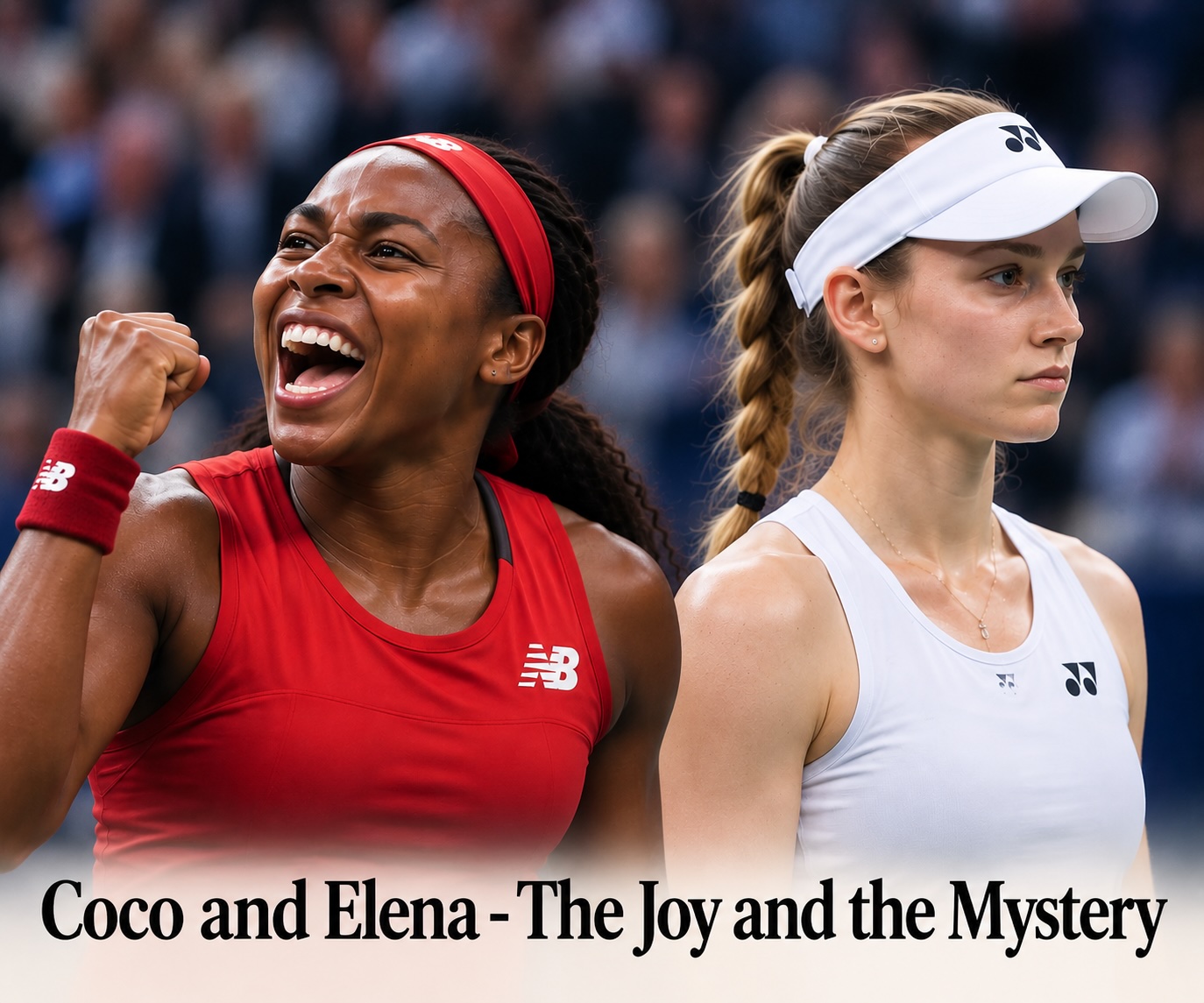
But tonight’s US Open semifinal offers one of the most striking personality contrasts in the women’s game.
Vibrant and open, tears and giggles – Coco Gauff lets you in.
Elena Rybakina doesn’t.
Gauff has been on tour since she was 15, yet somehow the 22-year-old still seems delighted by much of what surrounds her. She laughs. She giggles. She talks about music and fashion, edgy celebrities and provocative politics. She’ll discuss Black history, social issues, rappers, influencers and what she did last night. You want cultural hot takes? Coco has plenty. And yes, with a twinkle in her eye, she can’t help teasing her little brothers and hapless dad.
Her must-watch press conferences are story factories.
And her tennis?
That’s another adventure entirely.
No one wins in a messier manner. Almost half matches are three-setters. Sudden collapses, going off the rails, double digit double faults and forehands that land in the next area codes are the engines of the Coco train.
Still, the best athlete on the WTA tour has won two Slams, is No. 4 in the world and, by the way, is the most beloved kid in the game along with some conquistador named Carlos.
Brad Gilbert famously preached “winning ugly,” and no other player embodies that ethos more than Coco.
But why?
It’s not that complicated. Gauff’s two most vulnerable strokes – the two shots American tennis has been built on – are the serve and forehand.
And Coco’s are flawed. They can go south in a flash. 42 unforced errors in the quarterfinals is not ideal.
But no worries, she embraces crisis and goes to Plan B. She calls on her extraordinary heart, speed, athleticism, experience, defensive wizardry, competitive will and what she cheerfully describes as her sometimes “delusional” self-belief.
Elena Rybakina, who Monday will end Aryna Sabalenka’s 99-week reign at No. 1, offers a different universe.
The tall, lean Kazakh is the ambassador of impassive. Win a great point, lose a terrible one – blink and you might miss the reaction. She has one of the best serves in the WTA. Her clean, powerful game is an imposing wonder. She just beat Coco in Toronto. The reigning Australian Open and WTA Championships titlist is an impressive powerhouse. She leads the circuit in aces. And after a dip early last year, she’s been playing clutch ball.
But her inner world seems to be under lock and key. After winning Wimbledon in 2022 she gave us the most timid, ho-hum reaction imaginable: a gentle fist pump, a hint of a smile.
Lindsay Davenport noted, “she doesn’t let you in, we don’t know what she’s thinking.” Mary Carillo noted she’s not exactly a New Yorker.
She’s all business. She hits hard and speaks softly. Her mask rarely slips.
Perhaps that’s why her eruption during her quarterfinal against Zheng Qinwen was striking.
After dropping the first set, an unhappy Rybakina engaged in an intense exchange with her controversial longtime coach, Stefano Vukov. She later admitted, “I was quite negative,” and she’d been “letting the emotions out a bit.” Vukov tried to get her to refocus on their game plan.
It worked.
Rybakina stepped closer to the baseline, became more aggressive and came back to beat the Olympic champion Qinwen Zheng. The victory carried her into her first US Open semifinal, and, more significantly, she clinched the No. 1 ranking.
Her relationship with Vukov has long been one of tennis’ more complicated, controversial partnerships. They split in 2024, and their relationship prompted an investigation and eventually Vukov’s provisional suspension.
Their dynamic posed problematic questions. And Pam Shriver encouraged Elena, for her mental health, to get a new coach. Yet, the two reunited and throughout it all Rybakina has steadfastly supported Vukov.
Now the open-as-a-book Coco meets tennis’ most inscrutable champion.
The breezy and then dramatic Coco invites us along for the ride. Elena is a mystery within an enigma. She keeps the door closed.
Now Rybakina is No. 1 and the new face of the women’s game. So now, from atop the mountain, will she open up a bit?
Will she let us in?
THE BILLIONAIRES AND THE DREAMERS: Tennis has always had a complicated relationship with money and class.
The modern game emerged on the manicured lawns of Victorian England. Kings and emperors embraced it. The Riviera, Newport, the Hamptons and Palm Springs became its playgrounds. Leafy havens were the game’s safe place. Regular sports fans, with hot dogs in hand, dismissed tennis and its cousin golf, as “country club sports.”
Even today, the costs of coaching, equipment and travel make it a hefty challenge for families without tidy trust funds or annuities.
So perhaps it shouldn’t have been surprising that when Jessica Pegula and Emma Navarro walked onto Arthur Ashe Stadium Tuesday, the appealing daughters of two billionaires were playing for a place in the US Open semifinals.
Pegula’s father, Terry, made his fortune in oil and gas. He owns the Buffalo Bills and the Buffalo Sabres and has a net worth of $11.8 billion. Navarro’s father, Ben, built a credit-card and financial-services empire, owns major tennis properties and has a net worth of $3.2 billion.
But that’s only half the story. Tennis has an equally powerful counter-narrative.
Althea Gibson was born into a sharecropping family in South Carolina before growing up in Harlem. Arthur Ashe grew up in a caretaker’s cottage in a segregated Richmond park where his dad worked. Billie Jean King was a fireman’s daughter. Jimmy Connors’ father operated a toll bridge in East St. Louis.
And just before Pegula and Navarro took the court Tuesday, there was Frances Tiafoe.
His parents came to America from Sierra Leone. As a boy, Frances famously slept beside his father in a small room at the Maryland Junior Champions Tennis Center, where his dad worked maintenance.
Then there’s Novak Djokovic.
As war and sanctions battered Serbia, his family struggled to finance the improbable tennis dreams of their Belgrade boy. Djokovic remembers his father putting ten Deutsche marks on the table.
“That’s all we have.”
The message was unmistakable. His family was all in. The family’s financial future now rested on young Novak’s shoulders. Don’t screw it up.
Money can buy coaching, travel, equipment, time and opportunity. But hunger has its advantages, too. That may be one of tennis’s enduring fascinations. Mardy Fish’s dad told his son, “If you play like you’re broke, you’ll never be either.”
So on one side of a tennis net can stand the pride of a billionaire. On the other, a refugee’s son. The ball doesn’t know the difference.
A BLOW AGAINST THE SPANISH ARMADA: A gazillion years ago, America beat Spain in a war. “Remember the Maine!” But when it comes to Spanish sports against America or on American soil, things have been pretty grim – well that is until Ben Shelton lifted the flag and stopped Carlos Alcaraz’s perfect 13-0 career Grand Slam match winning streak against American players.
In the World Cup, Spain went undefeated in eight matches en route to the championship. Spain has won four of its last five Davis Cup ties against the US. And Spain’s best player, some guy called Nadal, once won 27 straight Grand Slam matches against Americans, and won over 80% of his matches against the red, white and blue.
MILESTONES: In August in Cincinnati, Arthur Fils beat Frances Tiafoe in the first-ever all-Black ATP Masters 1000 final. Friday, Tiafoe will face Ben Shelton in the first ever all-Black US Open semifinal.