
Bill Simons
There are reasons clichés are clichés. And the biggest cliché in sports is “the thrill of victory and the agony of defeat.”
Today, after four hours and 38 minutes of battle, we saw that, in one gut-wrenching moment.
The unseeded, under-the-radar Californian, Alex Michelsen, had let victory slip away. In the biggest match of his career, he’d been serving for the match in the third set. But he blinked, and gave his friend Frances Tiafoe the slightest of openings.
And for only the third time in his career, Tiafoe charged back from two sets down to capture an inexplicable 5-7, 3-6, 7-5, 6-3, 7-6(10-7) victory to reach the US Open semifinals.
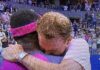
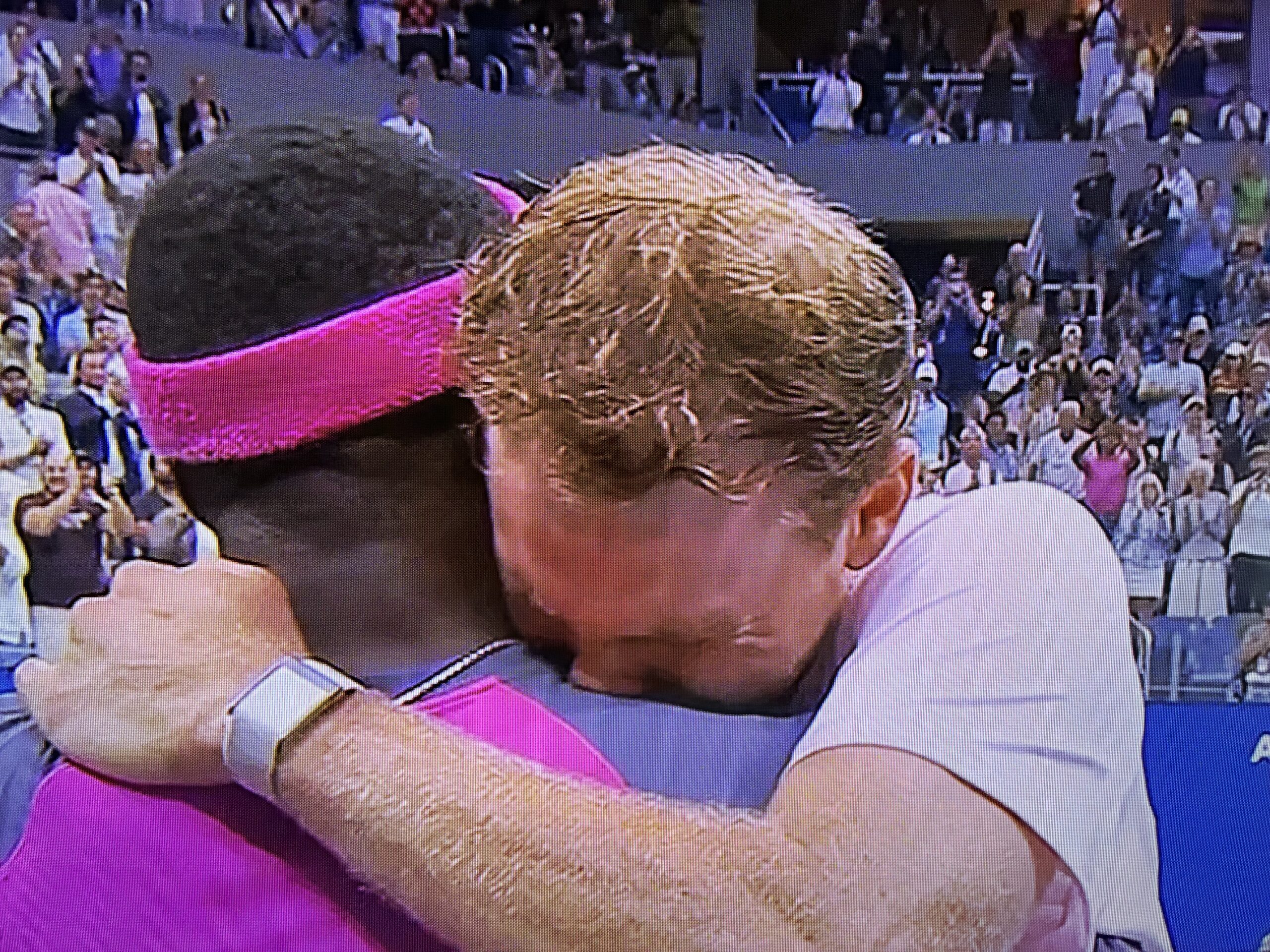
Then came the most indelible image of this year’s Open.
Tiafoe, one of the most beloved figures in tennis, went over and hugged his younger foe. For 21 unforgettable seconds, Michelsen’s chest heaved. Tears flowed. His sorrow was deep. An opportunity lost.
How could it not hurt?
After all, the Southern Californian, who’d shocked Brandon Nakashima in the second round, had been on his front foot, in command and seemingly en route to the most stunning victory of his career.
This was not supposed to happen.
Of late, in even-numbered years, Tiafoe had twice reached the US Open semis. He’d dismissed Daniil Medvedev with some ease on Louis Armstrong Stadium, where he’d run up a 10-0 record. He gushed that fans on Armstrong didn’t escape into the suites – that it was the people’s court.
One thought: If every match in tennis were played on Armstrong, Tiafoe would be No. 1 in the world.
But guess what? You can’t win the US Open on “Louie.”
And today, in a sleepy Ashe Stadium atmosphere, Tiafoe’s serve at first was shockingly subpar. Michelsen, who just in July had played a Challenger, took full advantage, hitting deep with his backhand, serving big and attacking Frances’ serve. He broke twice in the first set and marched to a 7-5, 6-3, 5-3 lead.
But, as Andy Roddick noted, “There is no way to talk sense into your nervous system.”
And the 6’ 6” 22-year-old, who is No. 46, played a terribly loose game. He double-faulted twice, lost the third set and then lost seven straight games as the now more aggressive Tiafoe counterattacked.
The Ashe crowd now surged, and so did Frances. He tapped his inner Pete Sampras and served like a demon, hitting monster aces when Michelsen had break points deep in the fifth, then unleashing fabulous forehands to capture the deciding match tiebreak, 10-7.
Michelsen had come so close. Victory was in his hands – until it all slipped away.
No wonder he wept in sorrow.
Frances told him, “You are going to be here so many times, man. And I’m going to be in a rocking chair when you do.”
WHO KNEW BONDS COULD BE SO FUNNY? Roger Federer and Rafa Nadal famously dissolved into howls of laughter while trying to tape a public-service announcement. Now Sam Querrey, John Isner and Steve Johnson nearly did the same thing during an overwritten ad read for Vanguard bonds on their superb Nothing Major podcast.As they tried to read the script, the three stumbled, bumbled and teetered on the edge of a gigglefest. Isner finally teased his old friend Querrey: “Sam was starting to talk in slow motion.”
EVERYONE’S GETTING INTO IT AT THE OPEN: The crowds are becoming part of the show at the Open. A staffer on a practice court led the chant, “When I say Coco, you say Gauff!” When a rowdy fan wouldn’t stop trash-talking during another match, the crowd started to chant, “Kick him out. Kick him out.” And when the deep-throated, much-celebrated umpire Kader Nouni called out “Deuce!” the Louis Armstrong crowd enthusiastically echoed him: “DEUCE!” Audience participation, US Open style.
WHO’DA THUNK IT? Alexander Zverev is in a commanding position in the top half of the men’s draw. Who would have predicted that No. 70 Botic van de Zandschulp, No. 50 Karen Khachanov and No. 34 Alexander Blockx would be there with him?
THREE-PEAT: In gritty three-set matches, Aryna Sabalenka downed Wimbledon champ Linda Noskova, and Jessica Pegula beat fellow American Emma Navarro. Now they’ll meet at the US Open for the third straight year. Sabalenka, who has a 9-4 record against Pegula, is seeking her third straight Open title. In their most recent meeting, in June on the grass in Berlin, Jessica prevailed, winning the last set 6-0.
GOULD’S ALL-STAR LINEUP: When writer Richard Osborn asked legendary coach Dick Gould what six players he would choose for an all-star, all-time Stanford line-up, he replied, “Johnny Mac’s not a bad start…He was an amazing team player…You could go with Roscoe Tanner or Sandy Mayer, and, of course, Gene Mayer. He got to No. 4…Then you fill in with guys like Tim Mayotte and David Wheaton, another Top Tenner.”
FRENCH FOLLIES: Arthur Fils arrived in New York fresh from winning Cincinnati and was picked by some to win the Open. Instead, Stefanos Tsitsipas bounced him out in the first round. Then France’s beloved icon Gael Monfils bowed out in his final Grand Slam. Finally, lucky loser Arthur Géa came within a point of becoming the first lucky loser ever to reach a men’s Grand Slam quarterfinal. He had a match point, and later served for the match, but Botic van de Zandschulp somehow escaped and won after five hours and 13 minutes. Sacré bleu!
JUST A RENTER: Zverev, the US Open’s midnight rider, was asked whether, after four straight wins on Arthur Ashe Stadium, he owned the place. He replied: “This isn’t my court at all. Federer won here 78 times. Sampras 112! I just rented it out from 11 PM to 2 AM for two weeks. And I hope they keep putting me on at the same time.”
THE LATE, LATE SHOW: British scribe Simon Cambers notes that play ended well after midnight on six of the US Open’s first seven nights. His most telling point: “I can’t think of another sport where fans are expected to pay top-dollar to attend and then don’t stick around for sometimes a big chunk of the action.” Players finish at 2 AM and may not get to bed until 5 or 6. Fans flee for home, while tournament workers and media endure marathon days – journalists covering all of Week One would have worked roughly 100 hours. Great drama is one thing. An endurance contest for everyone is another.
GO FIGURE: Six Americans – three men and three women – reached the US Open quarters, the most since eight did so in 2002. The three American men tie the most since 1995; the three women are the most since 2017.
CATCHING UP WITH COCO: Coco Gauff is the youngest American woman since Serena in 2003 to reach three Grand Slam quarterfinals in the same year. She also claims the last time she got tired was when she was 14.
And then there are the riddles. During a delightful ESPN interview, Malika Andrews asked about the riddles Coco’s been fielding at this year’s Open. Monday’s: “What is one thing that stays in a corner but travels all over the world?” Without hesitation, Andrews answered, “A stamp!” – then gleefully leapt for joy as if she’d won the lottery.
As for Coco’s childhood training philosophy, she was continually told, “If you’re not bleeding, you’re not trying.”
WHAT A DIFFERENCE A YEAR MAKES: John Craig of Newport Beach’s Performance Plus Tennis studied Coco’s rebuilt serve and found significant changes in her sequencing, rhythm and ball placement. Gauff herself says her toss is now more consistent and not as far in front, so she isn’t falling forward as much, and she’s curling her wrist less.
The payoff? Gauff hit just six double faults in her final three matches while winning Cincinnati – and only one in the final, against Jessica Pegula. Last year, Coco was hoping her serve would go in. Now she says she’s thinking ace. That’s quite a difference.
GEORGIA’S NO LONGER ON HIS MIND: Alex Michelsen’s parents, Sondra and Erik, both played college tennis, and Sondra hoped her son would follow suit. “I wanted him to go to college because it was so much fun,” she told USTA SoCal writer Steve Pratt. “Traveling and being with your teammates, and the football games and parties. It’s a good way to grow up a little, too.”
But the Aliso Viejo, Californian prospect simply got too good. Just ten days before leaving for the University of Georgia, Michelsen called legendary Bulldogs coach Manny Diaz with the news: Georgia was no longer on his mind. He was turning pro.
TALK TO ME ABOUT YOUR BEST STROKE IN FOUR WORDS OR LESS: Alex Michelsen said, “My backhand is pure.”
ONCE MORE WITH FEELING: Last year, Jeļena Ostapenko infamously told Taylor Townsend she had “no class, no education.” This year, the fiery Latvian was at it again. During a contentious doubles win with Taiwan’s Hsieh Su-wei over Australia’s Maya Joint and Taiwan’s Chan Hao-ching, Ostapenko complained that the opposing box was trash-talking and sarcastically cheering their mistakes in Chinese. When the match was over, Ostapenko twice turned toward the opposing box and roared in defiance, while longstanding tension between Hsieh and Chan added extra friction. Just another day at the Open.