


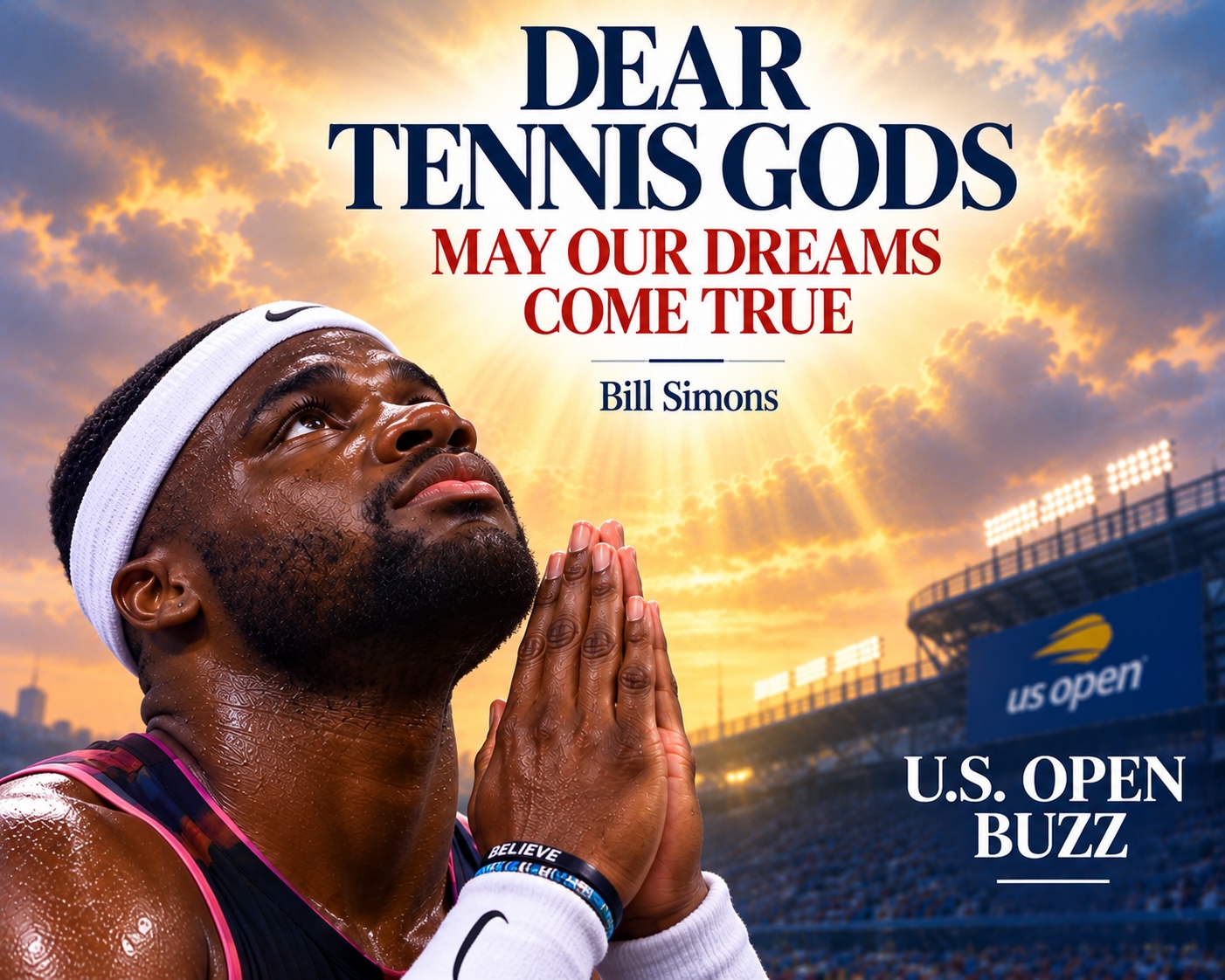
You could feel it. There was a buzz. This was going to be America’s year.
It was in the air. All summer, Americans had thrived. Taylor Fritz won Washington. Ben Shelton won in Canada. In Cincinnati, Coco Gauff triumphed, and Frances Tiafoe reached the final. Let’s go, guys. This is our year!
And in New York, Team America was balling. Early on, only Brandon Nakashima stumbled.
But then there was a speed bump. US Open organizers put a doubles match on Ashe Stadium to kick off the night session. Why not? It was the Williams sisters, whose combined age is 90, and whose combined charisma is off the charts.
They gained a seemingly comfortable 5-0 lead in the decisive tiebreak. But then collapsed. Patrick McEnroe suggested the loss didn’t really matter. It was just doubles. The Williamses hadn’t played in eons.
Fair enough. But don’t tell that to the heartbroken fans in Ashe.
Plus, it was an omen.
On Saturday, Amanda Anisimova, last year’s finalist and a significant long shot to win the title, fell without much of a fuss.
No worries. Taylor Fritz, for years the leader of the American pack and one of the favorites to win this year, was up two sets and a break against his friend Francisco Cerundolo.
Fritz was in cruise control. He’d been in fine form. He’d dropped only two games in the second round, and he’s a great closer.
But not so fast.
Errors kicked in. The Argentine, No. 25 in the world, raised his level and raced back, to down the grumbling Californian, 3-6, 4-6, 6-3, 6-4, 6-4. Fritz had entered the match 44-1 when leading by two sets.
In an oddly similar manner, Madison Keys, the 2025 Australian Open champion, was up 5-0 in the third set against Olympic champ Zheng Qinwen when her world imploded. She even had a match point. Zheng stormed back to win 1-6, 7-6(3), 7-5.
The heartbroken Madison, on the verge of tears, confided, “I just got really scared, like I couldn’t swing. Tennis just feels really hard right now.”
We’d seen this before. Both Fritz, and especially Madison, had reached US Open finals and then underperformed.
Of course, there are great advantages for players competing in their home Slams. You know the turf. The crowd rabidly backs you. Tiafoe gushed, “you get to play in front of your loved ones. It’s so fun.”
But it’s a double-edged sword.
Before playing Andy Murray in 2010, Roger Federer joked that it had been “150,000 years” since a Brit had won a Grand Slam.
As for Australia, an Aussie man hasn’t won the Happy Slam since Mark Edmondson in 1976. A Frenchman hasn’t won Roland Garros since Yannick Noah in 1983.
It’s called the Mauresmo effect. France’s Amélie Mauresmo reached No. 1 and won Wimbledon and the Australian Open. But at Roland Garros, too often she seemed to play like a soggy baguette. She tried everything. Lisa Dillman once joked, “What’s next? Amelie’s going to be channeling her inner Yannick Noah?”
The pressure players feel on home turf can be crushing. What American doesn’t want to win the Open?
For red, white and blue fans, things were getting a bit dicey. We knew there would be losses along the way. Still, yesterday we sent an urgent plea to the tennis gods: “We’re not panicking. We’re keeping the faith. There’s a long way to go. But please, don’t turn America’s dreamy US Open into a nightmare.”
Then Tommy Paul was punished by Carlos Alcaraz.
But things move fast in tennis. The tennis gods seemed to say, “Enough pain for you American fans.” So while Fritz had fallen to an Argentine, the 6′ 4″ Alex Michelsen, the No. 46 in the world, used his powerful backhand to sweep by Argentinian Thomas Martin Etcheverry 7-6(6), 6-4, 6-4. He hasn’t dropped a set en route to the semis and the only other Americans to do that in the past 30 years are Sampras, Agassi, Roddick and Fritz. Plus, Alex is the first unseeded American to reach the quarters since Gene Mayer in 1984.
Then Tiafoe, who had lost six of his previous seven matches against Daniil Medvedev, faced the Russian in raucous Louis Armstrong Stadium. There, the charismatic veteran with the big smile and dazzling athleticism maintained his fabulous level. He’d won eight of his last nine matches, and today, as fans and celebrities chanted loudly, he powered his way past the Russian, 7-6(1), 6-4, 7-6(6).
American glee again soared in NYC.
Big Foe will next call on his big momentum against Michelsen in the quarterfinals, so an American man will definitely get through to the semis.
And lest we forget, Jessica Pegula, Emma Navarro and Ben Shelton, who beat Stefanos Tsitsipas, advanced. And Americans Coco Gauff, Iva Jovic and Learner Tien are still in the draw. The US will have two women in the semis. Coco and Jovic are facing eachother and Pegula and Navarro will face-off.
Tien, the swift, steady 20-year-old master of the fifth set, outlasted No. 17 seed Jakub Mensik, 6-3, 1-6, 6-7(2), 6-3, 6-4 and will next face the Russian veteran Karen Khachanov.
THE PEOPLE’S COURT: Frances Tiafoe, who’s 10-0 on Louis Armstrong Stadium, was asked why he likes the arena. He replied, “It’s the People’s Court…There are no suites to hide in. Everyone is talking…[In Armstrong] people are actually watching tennis. And there are grounds passes for guys. It’s a cool court.”
GO FIGURE: Gauff has won 16 straight sets…Alexander Zverev is the only Top Ten player in the top half of the draw…Learner Tien is 5-0 in five-set matches. He previously was 0-4 at the Open. Now he’s a favorite to reach the semis…Zverev’s first three matches finished after 1 AM, and he’s spent over 11 hours on court, the most time by any men’s No. 1 seed en route to the Round of 16.
Osaka has seven career titles, four of them at Slams…In the third quarter of the women’s draw, there are five major winners and an Olympic medalist. In the men’s draw, there are only two players who’ve won majors, Alcaraz and Zverev.
QUOTEBOOK: Frances Tiafoe commented, “Nobody makes me eat my blood.” After a gutsy comeback win over Elise Mertens, Naomi Osaka admitted, “I’m literally shocked that I won. I’m not going to lie to you.”…After squandering a two-set lead for just the second time in his career, a despondent Taylor Fritz mused, “I don’t want to talk to anybody, see anybody…I don’t know how I let that happen.”
NIPPLEGATE: Often, when fans start talking about the Grand Slam drought suffered by American men, Andy Roddick is mentioned.
Years ago, before roofs were installed at the majors, whenever there was a rain delay, broadcasts invariably filled the gap by replaying Jimmy Connors’ epic win over poor Aaron Krickstein. Our hearts went out to Krickstein.
And when tennis suffers a wardrobe malfunction, some longtime fans still recall poor Linda Siegel, who in 1979 suffered an unfortunate one when she momentarily popped out of her low-cut dress.
This year, Carlos Alcaraz created a considerably lighter version of Nipplegate. In the first round, his loose-fitting sleeveless top repeatedly revealed more of his chest than intended.
So he began to wear an undershirt, explaining with characteristic simplicity: “I saw my nipple too much.”
THE FUTURE IS NOW: They have youth, they have charm, they have game – and bright potential.
Saturday night we may have seen the future of tennis, when for over three hours 20-year-old Filipina sensation Alex “I’m Already a Global Icon” Eala battled America’s brightest teen prospect since Amanda Anisimova, Iva Jovic.
Products of Spain’s Nadal Academy and the fabled Jack Kramer Club in Los Angeles, the two friends hit deep to the corners, moved beautifully and enthralled fans in what many considered the best match of the tourney.
When Jovic, 18, finally gutted out a 7-5, 3-6, 7-5 win, she fell to the ground, and her pal came over to give her a sweet hug. One sensed that around the world, people knew that, for years to come, this young duo will be great for the game.
After all, tennis knows how to renew itself.
Jovic, the youngest American to reach the fourth round of a Grand Slam three times in one season since Venus in 1998, will next play Coco.
COME ON NOW, SAVE OUR SOUL: Supportive comments continue to come in about our think piece on whether the soul of the US Open is in trouble. Reader Chuck Sanchelli put it this way: “Excellent analysis and a cautionary overview for the USTA to be aware so that tennis can continue to grow. The soul of what we love about tennis is critical to the game’s long-term life. It’s not just about growing more profits. Average players and youth across the U.S. need to have access to the great sport.”
AFTER MIDNIGHT: Rock sage Eric Clapton let us know, “After midnight, we’re gonna let it all hang out…We’re going to chug-a-lug and shout. We’re going to stimulate some action. We’re going to get some satisfaction. We’re going to find what it is all about.”
US Open fans have certainly been finding out what late-night tennis is all about. Thanks in large measure to marathon man Alexander Zverev, the US Open has endured a parade of after-midnight tennis.
Night Two ended at 12:26 AM. Night Three at 1:55 AM. Night Four offered relative mercy – 11:15 PM. Then came 2:15 AM on Night Five and 2:07 AM on Night Six, when Shelton beat Denis Shapovalov.
And then there was Venus. Her match with Sofia Kenin didn’t even start until 12:13 AM – the latest start for a women’s match in US Open history. Venus wasn’t amused: “It wasn’t great for either of us.”
The late finishes create an odd dynamic. Fans may pay huge prices to get in, but when things run really late, vast stadiums that had been packed become strangely empty.
There’s a structural problem. Put two matches in at 7 PM and you’re scheduling anywhere from five to eight sets. Matches can go quickly or stretch on forever.
There aren’t many easy solutions. You could start earlier than 7 PM but broadcasters like prime time. Fans have to get off work. And the Open doesn’t even open its evening session gates until 6.
Still, when 46-year-old Venus is being asked to start after midnight, something seems out of whack.
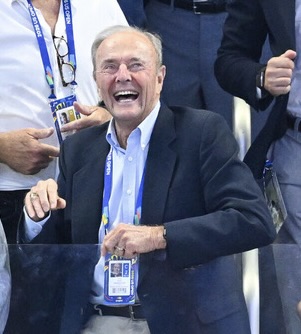
GOULD IS GOLDEN IN NEW YORK: Stanford may have been crushed by No. 7 Miami on their Palo Alto gridiron, but legendary Cardinal tennis coach Dick Gould crushed it during well-deserved ceremonies for him at the Open.
JUST 22, NO COLLEGE, NO PROBLEM: Poised and open, Coco Gauff doesn’t skip press conferences or dodge questions. She often smiles. Soft giggles are her thing. Her nuanced wisdom is often pitch-perfect. She gets us thinking.
And remember, she’s just 22.
But she handles probing questions with ease. What’s it like to be Black and traveling the world, when America’s standing abroad is wobbling? Tell us about your grandmother, a civil rights pioneer. What about transgender athletes competing in women’s sports?
When asked on Labor Day to salute workers who don’t always get recognized, Coco replied, “I’m grateful to all the working Americans who put a lot of effort in, just to make the world go round. Medical workers, first responders, teachers, educators. Special shout-out to all the US Open staff here…all the working Americans who make our country go around.”
Then she thanked fans for spending their “hard-earned money” to support tennis, especially women’s tennis, before saluting her grandmothers, aunt and mom – all teachers.
SAY IT ISN’T SO: In the second round, Madison Keys saved five match points and won. In the third round she had a match point and lost.
TWO TAKES ON TIEN: Learner Tien, the swift, steady 20-year-old master of the fifth set outlasted No. 17 seed Jakub Mensik, 6-3, 1-6, 6-7(2), 6-3, 6-4 and will next face the Russian veteran Karen Khachanov. John McEnroe said, “I can guarantee you Learner Tien is good at geometry.” Jim Courier said, “This kid may not be demonstrative, but his game speaks, and it speaks loudly.”













Thanks so much Bill; I loved your article.
Francis said that “grounds passes just for guys?”
The Eala/Jovic match was riveting.
And Coco doesn’t skip press, like Serena did?