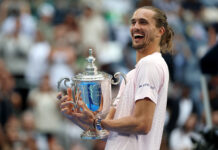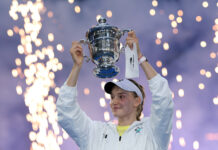


ALI AT ARMSTRONG: A sign at the Gael Monfils match read, “Float like a butterfly, sting like a Monfils.”
INTRODUCTION TO PANIC ATTACKS 101: Tennis does panic rather well. In 1986, USTA officials looked at the US Open singles finals and saw Ivan Lendl vs. Miloslav Mecir and Martina Navratilova vs. Helena Sukova—all four born in Czechoslovakia. Alarm bells rang. The next year the USTA formed a blue-ribbon Player Development committee, co-chaired by Arthur Ashe, charged with getting America back on top.
Then, in 1994, Sports Illustrated famously put a lonely tennis ball on its cover and asked, “Is Tennis Dying?”
It didn’t.
Now, 32 years later, the alarm has changed. US Open tickets have become stratospherically expensive, ordinary fans increasingly feel priced out, $23 Honey Deuces flow, corporate footprints seem to be everywhere and unvarnished critics complain that the People’s Open is becoming a playground for the hedge-fund crowd. Enter the New York Times, with its own ominous headline:
“The U.S. Open Can’t Go On Like This.”
Maybe this time the panic isn’t about whether tennis can survive. It’s about what kind of tennis – and whose US Open – will survive.
IS DANIIL MEDVEDEV A VILLAIN? After he won today, Daniil Medvedev was asked: If the US Open were a movie, would he rather play the hero or the villain?
“It’s super easy. For about 50% of the movie – [it would be the] kind of movie where you don’t know what the ending is and you try to guess who is the bad guy – I want to be the guy who you think, almost until the end, is the villain…
“Then, at the very last second, you understand that he was the best guy ever. He was actually amazing. And it was someone else who was the villain.
“That would be perfect.”
LA MONF’S COUNTRY: Gael Monfils hasn’t always pleased Americans. Back in 2009, when Andy Roddick encountered the young French showman in Paris, he barked, “You’re not that good to be that cocky!”
Then, at the 2013 US Open, the Louis Armstrong Stadium crowd astonishingly rooted for Monfils against America’s own John Isner. A miffed Isner later tweeted, “I miss the south. #godscountry.”
Tuesday night, Armstrong was once again Monfils’ country.
Sprinting, blasting jaw-dropping winners and unleashing leaping forehands that brought to mind both Pete Sampras’ airborne serve and the gravity-free Michael Jordan, the Frenchman captivated New York. At one point, after yet another outrageous flying forehand, the commentary booth simply proclaimed: “Hollywood tennis!”
This year’s Open hasn’t been respectful of its elders. Venus Williams, 46, couldn’t convert seven set points and was sent packing. The 39-year-old Djokovic looked every bit his age. And 41-year-old Stan Wawrinka was first snubbed, then unsnubbed, and then eliminated.
But Monfils, on his 40th birthday, turned back the clock. After dropping the first set, he overwhelmed Adolfo Daniel Vallejo 2-6, 6-1, 6-2, 6-0 to become the first man 40 or older to win a US Open match since Jimmy Connors in 1992.
Then Armstrong broke into a rousing rendition of “Happy Birthday.”
Maybe, after all these years, New York really is La Monf’s country. And by the way, Thursday night’s Monfils vs. Learner Tien should be eye candy.
LA DOLCE VITA AT THE US OPEN: Lorenzo Sonego’s operatic, almost epic five-set stand against Alexander Zverev brought it all back to mind: New York has always had an Italian heartbeat.
Fiorello La Guardia was its greatest mayor, Frank Sinatra gave the city its unofficial anthem, Little Italy remains one of Manhattan’s emblematic neighborhoods, and the Big Apple would be considerably less flavorful without Italian zest and pizza.
The US Open has had its Italian moments, too. Jannik Sinner won it in 2024. The most Italian of all the Italians, Fabio Fognini, with his pouts and struts, famously stunned Rafa Nadal at night. In 2015, Roberta Vinci shocked Serena to end her hopes for a calendar Grand Slam, then joked with me that her relative Leonardo da Vinci would give her advice for the all-Italian final against Flavia Pennetta.
But Rome may also have given us one of the Open’s greatest fans: Giovanni Bartocci, the tattooed Manhattan restaurateur and friend of Matteo Berrettini. During the fan-less 2020 Open, the prince of pizza stood outside the grounds, beyond the fences of Flushing Meadows, yelling encouragement – and even using a loudspeaker – so Berrettini could hear him inside.
That’s Italian passion, New York style.
TWO POINTS FROM CHAOS ZVEREV SURVIVES: If, as many people advocate, Grand Slam matches were best of three, Lorenzo Sonego would have taken down top seed Alexander Zverev last night, and this morning we’d all be proclaiming that the US Open was wide open.
Sinner’s on the sidelines. Djokovic vomited his way out of the tournament. A possibly rusty Alcaraz has just returned after four months away. And the door would be flung open for a group of title-starved American men.
But Grand Slam men’s matches are best of five.
And, if sporting victories were awarded based on moral virtue, Zverev’s record might look rather different. Yes, Sascha was not found guilty in either of the two cases involving allegations of domestic abuse by former partners. But he has never really publicly reckoned with what happened, opened up about it or offered the kind of accountability some hoped for. For many, clouds linger.
Then again, if sporting victories were based on ethical valor, quite possibly the German wouldn’t have Olympic gold, a Roland Garros crown – or had last night’s extraordinary escape.
And if tennis were like many other sports, where you could run out the clock, the US Open landscape would again look very different this morning.
But there is no clock in tennis.
So Sonego, who came within two points of victory, had to actually reach the finish line.
For nearly five hours, the stylish, appealing Italian seemed to be defying logic. He came in ranked No. 89 with an 11-14 record this year, had lost all six previous meetings with Zverev, and had never beaten a Top 10 player at a major.
Zverev, meanwhile, has been the most consistently successful player in tennis this year: an Australian Open semifinalist, the Roland Garros champion and Wimbledon finalist who is 19-2 in Slams this year.
Sonego, 31, has never cracked the Top 20 and has reached only one Grand Slam quarterfinal. Yet, with fearless shotmaking, wicked slices, anticipation, guile and a willingness to charge the net he seemed for long stretches to break Sascha’s rhythm – and perhaps his spirit.
At 5-4 in the fourth, Sonego came within two points of one of the great first-round shocks in recent Slam history. Had he finished it, he would have become the first man since Ivo Karlovic stunned top-seeded Lleyton Hewitt at Wimbledon in 2003 to knock the No. 1 seed out in the first round of a major.
But Sascha, eager to show New York that the deep scars from his 2020 US Open collapse had healed, didn’t blink. He served big, stayed remarkably calm, and took advantage when Sonego’s level finally dipped. Lorenzo’s three forehand errors and a double fault handed Sascha the decisive break in the fifth, and at 1:55 AM, after four hours and 53 minutes, Zverev finally prevailed 6-4, 3-6, 6-7(7), 7-5, 6-4.
Then, after somehow surviving the battle, Zverev seemed to issue an ominous warning to the rest of the field:
“Sometimes good things happen after you fight through one of these matches. So I’m hoping that will be the case for me.”
Stay tuned.
LOVE THY CONQUEROR: James Blake once reflected on the almost infuriating likability of Roger Federer: “You go out there, he beats the crap out of you, you come back in the locker room, and he’s just one of the guys.”
Now Andy Roddick has put it even more succinctly: “I love Roger as much as you can love anyone who has ruined your life.”
So, Federer proved to be a pretty talented guy. He beat everybody and then got them to love him afterward.
FROM SERENA TO RYBAKINA: At twelve, LA’s Thea Frondin played the young Serena Williams on screen in the 2021 film King Richard. Tuesday the 17-year-old lost to Elena Rybakina 6-3, 6-2.
BU WHO? No. 124, lucky loser Yunchaokete Bu, who hadn’t won any of his Grand Slam matches, shocked No. 12 Rafa Jodar 6-2, 6-1, 6-1.
NEW GAME IN TOWN: Fan week is no longer a pleasant pre-quel: It’s a significant sport happening unto itself. Over 300,000 fans turned up. Federer filled Ashe. A drone show filled the sky. Sky-high prices emptied pockets. A mayor stepped in. Serena returned. Wawrinka was snubbed, then un-snubbed. Novak and Aryna lost. Monfils and Svitolina gave us a fairy tale, and two Czechs, Muchova and Mensik, cashed a $1 million check after winning the jazzed-up mixed doubles.
THE COMA KID: In his opening round, Orange County native Sebastian Gorzny stunned world No. 38 Raphaël Collignon, saving five match points. But the University of Texas product lost today to Daniil Medvedev.
Not, however, before winning our hearts.
Gorzny told Tennis Channel that while playing the Kalamazoo juniors in 2019, he suffered a seizure at 2 AM and soon fell into a coma caused by meningitis, probably due to a mosquito bite. Doctors gave him just a 5% chance to live.
Somehow, Gorzny made his way back to full health – and eventually all the way to the US Open.
The ordeal, he said, changed his mindset: “It gave me a different perspective for being grateful for every day and every moment and making the most of it.”
AND IF WE MIGHT END ON A POETIC NOTE: Daniil Medvedev’s match against Gorzny had a strange little bird-on-the-net moment, when two birds briefly fluttered about.
Naturally, it brought to mind Leonard Cohen’s immortal “Bird on the Wire” – trying “in my way, to be free,” and that haunting tension between asking for too much and not asking for enough.
Curiously enough, Cohen himself had a couple of tennis connections. As a young man in Montreal, he wandered down to the tennis courts at Murray Hill Park after spotting a Spanish guitarist surrounded by girls. The Spaniard gave Cohen three lessons and taught him the flamenco chords that Cohen later said became the foundation of his music.
Decades later, when Cohen was studying to become a Zen monk at Mount Baldy, California, his master apparently decided that Leonard was already quite Zen enough. He sent him down the mountain to take tennis lessons at the Claremont Country Club. Cohen complied – until, he recalled, an automatic ball machine firing balls at him at about 90 mph rather frightened him off.