
Bill Simons
Years ago, Eleanor Preston posed the most consequential question of this tennis era: “Is it possible that Roger Federer is the most perfect tennis player — the most perfect man – in the history of everything, ever?”
“Of course!” almost everyone agreed.
But on Friday, at Roger’s Hall of Fame press conference, our core belief was shaken.
CBS’s Isabel Gonzalez brought up the topic of imposter syndrome – the sense that you aren’t worthy.
And the mighty Roger struck out. His expression was blank. He had no idea. So after all, perhaps our most revered sportsman ever was actually not the most perfect man ever.
But, not so fast. Years ago Lloyd Carrol claimed, “the aura of Federer is all over the Open.” This week, Roger’s aura was all over the game – and US Open singles play hadn’t even started. Not since 1991, when Jimmy Connors captivated us with his dazzling run to the US Open semis, had a player so thoroughly grabbed our attention for an entire week.
Newsflash: there was Fed practicing with Musetti. There he was, fielding questions from eight-year-olds, or explaining the glories of his beloved one-handed backhand. Tuesday night, when he played Andy Roddick, Ashe Stadium was packed as fans sought to get one last glimpse.
New Yorkers can be cynical. But forget about it. We saw nothing but giddy adoration. Everybody gushed. Drone shows over Manhattan celebrated the game’s great hero.
Then, in Newport, Rhode Island, we saw Roger, doe-eyed and appreciative, in a flawless beige outfit, touring the Hall of Fame Museum. He dazzled everyone at an upscale fundraiser in one of Newport’s many mansions.
Then – just to show us he still had it – in a doubles exo match, the 45-year-old unleashed a magical, gasp-inducing behind-the-back volley winner for the ages. John McEnroe was stunned: “You cannot be serious!”
Observers soon made comparisons: Djokovic may be the greatest ever, but Roger’s the most wonderful. Just a couple of years ago, Federer gave a great early-summer speech at Dartmouth. Now, could he deliver a great late-summer speech in nearby Newport?
And what of this year’s two inductees? Mary Carillo, a southpaw with plenty of snark, and the leading female broadcaster of all time, is a snappy product of New York. Roger, by contrast – a chill genius of ease and athletic grace – is simply Roger.
The internet couldn’t run enough highlights, and explained that the phrase, “the Roger Effect,” captures how Federer transcended traditional athletic stardom to fundamentally shape modern sports, culture, and global business.
Wordsmiths, too, searched for ways to explain his glory. Staccato steps, liquid movement, he bends time and sees the ball earlier, he answers questions others can’t even imagine.
Storytellers spoke of his Corinthian spirit and platonic truths. Here was the man who could not avoid beauty.
And he couldn’t avoid questions, either.
So, are you going to become a coach? No way.
What about doing TV commentary? Doubtful right now, but maybe some day.
Do you still love to play? “Absolutely, I love the shape of shots and the feel of the ball coming off my racket.”
Roger reflected on his skillful decision-making: “Once a decision was taken, I was free again to express myself…I felt like a winner.”
As for his emergence to become a global icon, he mused, “It’s good that you hit a little fuzzy ball. Its color is yellow. But actually it’s irrelevant, until all of a sudden you touch some people’s hearts, and you are able to change the world…at least for some people. So, little by little, you start to dream, and everything grows.”
One of the best signs in tennis history advised everyone, “Commit your sins when Federer is playing. Even God is watching.” And today, all of tennis was watching Roger’s induction. Federer predicted, “Time will stand still for a moment.”
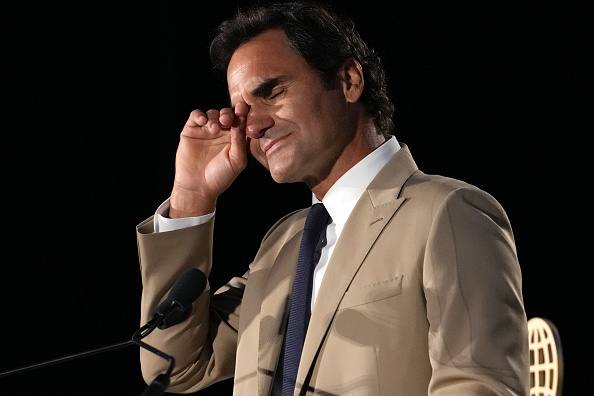
And, boy, did it. But at the podium we didn’t see the effortless athlete, the perfect tennis player we know so well. We didn’t see a man who amazed us with his elegant strokes.
We saw an elegant soul who knew and valued his journey. A man who knew his authentic self and wasn’t afraid to share.
We saw a nuanced, humble, vulnerable global icon.
And we were reminded: no one played the game with more beauty and no star weeps with more poignancy.
Roger gave us a gift. He let us in, as he recalled himself as the boy who took chalk and created a makeshift court by his Swiss house on Wasserhaus Way, the 13-year-old ball boy in Basel captivated by the pros. The kid with bleached blond hair and a fiery temper, the 18-year-old Sydney Olympian who almost medaled,and fell in love with a gorgeous older woman.
Today, in Newport, as dusk gave way to night, even the seagulls flew by to watch Federer as the still-funny-after-all-these-years star recalled how he pursued his girlfriend, who helped him warm up for matches, and how the humbled Andy Roddick complained, “I don’t believe I just lost to a guy who was warmed up by his girlfriend.”
Today it wasn’t hard for the Newport crowd to warm up to the festivities.
After all, Billie Jean King introduced inductee Mary Carillo. “She’s our storyteller,” said Billie. “She’s as persistent as she is curious, she has a house full of notebooks and has the remarkable ability to both string words together and let the action speak for itself. She’s knowledgeable and inspires.”
King recalled how Mary told her, “I’m responsible for everything that passes through these teeth.”
And when she took the stage, Carillo fcelebrated King’s great curiosity and kindness, adding, “She’s the most singular American I know – and I mean that in a good way.”
Few are better at telling tales than Carillo, and now she told a tale of a girl living by Great Neck Bay, who won a six-and-under fishing contest, and, as her prize, got an Alex Olmedo tennis racket.
Soon Mary’s parents didn’t have to worry where their kid was. She was at the Douglaston Club, where she eventually beat her father Tony and brushed up with history – a younger kid from her leafy town named Johnnie Mac who taught her, at a tender age, “how good I wasn’t.”
Still, Mary dreamed of having “a few innings in the big leagues, to walk through the gates of Wimbledon.”
But soon her knees betrayed her, and she began to work for cheap – $200 a shot. She wanted to be a journalist – to be accurate and fair, to have clear eyes and tell the hard truths. What a privilege it was just to have a credential.
Mary learned the tough way that there are hurdles. There were, as she might say, few broads in broadcasting and, “It was an occupational hazard to piss off people, especially your bosses.”
Sure Carillo spent some time in the penalty box. But she also soon gained many friends. Mary thanked Al Trautwig, Bud Collins, Pam Shriver, Fred Stolle, Nick Bollettieri and stats guru Leo Levin, to mention a few.
And she learned a few lessons. “Sometimes you tell stories. Sometimes you be quiet and sometimes [when things go off the tracks] you leave the country.”
Mary mused, “Matches get played, memories get made, stories get told, and laughs sure get laughed. And the years pass, and athletes know better than anyone that you can’t stop the tide. So enjoy the ride. I’ve been blessed to take mine with so many good people, and that is the best thing I can dream for anybody.”
Then again, in tennis, many feel Federer is the best player the game can imagine.
And soon his wife Mirka told us that as great and graceful a player as Roger was on court, what impressed her far more was the man who wanted his loved ones close to him – the kind, respectful man who wouldn’t travel if his family weren’t with him.
The great son, brother, husband and father treated everyone with “the same respect.”
Winning all his trophies was wonderful, but what was better was “who he was when no one was watching.”
Roger remembered watching pro tennis as a ball boy, with all its intensity and adversity. What he loved was the game’s sense of play. What he learned was that he couldn’t toss his rackets, that he had to control his temper, he had to balance fire and ice.
Over the years, he realized that tennis was a community, an ecosystem: the ball boys, the people who swept the lines, the fans.
His father told him to never moonball. No wonder Roger had an aggressive game. His hardworking mother did everything: lessons, coaches, preparing for matches. He recalled his heroes – Michael Jordan, Stefan Edberg and Boris Becker.
It’s said that those with game know game. And when Roger reflected on the beauty of Pete Sampras’ epic serve, tears again flowed, like Federer bending low to unleash his glorious crosscourt backhand.
The glory of Roger’s speech was the perfect man’s imperfection. As he teared up time and again, he went off script.
This wasn’t Agassi giving a flawless farewell speech in front of 23,500 at Ashe Stadium. This was a heartfelt outpouring in front of the tennis world that continually went off the rails.
Yes, he thanked his marvelous support team: coaches, trainers, bankers, sponsors. His entire team, especially Pierre Paganini, motivated him when he needed it, and protected him when things got rugged. His longtime agent, Tony Godsick, got him to think bigger and bolder.
But what he needed in the moment was different. “I need tissues and sunglasses and everything to protect me. And now we have the Mirka part [of my speech.] Oh, my god. This is such a mess. As you know, Mirka is my wife – duh…We’ll get through this – until the sun rises, guys.”
And we did.
Roger confided that Mirka taught him to “take joy in everything. We grabbed each other’s hands and went through walls.”
All the while, Roger tried to stay true to himself, show his love for the game and be worthy of his fans. “Everywhere I went, I felt I had the home field advantage. I wanted people to feel how great it was to have a ball being hit hard at you – the way it sounds, the way it spins, how geometry shifts, and how the court opens or closes. Tennis is spectacular to watch. It is a game of emotions that has meant the world to me.”
Roger then honored the many generations of the game, and pleaded that tennis today keeps some of its amateur spirit. “I hope players will always stay young at heart. Remember to never stop asking questions and taking risks. Do things with the game we have never seen before, and keep pushing the game forward…and find ways to give back your passion.”
Then he concluded, saying that wherever tennis is played, from Slovakia to India, in bitter cold or the blazing sun, “This boy from Basel thanks you for the honor.”
And today, tennis thanked its most imperfect, perfect man.