
Bill Simons
Tennis tournaments have stages; they evolve. Take the US Open, whose modern soul was forged by three unlikely visionaries born in the American South – Althea Gibson, Arthur Ashe, and a cigar chomping Louisiana oil wildcatter named Slew Hester.
Long before Hester looked down from an airplane and envisioned moving the Open to Flushing Meadows, the tournament had a cozy home at a classy club with Tudor buildings and gentle conversation: Forest Hills. It was a pleasant event on the end-of-summer calendar that quietly fit in without making much of a fuss.
Then came the transformation.
Soon Hester was lobbying New York City bosses and navigating the curious world of New York construction to build, in a flash, an entirely new site for the 1978 U.S. Open.
Everything changed.
Noise. Crowds. Razzle-dazzle. Night tennis. Unhinged battles that almost turned into riots. Long-haired, short-tempered superstars. We saw them in discos and they offered us drop shots and f-bombs: Ilie Nastase, Bjorn Borg, John McEnroe, Vitas Gerulaitis, Jimmy Connors, Chrissie and Martina.
We were bathed in a parade of icons. “If you can make it here, you can make it anywhere.”
Then came a magical marathon.
In 1984, Stan Smith and John Newcombe, Pat Cash and Ivan Lendl, Evert and Navratilova, and finally McEnroe and Connors, battled deep into the night on what was soon dubbed the greatest single day in tennis history: Super Saturday.
And then James Scott Connors poured gas on the fire.
Over the hill? “Forget about it, buddy!”
In 1991, at age 39, the game’s great showman danced, pranced, screamed and battled his way to the semifinals.
Filled with grievances, the crotch-clutching, gutter-mouthed sniper defied logic.
The New York Times noted, “The defending guardian of the tennis theater of the absurd, a beacon for all past-their-prime-time players…used mirrors, night magic, and his incredibly mean two-handed backhand to cut a defiant swath to the semifinals.” Suddenly tennis was no longer relegated to the back pages of sports sections.
Single-handedly, “the Brash Basher of Belleville” transformed the Open into a must-see happening. Everyone wanted in.
The Open became a celebrity magnet.
You just might spot a president or a princess, JFK Jr., Aretha, a Beatle or a Tiger. Trump, Tutu, and Hollywood royalty and influencers mingled.
Now the Open was a place to be seen.
And there would be plenty of other chapters.
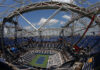
Louis Armstrong Stadium would lose its place as the tournament’s centerpiece when a new gleaming tennis palace opened its gates. First they called the place the USTA Stadium. But, after an uproar, it got its proper name – Arthur Ashe Stadium.
The place so enormous that Filip Bondy claimed that from the upper tier you were closer to Russia’s Soyuz satellite than the action. “Watching from Section 314,” he claimed, “made Marat Safin and Nicolas Kiefer look something like waltzing microbes.”
But the world’s biggest tennis stadium soon became beloved. “This place is so great,” a security guard told me. “Why don’t they play Wimbledon here every year?”
The Open had a stage equal to its ambitions. The Williams sisters made history there. In 2001, Venus and Serena commanded the stage in prime-time. Andre Agassi and James Blake played their epic 2005 quarterfinal deep into a New York night.
In 2018, Serena’s final against Naomi Osaka descended into a dysfunctional misadventure of accusations and anger that drew worldwide attention. At the Open, dysfunction often became compelling theater.
Few sporting events had a more compelling cast of characters: Becker and Edberg, Sampras and Agassi, the Big 3, the Williamses and Coco come to mind.
Quaint old stadiums with quirky traits, like the original Grandstand, bit the dust. A lovely new Grandstand took its place. The new Louis Armstrong stadium didn’t have a lousy seat. Astounding roofs allowed to play to continue. There were new indoor facilities, a stately statue of pioneer Gibson, and one of Ashe that had no clothes.
But the Open had plenty of pizzazz.
And then there was Arlen Kantarian. An unabashed Big Apple showman, he understood that the Open’s tennis wasn’t enough. There had to be music, celebrities, lights, food, and a pulsing, “Never let ‘em rest” spectacle.
The Open became a happening.
You sensed the sizzle of celebrities. You could smell the money. But of late you came to realize the toll the years had taken on the place.
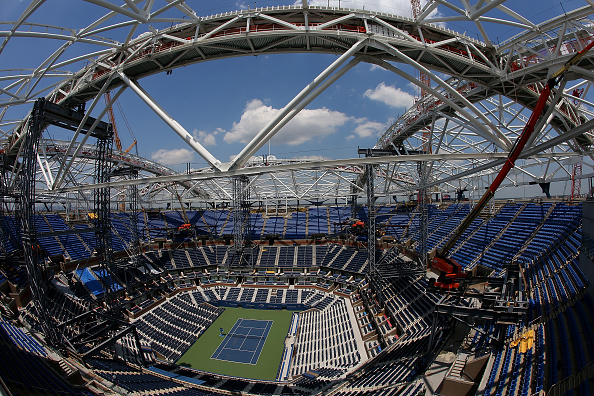
Walk through the cavernous corridors beneath the original Ashe bowl and you see mounds of mysterious mold. Get to your seat in the press section and it might be half broken. The grandest tennis stadium in the world was showing its age.
At the same time, players were pushing hard for a greater share of the game’s riches. Officials craved to further monetize their glorious asset. This is America, baby – follow the money. Hospitality, food services and premium seating promised riches.
But the place had to be overhauled.
Ashe originally cost $263 million. Enter now a $800-million, three-year transformation of the Billie Jean King National Tennis Center and Ashe – the largest single investment in US Open history.
The USTA is quick to point out that it’s paying for the project itself, without taxpayer or government money, and says the Open generates more than $1.2 billion in annual economic impact for New York.
Fair enough.
The New Lou and Grandstand provide convincing evidence that investment in the grounds makes the experience much better.
But follow the seats.
About 3,500 seats are being removed from Ashe’s upper reaches, while the courtside bowl gains 2,000 premium seats. Two dedicated levels of luxury suites are being added. Nine elite hospitality clubs are coming. There will be expanded restaurants, premium dining and huge bars.
The US Open calls its new hospitality program “US Open Premier.” Its promotional material promises luxurious suites, premium clubs, new vistas and innovative courtside experiences.
Welcome to the Premium Open – a tennis tournament morphing into an entertainment palooza. “Pass me my Honey Deuce. This is people watching on steroids.”
Decades ago, the late comedian Alan King joked that you had to mortgage your house just to pay for a parking spot near Forest Hills. These days, you only have to fork over your entire estate just to get a peek at the action. The place should have a medical tent just to treat the sticker shock.
We joke (and grumble). But consider the humble grounds pass.
For years, it was one of the great bargains in sports. You could roam the grounds and watch world-class tennis from a few feet away.
These days, on Ticketmaster’s official resale marketplace, grounds passes go for as much as $363.
Seats in the upper reaches cost hundreds. A $100 seat for the Federer celebration landed up going for $1000 or so.
Want to get courtside during the main draw? Think in the thousands. How about a decent seat for the final? $21,000 – thank you very much. Then again, why not a luxury suite for your pals for the tourney? How about a million bucks, give or take? “But what the heck – write it off. We had a robust quarter.”
The USTA makes no secret of another fact: single-session tickets are subject to dynamic pricing. Like airline seats or hotel rooms, prices move with demand. While other Slams ban or limit resale markets, here the market soars and restrictions face serious obstacles, especially in New York. But the USTA, which does profit from ticket resales, could take steps to limit predatory reselling and bulk buying. Ticketmaster, the US Open’s partner, managed to get a surprise sweetheart deal in March from the Department of Justice.
Originally a suit sought to break up Ticketmaster. Instead, they got a slap on the wrist. Now, many states have joined in another effort to break up the ticket giant.
All the while the Big Apple popularity of the Open continues to grow.
In 2024, the Open passed one million attendees for the first time: 1,048,669 people over its three weeks. In 2025, it did it again – and topped the record: 1,144,562.
The market is talking – and so is the USTA.
Defending the spike in prices, they note that people are buying the tickets, and the Open is the USTA’s economic engine. TV, sponsorships, ticket sales, concessions and hospitality generate the money that helps fund tennis programs across America, they’re quick to note.
The USTA’s mission is admirably expansive: “Growing tennis to inspire healthier people and communities everywhere.” Its public filings go further. Among the purposes of the Open, the organization says, is “to promote the game of tennis to the general public.”
That’s where things get interesting.
Because the USTA isn’t Madison Square Garden or the Yankees. It isn’t a private entertainment conglomerate whose sole purpose is to maximize the yield from every square foot of its property.
It is the national governing body of American tennis.
So what happens when the mission to bring tennis to the public collides with the opportunity to extract extraordinary sums from the most valuable tennis property in America?
Who wins? And who gets the good seats?
But there’s another side to this story – and it’s a pretty good one.
Fan Week remains free – and it’s packed to the gills.
And, in just two years, the reimagined mixed doubles championship has become an extraordinary, creative add-on. The revamped event has produced sellouts in Ashe, while thousands more watched for free in Armstrong.
This year? How about Serena and Carlos on the same side of the net and Djokovic and Sabalenka side by side?
So, give the USTA credit.
You could say that the modern US Open is becoming more democratic on its fringes and more exclusive at its center. Where the game has plenty of sizzle, but relatively little is at stake, come on in. Where championships are decided and history is made, contact your offshore manager.
The contradiction is architectural.
Outside Arthur Ashe Stadium, the USTA gives us accessibility, inclusion, and the noisy, democratic joy of public tennis. Inside, those ideals are being re-engineered: thousands of cheap seats high in the upper deck are disappearing to make room for lower-tier luxury suites, exclusive lounges, and pricey courtside perches.
Maybe that’s simply modern sports – America’s twenty-first entertainment machine. Maybe the USTA would be foolish not to capitalize on overwhelming demand. The market is speaking. Many are willing to pay these prices. People are voting with their feet and their pocket books. Why shouldn’t tennis collect the money, rather than leave it on the table?
And if those dollars ultimately build courts, train coaches, support community programs and put rackets into kids hands, there’s a powerful argument that the Premium Open actually helps finance the People’s Game.
But there is another question.
At what point does monetizing demand begin to change the character of the event itself?
For years, the US Open took pride in being different.
Wimbledon had its traditions and its royal box. Roland Garros had Parisian style. The Australian Open was the Happy Slam. New York had the People’s Open.
It was loud. Messy. Democratic. More than crazed.
You took the 7 train. You wandered the grounds. You sweated. You shouted. You watched tennis beyond midnight with well-lubricated strangers. The whole thing had an edgy New York energy.
Hedge fund managers should have great fun – yes. Yet, increasingly, the US Open is speaking a different language.
Premium
Premier
Courtside bunker suites
Elevated global concessions
Rotating chef stations
Multi-course plated dining
And let’s not forget next year’s four-story, $250 million Player Performance Center that will provide spa-like experiences.
I recently reached out to Craig Tiley, the USTA’s new CEO, whom I’ve known for years from his long tenure running Australian tennis. I wanted to ask him a simple question:
“The US Open was long celebrated as the People’s Open. As you dramatically expand courtside seating, luxury suites and premium hospitality, how do you make sure it remains the People’s Open?”
So far, I’ve received no response. Perhaps I will – but the question isn’t going away.
After all, the US Open has lived many lives. There was the genteel Forest Hills Open. There was the barrier-breaking Open of Gibson and Ashe. There was Slew Hester’s rambunctious public playground in Flushing Meadows.
There was the McEnroe-Connors-Nastase circus, Super Saturday and Connors’ astonishing 1991 romp. There was the celebrity Open, the entertainment Open and the million-fan Open. And the Federer celebration that packed Ashe Stadium was astounding.
So now we’re entering another, perhaps perplexing, stage. Quite possibly, the US Open could prove to be grander. Sleeker, richer, more comfortable. More spectacular.
There will be fabulous suites, better restaurants, huge more liquid bars, inviting vistas and splendid seats for those who can afford them.
And hopefully the surging revenues it produces will grow tennis – from Harlem to Hawaii.
But, as the old People’s Open races headlong into the age of the Premium Open, one rather basic question lingers:
Just who are the people it’s for?