
Inspired documentarian Jason Hehir explores the defiance, darkness, tenderness, and astonishing drive of Novak Djokovic
Bill Simons
It was a joke – but it wasn’t.
When my sister asked me why, as a young man, I’d left the East – with its tight streets, biting winters and tangled history – for the West, with its open spaces, inviting breezes, and hopeful future, I replied, “Because I wanted to howl to the wind.”
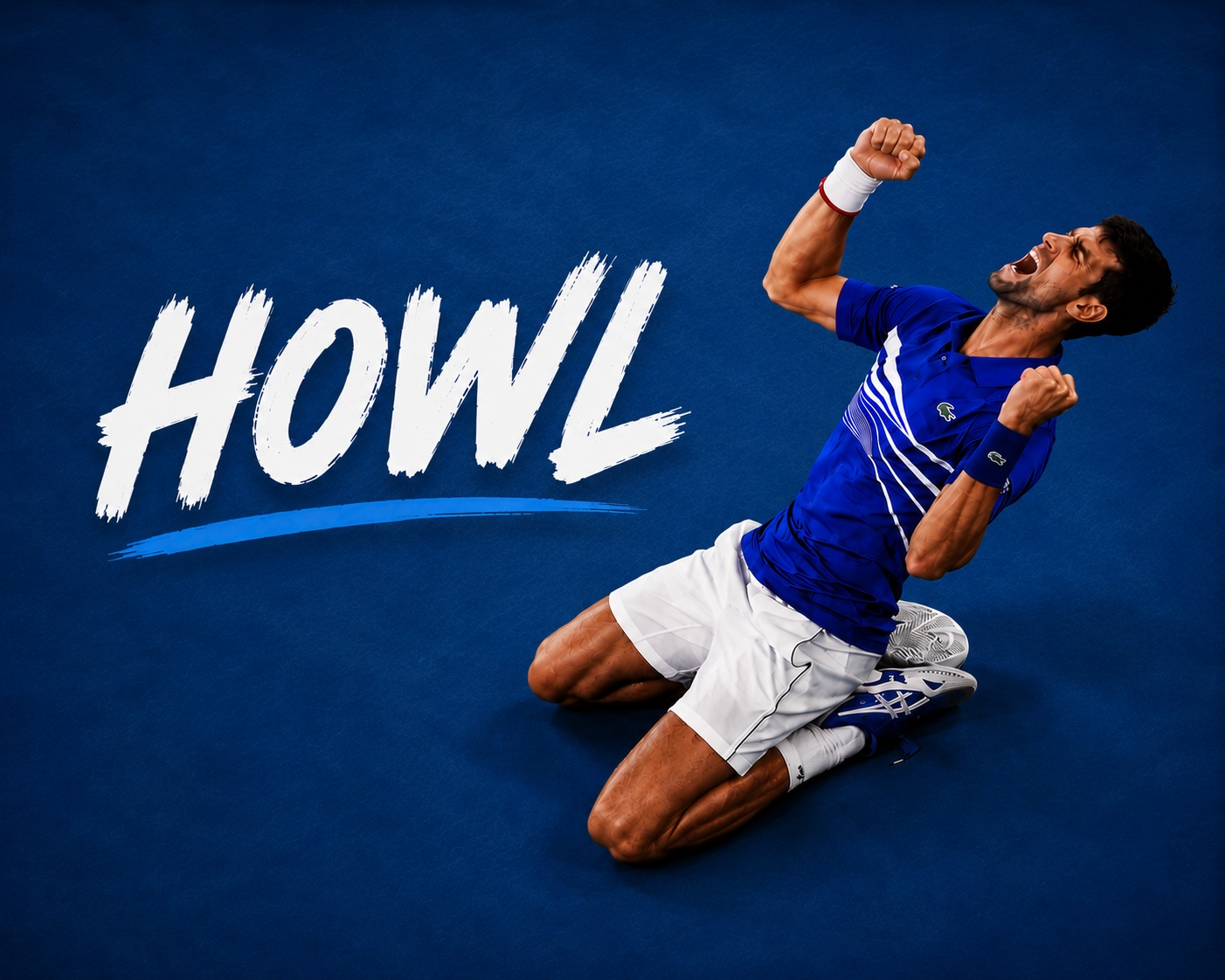
Early in Jason Hehir’s compelling documentary, Novak Djokovic: The Wolf in Winter, we see the Serb on a mountain slope howling free – an astounding moment that’s unburdened, defiant, gleeful, and wild.
Maybe Roger Federer once let it all out in the Alps. Perhaps Rafa had glorious moments of existential joy on his boat at sea. But it’s not easy to imagine.
As the film gets going, we’re told, “The wolf is a symbol of fearlessness and spiritual connection in Balkan culture.” No elite tennis star has been as wide-ranging a seeker as Nole.
Yes, from the outset, Novak was raw and fierce – a brash disrupter, an ambitious, restless talent who lived by his own code. Deep into his tumultuous career, he told us: “It’s true wisdom to know how to let go, to liberate yourself – because there’s no stronger feeling in life than freedom.”
Yet feeling free on international stages brings its own challenges. Novak, who likes to hug Melbourne trees and climb French mountains, was detained in Australia and once booted out of the US Open. He’s a wolf with plenty of scar tissue.
His wife Jelena tells us he’s a gentle, joyful soul – yet he harbors plenty of anger. Andre Agassi goes further, noting that Novak wants to be kind, caring, open, and receptive, but, to win, he can’t let his heart go there. Andre recalled, “I was surprised how dark Novak had to feel to get the most out of himself. For him to do his job, he needed fear or anger because with love or appreciation, he lost his fangs.”
Long ago, young Novak was pictured as a panther pouncing from every corner of the court. Then he became a python. As Andy Roddick put it, “First he takes your legs. Then he takes your soul.” Now, while most consider him the GOAT, many picture the battle-tested Serb as a noble lion in winter.
As soon as I heard of Hehir’s documentary, Novak Djokovic: The Wolf in Winter – airing on Prime Video August 20 – I knew I wanted to speak with the filmmaker. After all, tennis, with its vivid characters, lends itself to cinema – think of Nadal, Evert, and Navratilova, feature films like King Richard and The Battle of the Sexes, and Netflix’s Break Point.
Hehir is a prize-winning storyteller who specializes in psychological deep dives and portraits of iconic figures like Elvis and Andre the Giant. His ten-part masterpiece, The Last Dance, about Michael Jordan and the Chicago Bulls, stands as the definitive sports documentary of our era.
Here’s our conversation.
BILL SIMONS: I have to tell you that my greatest journalistic triumph over my 500 years – well, make that 48 years – of tennis journalism came when I interviewed Michael Jordan in New York, and got him to reveal that he’d taken an Introduction to Tennis course at the University of North Carolina. So that was my great scoop. Imagine the impact he might have had on American tennis if somehow he’d become a pro.
JASON HEHIR: Imagine the serve he’d have if he just had the right mechanics. Broadcaster Ahmad Rashad tells great stories about how he couldn’t play tennis with Jordan any more because Michael was literally hopping over the net and tackling people. He was just physically too intense.
SIMONS: Anyway, let me ask my first question. Let’s say your days have all come and gone and you’re up in heaven shooting the bull with St. Peter. He says, “Look, Jason, I’m a big tennis fan, but I’m trying to figure out just who this guy Novak Djokovic is. What’s the essence of the guy?”
HEHIR: Is St. Peter making a decision?
SIMONS: Oh, you’re in, Jason – no worries – you’re in!
HEHIR: He’ll open the gates? But what about Novak? But seriously, I’d say first, if you want to start to understand somebody, then observe the respect with which they treat others, strangers and loved ones alike. And, in particular, how younger and older people respond to them, and how they respond to younger and older people.
One of the things I was struck by early in my dealings with Novak was the affection he had for his kids and the affection his kids had for him. It was unshakeable. My favorite shot in the entire film is the one where his young daughter Tara comes over and sits on his lap and puts a hat on his head, and he kind of plays along with her.
It was at the first Novak practice we ever filmed and she came up from the beach in Montenegro in flip-flops. She just needed to see her daddy before she went to take a nap. So hopped up on his lap and had this moment with him that only four, five or six years of affection and bonding can recreate.
So I admired him as a dad right away. And I also admire his relationship with his wife. They are best friends, and ceaseless, fierce supporters of each other.
I came to know him in a different way. I had my doubts going in about how easy it was going to be to work with him, because of his reputation. But he was a curious and enthusiastic participant in the entire making of the doc. Sometimes too much, because he wanted us to shoot too many things.
SIMONS: Well, that’s Novak. I’ve interviewed virtually all the stars in tennis, going back to Helen Wills Moody and Don Budge, and from Connors and McEnroe to Serena and Coco. And there’s nothing quite like locking eye-to-eye with Novak on a significant question. How did you find that?
HEHIR: What I’ve noticed about all the greats I’ve dealt with is that they treat each of their interactions as a competition. Novak doesn’t have to win the conversation, but he’s going to get something out of it. He’s always going to walk away with something – it’s never for nothing.
Everything has a purpose: his stretching routine, his meditation, his diet, his interview, even a car ride where we put a camera in the back seat. If a fan approaches him for an autograph, that has a purpose. When he saw a fan who had painted a picture of him, he got out of the car and took a photo with her. Everything is intentional.
SIMONS: You did a film on the aging Elvis, you did the Michael-centric Last Dance, and now The Wolf in Winter explores the aging Novak. You could say that the theme in each of these is the lion in winter – the titan in the twilight who’s trying to draw on his reserves, his heart. Is there a certain tragic beauty to that?
HEHIR: As Howard Bryant said in the doc, my favorite phase of an athlete is the lion in winter. There are many stages across an athlete’s, artist’s or entertainer’s career that are fascinating, but the lion in winter is particularly striking. Once someone has achieved everything there is to achieve, they become an underdog again.
It’s fascinating to see what they have learned during their rise up to get to that point. Once they’re coming down, they have a wealth of experience, and maybe their body is betraying them in ways that are unavoidable. But they have learned so much during their journey, so they can draw on that.
And in Michael Jordan’s case – and you could argue in Elvis’s case – they were better at what they did in the latter stages of their careers. Michael considers himself a more complete player in 1998 than he was in 1992, when he could seemingly do anything on court. He wasn’t going to win a dunk contest then. But in 1992, he wasn’t going to back you down and hit a 15-foot turnaround the way that he could on command in ‘98. And the same with Novak now.
SIMONS: Years ago, in Australia, Novak was talking about the wolf metaphor and told me, “The wolf who’s going up the hill is always hungrier.” And now, even though he’s considered to be the GOAT, in so many key matches, you sense he’s hungrier than his much younger foes.
HEHIR: Not to invoke Michael too much, but I remember asking him what he missed the most, and I barely got the question out of my mouth before he said, “Proving people wrong.”
It seems so unnecessary for him to feel that he has to prove anybody wrong – because no one is doubting him. And Novak is the same. The way these guys are wired is a blessing and a curse. They are cursed, just because that’s a tough way to go through life, being so cynical that you think everybody doubts you. But you wouldn’t be where you are if you didn’t have that switch inside of you. And not all of us have it, because in a Darwinian sense, we would have died off a long time ago – it’s too much stress to live under. This is what drives these guys to be great.
SIMONS: I was at that Wimbledon match where he turned to the very proper crowd and said, “And to all those people who have chosen to disrespect me, I say, ‘Gooood night!’” Well, there was only a guy or two or three in the stands. Don’t both Novak and Michael use disses or perceived disses to fuel themselves?
HEHIR: They make it up. They will pretend that somebody in the stands has said something, and convince themselves that that person believes that. His team and his coaches told us that they had to tell Novak, “Stop yelling at that guy in the stands. He’s booing against the other guy and cheering for you. You caught him out of context.” Novak doesn’t want to hear that, because once he latches onto you, he doesn’t care about the validity.
SIMONS: And he says the truth out loud: “I’m here to prove you wrong and to prove me wrong. The number one doubter is me. I’m trying to prove myself wrong more than anybody else.”
Let’s go back and talk about Michael and Novak. To many, Jordan is the GOAT of team sports and Djokovic is the GOAT of individual sports. What do they have in common?
HEHIR: There are two commonalities.
One is living in the moment and their presence of mind – they would go back and talk about the past only if you could dig it out of them, and they were extremely reluctant to talk about the future in terms of the next month or year, or even what their schedule is tomorrow.
They are preternaturally focused on the now. That’s a talent and a gift that eclipses all their athletic gifts – the ability to be in the present.
When you’re down by three points to the Utah Jazz with possibly 90 seconds left in your career, or if you’re down 40-15, 5-3 in the fifth set at the US Open and Federer is serving at you, you cannot think about what happens after this possession or after this point. You have to think about just right now. Because if you think about two points from now, you’re done.
Both of their philosophies are, “Why would I think of that? I can’t control that. Why would I think of anything that’s going to happen after this? Right now, I can control.” That’s a gift that they both have.
And then the other one is that they live in a constant state of competition. It’s playful, but it sounds like it’s laborious to be around. I’m sure for those closest to them, they get sick of it after a while.
Whether it was Sudoku, a word game or trivia, Michael was always competing. The first time we spent time together, we were on a half-hour car ride and he called out to the people in our SUV, “I bet we see 10 pairs of Jordans on the way to the arena.” It was just a game to play.
And with Novak, after the first practice we filmed, they started playing this game where whoever rolled the ball closest to the baseline wins. He invited all of us to play. If you lost, you had to run sprints.
SIMONS: Yeah, after an intense Wimbledon practice, I saw him play bocce ball with his team, and there were laughs all around.
HEHIR: Exactly. So when they’re done with the main competition part of the day, they still need one more game, one more contest. That’s how these guys communicate – through competition.
SIMONS: It’s amazing how Novak stays in the moment. Yet, he’s such a different man now from that 12-year-old boy who was shipped off to a German tennis factory, then tried to insert himself into the Roger and Rafa buddy flick, then sought inner wisdom with a Spanish guru, made his golden Olympic run, and now is a dad and an almost ancient icon. So many different chapters.
HEHIR: He’s honed it. He’s been sanding this block of wood for his entire career. Now he’s in a position where, ironically, he can be a much better dad than he would have been 10 years ago.
So the timing works well. And I don’t think he’s going to stop playing anytime soon. He’s going to have to have some sort of injury that disables him in order to stop. Because until they can prove that on any given day he can’t beat Sinner or Alcaraz, if he loves the sport, why would he stop?
SIMONS: One of the intriguing things in the documentary was Agassi saying Novak wanted to love and to care, but he has so much anger and ferocity. So he needed fear or anger, because “with love or appreciation, he lost his fangs.”
HEHIR: There was his match against Daniil Medvedev at the 2021 US Open, when Novak needed the title to win all the Slams that year. He got a roaring ovation when he came out, and then got smoked. That’s not to say he can’t win if he’s beloved, because crowds now are actually pro-Novak for the most part.
I know that he said he has to go to dark places to win. That I do believe. I think he has to bring his mind to a place where he feels like he’s playing the entire arena. It’s no longer fun or challenging for him just to play one person. He needs to taunt people. He needs to take people out. I think the maverick in him loves that—finding someone who doubts him and then dedicating the rest of the match to proving that guy wrong.
SIMONS: In your documentary, Howard Bryant notes he’s never seen such a “negative quotient” around a superstar as he has with Novak. Usually, toward the end of a career, fans lean in and support aging legends, but less so with him. We’ve seen great athletes – like Wilt Chamberlain, Martina Navratilova, or Tim Duncan – struggle at times to get that warm adulation.
Your film features that incredible scene in Melbourne where Novak gets booed off the court after having to retire due to an injury. He has fed off of hostile crowds his whole career, but he still hasn’t received the kind of deep embrace that Roger and Rafa enjoyed. What about that dynamic?
HEHIR: I think there are two different notions here. One is not getting the embrace. I do think if he were to win now – when he’s down in matches or deep into a tournament – he actually has most of the crowd on his side, simply because he’s so undeniable.
I use the analogy of Tom Brady, Tiger Woods, or – as a Red Sox fan – Derek Jeter getting a standing ovation when he walked off the field at Fenway. There’s a point in an athlete’s career where their greatness is so sustained that you can only tip your cap.
Fans start to see them as this lion in winter rather than part of the “evil empire,” in Jeter’s case. If Novak wins, he’s just as embraced as Rafa and Roger in the moment.
On the flip side, I don’t think Roger or Rafa would have been booed off the court late in their careers if they retired due to injury in the semifinals of a major. It just wouldn’t have happened. It’s almost like Novak has cultivated this personality where some fans think, “He can take it. He actually likes this – ‘Boo!’”
My goal is to show the human side of the subject. I hope that when viewers watch this, they know enough about Novak that when they hear those boos – whether they like Novak or not – they look at it from his perspective: what that felt like walking off the court injured, having just beaten Alcaraz in the previous round, where he’d almost had to pull out.
I hope people understand that frustration, because it gives them a better appreciation of his greatness. I’m not trying to change people’s minds. I’m not trying to make people like him. My responsibility is just to give people a better understanding of Novak.
SIMONS: To me, Djokovic is a singular athlete, a singular man. I mean, no offense, but I couldn’t imagine Roger Federer going up in the Alps and howling, or Rafa on his boat in the Mediterranean just letting it all hang out.
HEHIR: I haven’t spent time with those guys, so I don’t know. I do know that Novak’s howl was unplanned and unexpected. One of our production assistants had biked up to the top of that mountain for training. And Novak was up there taking a drink of water, and his wife was with him, and he hugged her and took a picture.
And then he just let out that howl. Our PA was around the corner stopping traffic so no one would drive through our shot, so she couldn’t see what was going on. She thought an actual wolf was over there! She didn’t know if a wolf was coming for her or what. She was by herself at the top of a mountain in Montenegro, wondering if this was the last assignment she was going to have.
And then – I love this – we included a second howl that Novak did, and right after he does that fierce, primal howl, he looks at the camera and gives this…
SIMONS: Sheepish.
HEHIR: Yes, this kind of sheepish, aw-shucks grin. To me, that’s Novak right there. That’s the two sides of that guy within three seconds.
SIMONS: His wife, Jelena, says he’s so gentle and vulnerable, and yet he has anger – and that’s the intriguing part. Plus, talk to me about the Serbian trait of defiance, pride and stubbornness that you detail in the film.
HEHIR: Inat is the word for it, and if it were a more memorable, pronounceable word, we could have titled the doc Inat, because it’s the essence of who Novak is. But it’s also the essence of who a lot of Serbians feel they are. It’s a sense of defiance: “I’m going to do something just because you told me I can’t do it. That’s the reason I’m going to do it.”
What’s ironic is that Michael might be the most inat-infused person I’ve met besides Novak. Michael’s the opposite of Serbian, but if there were a Carolinian word for inat, Michael is that – because that’s exactly the same spirit in both of them.
SIMONS: I sometimes think about how NATO and our country so heavily bombed his country. As a little boy, he saw two bombs hit a hospital near his house. Still, he loves Americans; he bonds with Americans.
HEHIR: He’s smart enough to know that the people in those stands – and most Americans – are not the administration that was there in 1999. I’m sure our administration could defend their decisions, but think of Novak growing up as a kid and his relationship to authority figures.
You have one authority figure, President Slobodan Milošević, who is a war criminal. Then you have another authority figure [President Clinton] coming in to save you, that’s actually bombing civilian sites. And then you have a dad who sends you off to a German tennis factory, and he says, “We’re down to our last 10 bucks. You better come home a champion.”
So, fast-forward – it’s why we included all of this stuff – because, to me, that was a precursor to the whole COVID controversy in Australia in 2022. How would he have a healthy respect or trust in authority figures, after coming up against those kinds of authority figures throughout his childhood?
SIMONS: Novak’s an athlete who hasn’t been able to avoid controversy – with Roger and Rafa, with raging stadiums, with COVID, and with those US Open debacles. And yet, we see that intimate, incredibly poignant scene with his little daughter, Tara. Novak’s wife explains how after a devastating loss, Tara is the one person who can melt him and pull him out of his deep funk. Put that beautiful scene in the context of this fierce warrior.
HEHIR: After a loss, he isolates himself. It once took weeks before he was back on the radar to even discuss what our next shoot would be. He’s so gracious when he leaves the court that it looks to an outsider like, “Ah, he’s fine. He doesn’t really care. He’s got enough of these.” But it devastates him when he loses.
Then there’s his love for his little girl. Jelena said that when he tries to isolate, Tara simply doesn’t let him. I get choked up thinking about it, because I have a one-year-old daughter, and I can only hope that I have that kind of relationship with her.
The fact that it hurts him so deeply when he loses, and it means so much to him to win, yet his love and affection for his daughter still supersedes all of that – that tells you all you need to know about him as a man and as a father.