
Bill Simons
Decades ago, I did a great interview with one of the masters of 20th century journalism, a driving force of “60 Minutes,” the tennis-loving Mike Wallace.
“So, Mike,” I asked, “What’s the key to getting a great interview?”
“Preparation, Bill. Always prepare.”
“Got it!” I replied.
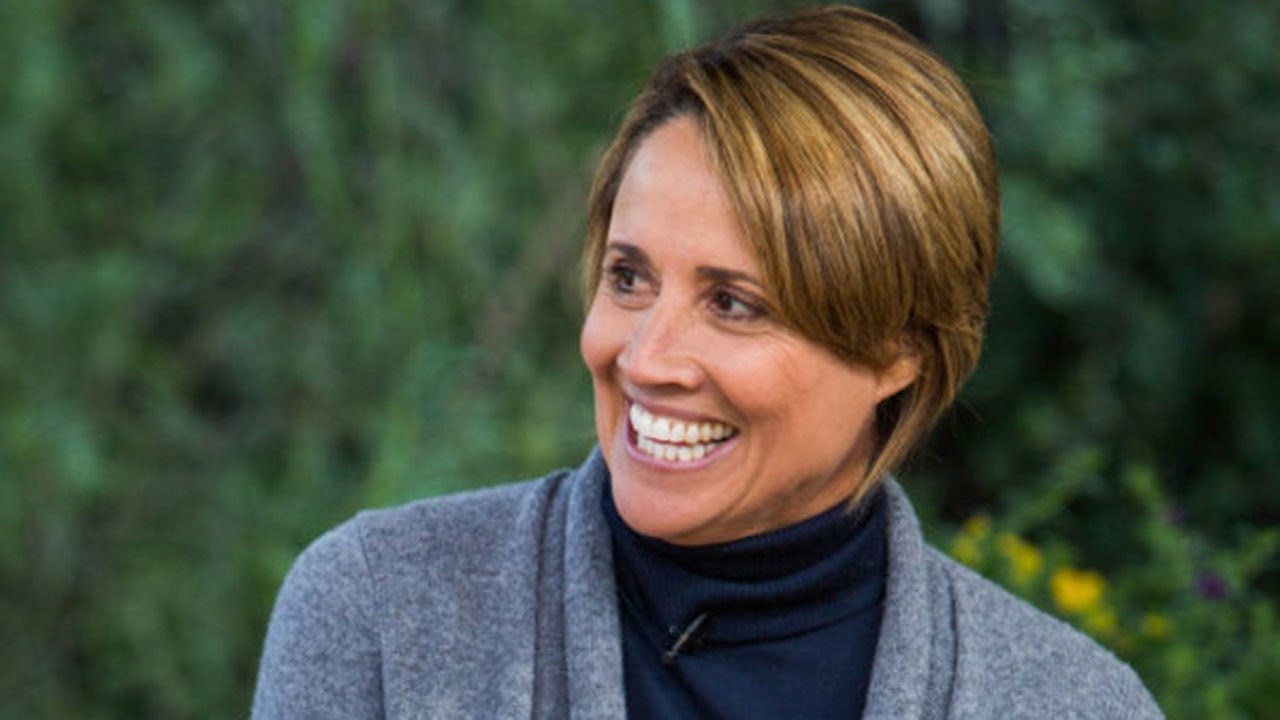
Flash forward 30 years, and I’d lined up an interview with my pal Mary Carillo, who, along with Roger Federer, is soon going into the International Tennis Hall of Fame. So I prepared a slew of questions.
“How does it feel to be going into the Hall of Fame with Mozart?…When people meet you for the first time, what’s the first thing they want to know?” And the old reliable – ”What’s been the highlight of your career?”
One after another I lined up my provocative queries.
“What would you say now, to your ten-year-old self?”
“Just how far have women come in the game?”
This was going to be great. I’d get 101 revelations.
“What was the most challenging moment of your career?”
Forget spontaneity – never mind going with the flow.
My questions aligned seamlessly. “Who are the top five players of all time?”
I’ve got this. We’re talking an interview for the ages. One of the game’s great storytellers would soon be singing.
My coffee had kicked in. The zoom connection was flawless. What could go wrong?
From the get-go, two old warhorse journalists started to reminisce. Here were a couple of folks who’d spent their whole lives traveling the same circus.
Secrets were told. Confidential quips were shared. So what’s printable? What’s not? Such an exchange – what fun!
But hold on. I can’t just indulge in a delightful, untethered ramble. I’ve got to get to my treasured questions. So I began to plow in.
But Mary interrupted, “Wait, wait, Bill. Let me start. So how far back do we actually go? When did we first meet?”
My exquisitely crafted questions had to wait. Soon I was recalling the night in 1978 at Madison Square Garden when Guillermo Vilas, for tactical purposes, feigned injury and pulled out of his final round-robin match. Later Jimmy Connors, ever the prankster, decided to retaliate and limped onto court with a crutch – to howls of laughter.
Carillo then topped me with her tale of how Vitas Gerulaitis’ sister asked her to get tickets to the Masters for all four of Vitas’ girlfriends, but none of the seats could be near each other.
Then Mary recalled overhearing Vitas explaining the nuances of profanity to Ilie Nastase. After all, Nastase had once taunted his frenemy Arthur Ashe by calling him a Negroni. Now Vitas was reminding Nastase, “The proper usage is mother fucker, not fucker mother.”
Memories from back lanes in London and imaginary matches we supposedly covered in 1947 melded with claims that Wimbledon’s ditching of Middle Sunday—a day of rest when there was no play—was the epitome of every dastardly deed imposed on tennis in recent years, and that the bulldozing of the French Open’s enchanting Bullring court was a crippling blow to Western civilization.
As we joked about the increasing length of tourneys, I suggested that Roland Garros would soon be starting on the last Tuesday in April. Mary sighed: “Let’s face it, Slams are now three weeks.”
We went on grumbling about this and that before addressing Carillo’s classic tennis zinger: “No matter how cynical you are, it’s hard to keep up.” Mary then spoke of New Yorkers and claimed that birth certificates in the Big Apple always start by listing the infant’s weight – seven pounds four ounces – and then they would stamp in the personality type – “cynic.”
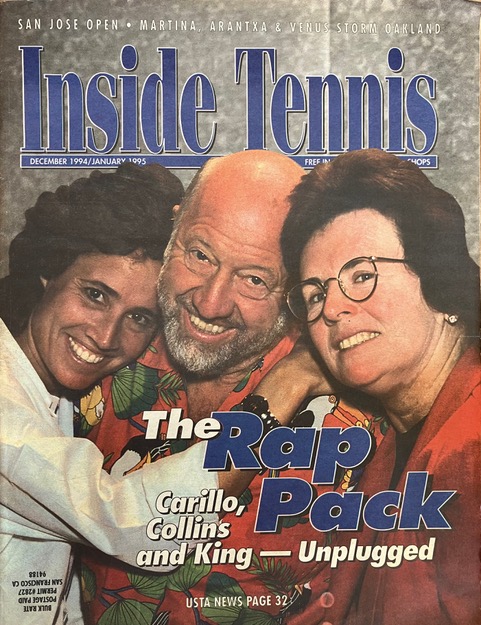
Mary then mentioned the irrepressible Bud Collins, who so loved tennis. “Whenever I told him something that aggravated me about the game, he’d just give me a wry smile and keep typing.”
Mary then asked, “So, wait, Bill, do you still find tennis charming, or…?
“Yes,” I assured her, “I still find it to be my lens, my mistress, my passport—I’m addicted. Sure, a few battle scars are still healing, but I love tennis dearly. One month we’re reporting on dukes in their tweeds and duchesses in their frocks, and the next we’re talking about some outrageous stockbroker from Great Neck going nuts high in Ashe Stadium.
“Plus, there’s always a fresh angle, like this new kid Eala from the Philippines.”
Mary said Alexandra is “the most charming player since Li Na.” But me, Mr. Know-it-all, offered some blowback to one of the game’s great wordsmiths. “No, ‘charming’ isn’t quite the right word for Li Na. With her, there was always a twist. Early on, she was battling the villainous tennis bureaucrats in China, then at an Australian awards ceremony she hilariously dissed her husband, saying, ‘I make you rich…You lucky to have me.’”
On and on we went, two drunks at the end of the bar, refusing to go home.
Then, somehow, I shared that when I’d been concocting my questions for this interview, I’d thought of the time Mary told me how magical it was, as a kid, sitting on McEnroe’s bed sharing tales and dreams. And I thought what a long, intricate journey they’ve had, and how Mary and the tortured genius Mac were tennis’ answer to Bob Dylan and Joan Baez—right? No, not right—forget it.
Soon Mary joked about the time a beefy fan at the US Open hugged her and said, “Hey, man, I think you’re good. I don’t care if you’re a chick.”
Soon we were off on tales of the counterculture: the Rolling Stones, the Grateful Dead, and the pursuit of eternal truths.
Mary then recalled recently watching the Washington final with her mother as an official made the sponsor sound like the second coming of Mother Teresa. Carillo’s mom asked, “Where is the country of Mubadala?”
Then Mary shared that she was preparing her Hall of Fame induction speech, which prompted me to mention that I was putting together a tennis book full of autobiographical tales.
Mary seized the steering wheel again. “Hold on, hold on. What’s the opening page? Where do you start? I’ve got to know.”
“What a layup,” I thought. Every writer knows the opening lines of their own book.
“I start in 1974,” I told her, “just coming back from a quixotic journey seeking the Holy Grail in Sikkim. All day I’d been bouncing up and down on a rickety bus, descending the Himalayas, until I finally rolled into a dusty Indian village at 10 PM. The whole town was shut down except for one dim cafe. As I took my first bite of the last chapati in town, an old jukebox cranked up and started playing Aretha Franklin’s epic song ‘A Rose in Spanish Harlem.’
“Flash forward 33 years: I’m sitting right outside the US Open Players Lounge interviewing none other than Aretha herself, telling the Queen of Soul that story, about hearing her voice after coming down from the Himalayas.”
“That’s it!” Mary interrupted, her eyes lighting up.
“That’s what?” I asked.
“You’ve got to weave all those wild yarns together and call the book The Holy Grail!”
Now that Mary had resolved all my literary dilemmas, I seized the moment to ask the question I’d been holding back: What’s the skinny on your long, warm, tumultuous, and now rather settled relationship with McEnroe?
Mary recalled, “I consider him to be a dear friend now – but we definitely went through it. I mean, we were little kids together. And then, obviously, we played a little tennis together.
“Then I was critical of John. There were times when he’d be messing with an umpire and I said what I thought. He thought I was hurting him. His attitude was, ‘What? How can you do that? We’re friends.’ So I had to try to defend my words. Still, it bothered him, and it bothered me to do it, believe me.”
Then at one point in her mid-career, when Mary and McEnroe were working together for CBS, John said, “I don’t like three people in a booth, and I just want to do men’s tennis, and Mary should go.” Carillo noted, “He was kicking me out of a booth I’d been in for years.”
But producer Ted Shaker stood up and saved her job.
Carillo concluded, “John and I ended up being really good. We both grew up, got married, had kids. A lot of athletes grow old, but they’ve been pampered for so long that they don’t really grow up. We grew up.”
“Speaking of growing up,” I asked, “how did Billie Jean King, a skinny fireman’s daughter who was banned from a group picture because she wasn’t wearing a tennis dress, come to shake up the world?”
Mary didn’t hold back. “Beyond my family, nobody has changed my life, my sensibilities, my thinking, my attitude about things more than Billie. She totally changed my life and who I am. She saved my life.
“And we don’t always agree. When I got pissed off that the WTA was going to Saudi Arabia, Billie would just say, ‘But the money. The WTA needs it.’
“Then I’d punch back, and finally she’ll just say, ‘You’re too idealistic.’
“To be called too idealistic by Billie Jean King is the greatest thing I’ve ever been accused of.”
Mary went on to detail King’s genius, including her mastery of details. “She wants to get everything right.” Billie has a collection of different-colored glasses so she can wear the perfect pair for every occasion.
For Carillo, two of King’s traits stand out: curiosity and kindness.
“The most important lesson I ever learned from Billie Jean came when we were doing the hour-long HBO Wimbledon highlight show. Every night after the show, Billie would go downstairs into the bowels of the broadcast center and talk to every single person – in tape, the people who were doing the logging. She introduced herself – as though she needed an introduction.
“She’d thank every one of those people and try to learn everybody’s name. To me, kindness is the thing. I learned more from Billie Jean than from anybody.”
I was stunned. How poignant.
Then in a flash, out of nowhere, Carillo’s lovely wife Sara dropped by. I joked, “You’ve got to do something to get Mary to open up and get out of her shell. She just has to learn to express herself.”
Sara chuckled and then reminded Mary, “Remember, you have that interview with the Boston Globe in 20 minutes.”
“TWENTY MINUTES?” I shouted to myself. “It’s already been 40 minutes and you haven’t gotten to question one!”
Desperately, I tried to get on script. I pivoted into lightning-round mode.
“Hey Mary, if you could invite three people in tennis out to dinner, who would it be?”
She bristled. “I only get three? Give me seven. Honestly, the people I’m closest to now are Pammy [Shriver], Martina and Chris. But if I could have a larger table, I would certainly throw in Andy Roddick, a couple of McEnroes, Agassi, and there’s Lindsay Davenport. These are good people. They helped shape me.”
I kept firing questions and Mary shot back from the hip. I tossed out some of tennis’ great eccentrics – Nastase, Goran Ivanisevic, Marat Safin, Nick Kyrgios and Alexander Bublik. Mary noted there were no women on the zany list. She said she doesn’t like crudeness, and these days, Daniil Medvedev is her favorite eccentric: “He makes me laugh and he breaks my heart.”
Speaking of heartbreak, I brought up the drought American men have suffered: 23 years without a Slam.
“A lot of people think Ben Shelton might be the next guy,” Mary noted. “But I think Taylor is further along. His coach Paul Annacone told me, ‘This man is very ambitious.’ He’s looking to improve his game. He doesn’t try to take shortcuts.”
But I had to. I teed up queries at breakneck speed.
“Dream interview?”
“Michelle Obama.”
“Favorite court?”
“That beautiful one at the French Open,” she said, referring to Court Simonne-Mathieu, tucked within Roland Garros’ gardens.
“A player the tennis world still doesn’t quite understand?”
“Naomi Osaka. I still don’t think I fully understand her.”
“Favorite tennis wordsmith of all time?”
“Rex Bellamy.”
“Pet peeve?”
“Players falling flat on their backs after winning a tournament,” Mary groaned. “Maybe it’s just a function of my age, but come on, fellows – stay on your feet.”
I kept the assembly line moving.
“If you could sit down with Major Wingfield – the guy who patented modern lawn tennis back in the 1870s – what’s the message?”
Mary grinned. “I’d tell him he cooked up a pretty good idea. I love the net, the precise dimensions of the court, the fact that there’s room for four people in doubles. When I watch basketball, I think the court should be bigger because these guys are so massive, and maybe the basket ought to be higher. But tennis got the scale right from day one. It brings out every emotion in me. It’s given me my house. It’s given me my life.”
So Wingfield got the dimensions right. But what about current personalities?
I noted that on one end of the spectrum was Elena Rybakina’s famously stone-faced celebrations, which I’ve dubbed “the Rybakina Roar.” And that brought to mind another reserved, inward superstar, the brilliant but at times bland world No. 1.
Mary said of Jannik Sinner, “I hear from his coach Darren Cahill all the time about what a refined man Sinner is. How well he was raised, what his values are. I’m a huge fan of this kid. I think he’s taking tennis to places it hasn’t been.”
As the clock finally ran out, Carillo blew the whistle to end the interview. Still, in overtime, I managed to get in one last question.
“Our sport has been blessed to have had the Big Three. Roger is Baryshnikov, the ultimate artist. Rafa’s so magnetic – his muscles have muscles. And there’s no greater craftsman, no greater seeker, than Novak. Which aspect of these three icons appeals to you the most?”
“Raj. The grace, the elegance of Raj. It’s not even – I think people dream about being the kind of tennis player Roger is. How easy he makes a hard thing look. In anything, like music or art, it’s amazing when anybody can make something hard look easy, you know.”
Yes, I know.
But ironically, I feared I’d done just the opposite. I’d managed to make what should have been one of the easiest things in tennis – interviewing Carillo – complicated.
Oh well. It sure was fun hanging out at the end of the bar with Mary.