


Bill Simons
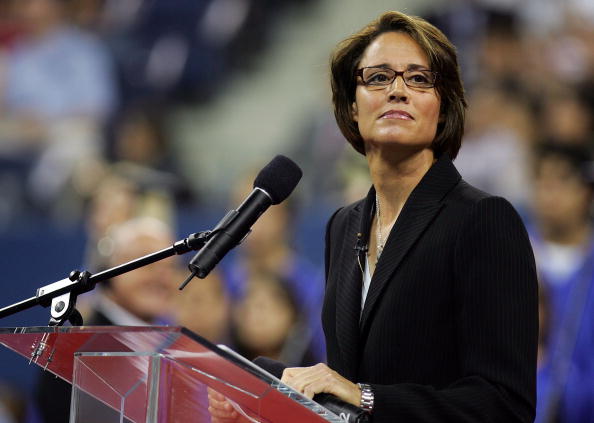
First she called herself, “that chick from Queens.” Then, as if it were a badge of honor, she said she was “the broad they tried to kick out of broadcasting.” To me, she’ll always be Moxie Mary.
Soon she’ll be a Hall of Famer.
In a sport defined by its sounds – the roar of Ashe Stadium, the silence of Wimbledon’s Centre Court, the grunts of Sharapova – Carillo’s voice was the sound that, along with those of John McEnroe and Bud Collins, defined our sport. We’ve seen the game through her prism.
She’s pulled back many a veil of power. Irreverence is her brand. She suggests, “No matter how cynical you are, you can’t keep up.”
Yet reverence for the game is her foundation. “Tennis fed and formed my entire life,” she recalls. “Oh, to find something so young that you are so passionate about, and you land up doing exactly what you want with the people you want…Tennis became my world and my identity.”
An observational savant, rapid-fire quipster and intrepid truth teller, Carillo journeyed from one gig to another, surviving no shortage of turmoil with grit and grace. The broadcaster who told us that Venus and Serena danced on the edge of a volcano often danced near the edge herself.
During a Hingis match, she observed, “There’s no one on court who knows more what an original thought tastes like than Martina.” Few in broadcasting have tasted more original tennis thoughts than Carillo.
While watching Rafa on clay, she asked, “Have you ever seen anyone who has the same sense of recognition of the rhythms of a clay court match?” Listening to her, you realized that few broadcasters ever grasped the rhythms of a tennis match as well as she did.
When a generation of power-blasting WTA newcomers emerged, Carillo captured their essence in three words: “Big Babe Tennis.” Mary made the complex seem simple.
When two of the game’s most beloved players – Roger Federer and Juan Martin del Potro – were battling it out in the game’s most judgmental arena, Ashe Stadium, she noted, “There’s no one on this court who is boo-able.”
And speaking of courts, when a Svetlana Kuznetsova match was heating up on the French Open’s No. 2 show stadium, Court Suzanne-Lenglen, Carillo quipped, “It’s a doozy by Kuzy on Suzie.”
Then again, Mary Queen of Swats often left us in knots. She punctured young Anna Kournikova’s sense of entitlement, saying, “Everybody’s there to serve her…Her attitude is, ‘Peel me a grape.’”
At one particularly soggy Wimbledon, Carillo explained a bad bounce, saying, “A worm probably came up for air.”
Mary had few filters – her imagination knows few bounds. Yet, for all her quips, Carillo is most proud of her journalistic chops. She’s one reporter with the zeal of a crime detective.
Preparation fuels her spontaneity. She dashes down the boulevard to a Roland Garros practice court. She checks in with that agent who knows everything about the teenage Czech phenom who’s through to the quarters. She asks those savvy British writers what they’re cooking up.
Many star broadcasters would never bother to show up in the interview room. Mary would be in the front row. She had a gift for mining nuggets, and relished a snappy yarn. In her hands, rain delays were rarely boring, second-round blowouts had zing. Storytelling is her bliss.
And her singular origin story deserves to be told.
Carillo emerged from the perfect place at the perfect time. Sure, California and Florida have had plenty of moments of glory. But, at the height of the tennis boom in the late ’70s, New York was a sizzling epicenter.
By the East River, Annie Hall was bopping her backhand to Woody Allen. Up on the Upper West Side, Billie Jean King had her apartment, and ladies shopped in snazzy tennis dresses at Gristede’s. A Brooklyn-born disco king, Vitas Gerulaitis, would come to insist that nobody could beat him 17 times in a row.
Fans packed Madison Square Garden to see Jimbo and Bjorn or Chrissie and Martina. From The Hamptons to Connecticut, tennis estates drew the likes of Frank Sinatra and Katharine Hepburn. A stylish, wealthy man of conscience, Gene Scott, pumped out the must-read Tennis Week. And the sport stepped up big-time as the US Open moved to Flushing Meadows – game on!
Three remarkable personalities emerged from the little Douglaston Club. One would lead the Hall of Fame. Two would enter it.
Out at the city’s leafiest hamlet on the breezy shores of Little Neck Bay, three spunky kids stuck out their necks.
Patrick McEnroe, the game’s most accomplished younger brother this side of Mike Bryan, would become the president of the International Tennis Hall of Fame. His defiant older brother first bombarded the game, and then inexplicably went on to become its most enduring presence. And Moxie Mary would become a groundbreaking icon.
The McEnroes were part of a feisty Irish clan. Carillo came from a tribe of “Kiss me, I’m Italian” artists.
So what? Together they hit forehands deep into the dusk, carpooled to Port Washington and skipped school to make the seven-mile trek to check out the US Open.
Sure, said Carillo, “If you grow up with McEnroe, you know how good you aren’t.” Yet, Mary recalled, there was no better place in the world than hanging out on McEnroe’s bed, sharing tennis tales and dreaming big.
Such heady days of youth, friendship, and ambition.
All the while, Mary talked tennis – and what mattered in life – with Billie Jean. “I learned at her knee,” Carillo recalled. “She taught me what mattered on this planet. She’s as remarkable a person as I’ve ever known…I try to live up to her.”
Back in 1977, young Carillo and 18-year-old McEnroe headed off to play the French Open and Wimbledon.
John happened to notice a sign-up sheet for the French Open mixed doubles, and, just like that, the two southpaws claimed the Roland Garros title.
McEnroe went on to shake up the tennis seas. Carillo’s wave was more modest. She clawed her way to No. 33, but her knees betrayed her.
Her brain, her guts and her voice didn’t. She had both luck and pluck. A veteran New York broadcaster showed Carillo’s match notes to his boss, and insisted, “You gotta put that kid on air.”
Soon Carillo became a work-for-cheap staple. Many came to recognize her blazing talent. (Once, while trying to persuade the USA Network to advertise in Inside Tennis, I encouraged its executives to take good care of Carillo. She was a gem.)
Mary’s talent was obvious. Opportunity was another matter. The glass ceiling in sports broadcasting was steely. Just a day after Billie Jean King came out in 1981, NBC fired her. Networks often handed microphones to superstars. Carillo had to earn hers. Nor did she fit the glamorous stereotype that’s so appealing to TV executives.
But the unsinkable Mary soon proved her mettle. If there was a tennis-aligned network with initials – MSG, PBS, TNT, USA, HBO, CBS, NBC, ESPN or TTC – Carillo found her way there, behind the mic.
Still, bigwigs found inventive ways to blunt her progress. She hadn’t played Davis Cup, so she was ignominiously yanked off her scheduled broadcast of a Davis Cup match. To this day, she hasn’t broadcast a Wimbledon men’s final in America.
Off the cuff, without much fluff, Mary could delight one moment and ruffle feathers the next. Rarely vanilla, she drew criticism. Some fans insisted she spoke too much. Players like Agassi and Sharapova were not always pleased.
When an issue arose about Venus and Serena not playing the Fed Cup, she reminded me, “The sisters are going to take you for a ride, and you have to hold on.”
Broadcaster Ted Robinson was a fan: “She can go off the rails a bit. She can look at things a little differently. I see that as a good thing. She has this wonderful mix – she can be very candid, very blunt, yet capture the human pathos. She can be so empathetic.”
Not everyone was so enthusiastic. Not only did John McEnroe often insist there could be only two people in his broadcast booth, he also took aim at Carillo’s gender and her appeal.
“I don’t know any woman who knows the men’s game,” he said. “Mary has a lot of personality and energy. Maybe they want ratings…Maybe they want to sell the most Perrier.”
Not exactly a wallflower, Carillo counterpunched: “Basically, what he’s saying is that when he speaks about men’s tennis, half the population can’t really understand him.”
She added, “John represents the views of a lot of men in locker rooms and boardrooms and congressional hearing rooms.”
Eventually McEnroe changed much of his tune. But when asked about his conversion, Carillo said she was “too busy dabbing tears from my eyes.”
McEnroe and Mary would hug and make up. After all, John was a member of her extended family, and Mary loves family.
McEnroe skipped his high school graduation to play in Paris. Carillo passed on broadcasting the French Open to be at her daughter’s high school graduation.
When Jelena Ostapenko unleashed one of her pout-fests, Mary’s maternal instincts kicked in: “This kid gives you so many looks – and anyone who’s owned a teenager knows many of them.”
When one Wimbledon rain delay lingered long, she noted, “As my great uncle Frank used to say, ‘What’s holding up the delay?’”
Long a tennis purist, she at first opposed tennis in the Olympics, on-court coaching, and flawed human beings as linespersons. And, by the way, she backed that pivotal US Open foot fault call against Serena at crunch time. A rule had been broken.
Carillo’s most poignant work was a sublime letter to her kids explaining that she wanted them to live life as if they were playing on clay. There, you have to learn to construct points, and you aren’t rewarded immediately. You learn patience. Life isn’t one winner after another.
The surface demands what Mary most values in tennis – resilience.
During her 46-year career, Carillo took her talents to 17 Olympics, Real Sports, provocative documentaries – and dog shows. We saw her with huskies in Manitoba, pandas in China, and a posh etiquette expert in London. When overing luge, she quipped the sport was “like a beer bet gone bad.” She reminded us that every feather in a badminton birdie comes from the left side of a goose.
All the while, she reflected on her favorite tennis moment – Jimmy Connors’ operatic run at the 1991 US Open. She delighted in asking whimsical questions and coining memorable phrases. When the young Fabio Fognini scored a huge upset, she wondered, “Is he top-tenable or not very top-tenable?”
Her inventive stroke analyses rarely disappointed. At the Cincinnati Open, she observed that Guga Kuerten “hasn’t lost any of his surfer-dudeosity. He’s a human slinky…his backswing starts in Kentucky and ends in Ohio.”
For all her fun-loving silliness, Carillo was also one of tennis’ strongest moral voices. When the sport looked away, she rarely did.
She loves tennis because it reveals the human condition. For Mary, the human story always comes before the tennis story.
When Russia enacted punitive anti-gay legislation, she bristled. When Justin Gimelstob’s conduct came under serious scrutiny, she spoke out. When Novak Djokovic defied COVID-era protocols, she suggested, “Novak does not believe in the sanctity of science…[He] believes science is just another opinion.”
Margaret Court’s condemnation of same-sex marriage and her belief that LGBTQ advocacy was “the work of the devil” prompted Carillo to reflect, “My whole world seems to be rejecting the realities of the dangerous present…At first, my inclination was to ignore Margaret’s harmful, hateful words. She is shouting at the ocean; surely the seas will drown out her incessant cries of perversion. Where is the kindness?”
A few years later, Mary took an even bolder stand. A longtime Laver Cup broadcaster and host, she walked away from the event, because she believed the domestic abuse allegations against Alexander Zverev had not been addressed.
At significant financial cost, she refused to lend her voice to an event that would celebrate Zverev. She explained, “I’d be complicit in the whitewashing of very serious allegations…I don’t want to be part of the silence. If you’re quiet, it suggests you’re complicit.”
There were many broadcast titans I barely knew – from Pat Summerall to Dick Enberg to Jim Courier. Not Mary.
I grew to love the confident stride that announced her Big Apple cred – such swagger. I felt her cackle was the best in all of sports – such unvarnished delight. And she was everywhere. In a tiny Palm Desert restaurant chatting with a New York Times icon. In a French Open green room, or on the corner of a Wimbledon lane early one Sunday morning chatting with teaching master Nick Saviano about the glories of Italian-American coaches, from Vince Lombardi and Tommy Lasorda to Jim Valvano and Nick Bollettieri.
Carillo is a woman who’s shaped our perceptions. She has morphed wit, spontaneity, language and journalism into a unique, very American art form.
I was bowled over during my interview with her in a Palo Alto hotel when, after one of my queries, she said, “You’re the only person who’d ask that. You ask all the questions I’d ask.”
Wow.
Then again, the two roundtables I did with her, Billie Jean and Bud Collins were mountaintop experiences.
On August 29, Mary will be inducted into the International Tennis Hall of Fame, alongside a Swiss player she seems to understand pretty well. To her, Roger Federer is “the man who bends time. He never seems rushed…The man appreciates incandescence.”
Now the time has come to salute the broad they tried to ban from broadcasting, the chick from Queens, with her bad knees, razor-sharp wit and unwavering moral compass. The wide-eyed kid who learned at the knees of Billie Jean will at last have her moment of honor.
I bet it will be snappy. I hope she cackles. I know there will be laughter. For Moxie Mary, wit is always a pathway to wisdom.















Awesome job. Wanted to know her backstory.
Thanks!
Appreciate.