
Bill Simons
Netflix is launching a new documentary on Chris Evert and Martina Navratilova. Here’s our take on the most glorious rivalry in sports history.
*****
The Orlando crowd roared. The trophy gleamed. Martina Navratilova had just won her first tournament. She wanted to hug someone – anyone. But there was no one. So she wrapped her arms around an aluminum pole.
For decades to come, there would be someone – across the net.
Rivalries are the rocket fuel of sports. Ali and Frazier. Magic and Bird. Palmer and Nicklaus. Yet in women’s tennis – and perhaps in all of sport – no rivalry had the range, duration or psychological depth of Evert vs. Navratilova.
After playing as teens in a rusty Ohio city in 1973, they’d face each other 79 more times. Martina would edge the ledger, 43-37. Each would claim 18 singles Slams. Together they owned an era. Today, both are cancer survivors – still inspiring, still broadcasting the game they once ruled.
Their numbers are staggering. Their story reshaped the sport. Billie Jean King laid the foundation – Chris and Martina built the mansion.
“Our rivalry didn’t have a rival,” Martina noted. It wasn’t just righty versus lefty, the baseliner who refused to miss vs. the athletic savant who charged the net with venom. It wasn’t merely America’s ice maiden versus the passionate Czech immigrant. It wasn’t simply the seemingly sweet versus the rather prickly. It was evolution in public – from phenoms to rivals to survivors.
Evert was the game’s double-fisted metronome – balanced, relentless, almost impossible to rush. If you wanted to beat her, you needed the patience of Job – or the nerve to drag her forward. From the baseline, there were no cracks to exploit.
The queen of consistency, she was the dominant baseliner of her era. Clean strokes, the essence of efficiency.
The Floridian made a definitive statement that reshaped the sport: the two-handed backhand was not a compromise. It was the future.
She met every challenge.
Prove teens could thrive at the top? Not a problem.
Go to Paris and win seven French Opens? Check.
Collect 125 straight clay court wins over six years? Got it.
Reach the semifinals of 52 of her 56 Slams? You’ve got to be kidding.
Minimal expression. Iron will. Her backhand was her fortress. Focus was her dagger. No wonder Martina dreaded her foe’s grit: “There was always Chris’ determination. I’d see those eyes squint and think, ‘Oh, no.’”
For decades, the media said, “Oh, yes.” There was always an Evert storyline.
The dutiful product of a strict, don’t-laugh-too-much family, she emerged from twelve years of white-knuckle Catholic schooling, then launched her own quiet counterattack.
On a dare, she sprinted nude past an open Wimbledon window – nobody noticed. The world No. 1 got engaged to the game’s great, unharnessed bad boy, Jimmy Connors – everybody blinked. She would marry three sportsmen from three continents – British tennis player John Lloyd, American skier Andy Mill and Australian golfer Greg Norman – and date the likes of Burt Reynolds, Warren Beatty, Jack Ford, and Adam Faith.
But, clutch your pearls, the golden girl of American sports could down four gin and tonics in half an hour and cuss like a sailor. When she unleashed a dirty joke out of nowhere, it landed with extra bite. Who knew that nice girl next door had such a mouth?
In 1982, at the Federation Cup in Santa Clara, Chris and Martina sat side by side at a press conference. China’s Hu Na had just mysteriously vanished, and for days Martina had been livid that the press had presumed Hu Na had defected. In any case, I asked Martina, who only recently had become a US citizen, “What do you like most about America?”
Before she could answer, Chrissie quipped, dry as a backhand down the line, “I hope it’s not freedom of the press.” The room erupted – the tension dissolved.
Chris didn’t just control points. She controlled moments. When a rally grew tight, she redirected pace. When a room grew tight, she redirected the vibe.
Evert’s wit wasn’t confined to press rooms. Her comic instincts drew howls of laughter on Saturday Night Live. It was comedy gold when tennis’ queen of control played the ultimate monarch – Queen Elizabeth – leaning into royal rigidity with a wink. Even in parody, she understood the power of restraint.
Speaking of rulers, Chris delighted us with the tale of lounging in her pajamas on the hotel bed of Barb and George Bush as they sipped their coffee and leafed through the morning papers. She had a way of being at ease almost anywhere – on a center court or in unexpected company – rarely overawed, always herself.
The media adored sassy Chrissie. Every detail was grist for their mill. British humorist Lynne Truss once gushed that at the opening of Wimbledon’s No. 1 Court, “Chris wore a short skirt, and the sight of her long, brown, slender legs was breathtaking, inducing in me the reaction Piglet has to Winnie the Pooh when he sees the blue braces and has to go home and lie down. Here is a woman who never needed a diamond navel stud to get noticed.”
Evert never needed ornament. Her power was precision – of stroke, of timing, of line. And the world, whether it cheered or gossiped, couldn’t look away.
She turned out to be a lovely, user-friendly celeb – smart, funny, accessible, reassuring and, in her way, quietly elegant.
Martina Navratilova was something else.
A quip from Scott Ostler captured much. Once, when she was upset, he wrote, “Martina was beside herself, which, come to think of it, would make a hell of a doubles team.”
She was a left-handed attacker who charged the net as if the baseline were temporary. Brave. Muscular. Emotional. Risk-taking. Imposing. Chris absorbed pace, Martina created it. Chris calculated, Martina lunged.
In 1975, she defected from communist Czechoslovakia, leaving her family behind. When she exhaled, saying, “I am free,” the words were simple. Her life ahead was not.
For the teen from a small Czech village, America was not subtle, it roared. Freeways with fast lanes. McDonald’s with Big Macs. Endless choices.
The communists had taken all her money. Not to worry, she was soon cruising down a Dallas freeway in a Mercedes, the license plate reading EX-CZECH. She embraced what she jokingly called the seafood diet—see food, eat food. Then came a culinary revelation: America had pancakes. She gained twenty pounds in two weeks.
Eventually, Martina reinvented her body through weight training and nutrition, long before they became standard. It sounds simple now. It wasn’t. She sweated through endless drills – “Let’s run some more suicides.” A sports-loving jock made conditioning mandatory.
It’s often said that women players should send a percentage of their earnings to Billie Jean King – after all, she’s the reason Brinks trucks began showing up at WTA events. Fair enough.
But maybe today’s millionaires – the ones who travel with fitness coaches, trainers and Pilates gurus – owe Martina a cut. After all, she created the template for the modern tennis body.
Tennis didn’t quite know what to do with the gifted, edgy, provocative Navratilova.
Chris mastered control. Martina tested limits. One refined the margins; the other expanded them. Together, they stretched the sport – and each other – into something larger than either might have been able to do alone.
There were counterpoints – discipline versus daring, steadiness versus surge, containment versus zeal. Chris counterpunched with geometry and nerve. Martina pressed forward with muscle and momentum.
Their rivalry defined the women’s game, forced it to evolve, and revealed that greatness could have two entirely different faces. In time, the friction between them made tennis grow up.
But not at first.
Instead of celebrating Martina’s discipline, muscular athleticism and love of the battle, she was cast as the outsider, the disruptor. The one intruding on the feel-good narrative people preferred – “Come on, Chrissie!” A harsh fan barked, “We want to see the real woman win.” On court, Martina felt she was playing against Chris and 15,000 fans.
Navratilova’s emotions were as sharp as her volleys. The observational genius Ted Tinling put it this way: “Martina has that dramatic Slav temperament that requires the stimulus of a crisis…She’s always going to have the storm…She goes from arrogance to panic with nothing in between.”
“When I think of Martina,” Chris once said, “I think of all the times she tried to be tough, confident and strong. Yet, knowing her, I always knew she could cry at the drop of a hat. Her body language could be intimidating. But I could see right through that. She’s very emotional, very sensitive. Her feelings were hurt very easily.”
When Martina first played Chris, she simply hoped she wouldn’t be overwhelmed by Chrissie’s celebrity glow, and that the phenom might even remember her name.
But she needn’t have worried. Chris welcomed her. Soon the two were winning doubles titles together at the French Open and Wimbledon. And, improbably, they even went out on a Hollywood double date with Dino Martin and Desi Arnaz, Jr.
Yet beneath the camaraderie, the numbers were unforgiving. Martina won just 13 of the first 41 matches she played against Chris, and after a long night of lovemaking, she lost 6-0, 6-0 at Amelia Island. Navratilova’s new partner and coach, hoops star Nancy Lieberman, saw what was happening.
The fierce competitor known as “Agent Orange” told Martina, “It’s war for Chris. It’s tennis for you. She wants to take your trophies, your money, your place in history.” Stop being her pal. No more dinners, no more friendship. Hate her – she’s the enemy.
Lieberman was also shocked that Martina was chubby – she’d fade at crunch time. A great talent was wasting her gifts. So Nancy dragged her onto the track and into the gym and whipped her into shape.
Martina built bulging muscles. Her confidence soared. She gained ascendance in the WTA and beat Evert thirteen times in a row.
Chris was slow to adjust. Too often coming to net was a misadventure. She clung to her wooden racket longer than most. But, as Billie Jean says, “Champions adjust.” And a stronger, bolder Chrissie fought back. She and Martina met everywhere – in finals at Wimbledon and Roland Garros, on Super Saturday in New York, in epic matches that halted streaks and shifted momentum.
When tournaments reached the finals, there they were.
Rivalries expand you and narrow you at the same time. Just ask Carlos Alcaraz and Jannik Sinner. You study the other’s patterns. You anticipate moods. You know the tells. No one understood the dynamics of finals more than Chris and Martina.
As Evert noted, “When you throw everything into a bag, we were so equal that we had to pick apart each other’s games – and each other’s brains – to figure out how to win.”
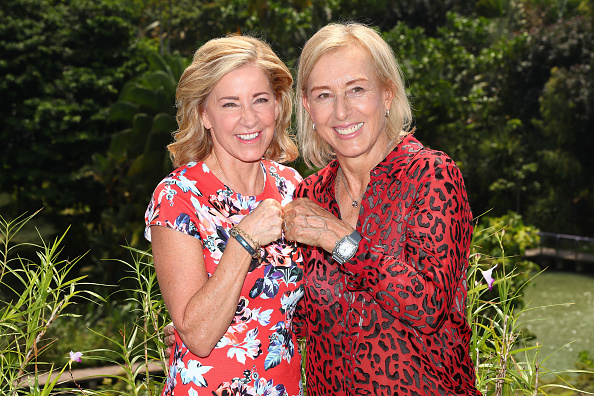
When you see Chris and Martina together now, you can’t miss a bond forged in fire – relaxed, familiar, hard-won. “We have a love affair,” Martina said. “It’s platonic.”
I’ve been blessed to witness their journey up close. My relationship with Chris has been steady and rather lovely for more than forty years.
In 1981, I was Inside Tennis’ eager young publisher at the Oakland Coliseum. Day after day, Chris said she would grant me an interview. Each day she canceled – until, finally, it happened. It was a breakthrough for my career.
We sat in a small room beneath the stadium. Her husband, John Lloyd, was nearby playing a loud pinball machine. At one point Chris barked at him, “How rude!” Even then, I sensed that their marriage might have cracks – and that beneath Chris’s polished exterior was steel.
Decades later, at Roland Garros, I came down the stairs of the press center into a bustling hallway. A blonde woman in sunglasses called out, “Hi, Bill.” I thought, Who’s that? She looks just like my sister. But Brook was back in Southern California. Then she lowered her sunglasses and smiled. “Hey, Bill, it’s me, Chrissie.” We both laughed.
That was Chris – an icon, yet real and engaging. When a titan of California industry wanted to chat with her, I made the arrangements. And we still have our moments – exchanging emails as the Australian Open begins or running into each other on a Paris boulevard.
Martina was different – more vulnerable. More combustible. In the big picture, I admire Navratilova – such guts, such fire. She told us, “The only thing you regret in life is the thing you didn’t do.”
Many doubted her. When she lost at the 1988 US Open, the usually spot-on Ted Tinling muttered, “This is the last glimmer of hope. I think Madame has lost her nerve.”
Madame hadn’t. Martina would play on for eighteen more years. And when her fans insist she belongs in the GOAT conversation, I listen. Any discussion about tennis greatness runs straight through Martina.
She won a record 1,442 singles matches and 167 singles titles. Men’s record holder Jimmy Connors won a measly 109 tourneys. Martina unleashed winning streaks that bent logic – 74 matches won in a row, an 87-1 season in 1983, five Slams in six tries.
Chris’ favorite legacy mark is her 90% lifetime winning record. Martina relishes her nine Wimbledon singles titles, a record most doubt will ever be broken. But her proudest feat was winning both the singles and doubles titles in the same tournament 80 times. Skip to main contentSkip to toolbar
- About WordPress
- InsideTennis.com
- 1818 updates available
- 338338 Comments in moderation
- New
- Titan Security
- View Post
- Insights5
- Theme support
- UpdraftPlus
- Howdy, Bill Simons
Edit Post
Chrissie and Martina: Sport’s Most Glorious Rivalry
⌘K
Change block type or style
Move Paragraph block from position 67 up to position 66
Move Paragraph block from position 67 down to position 68
Change text alignment
Displays more block tools
Chrissie and Martina: Sport’s Most Glorious Rivalry
Bill Simons
Netflix is launching a new documentary on Chris Evert and Martina Navratilova. Here’s our take on the most glorious rivalry in sports history.
*****
The Orlando crowd roared. The trophy gleamed. Martina Navratilova had just won her first tournament. She wanted to hug someone – anyone. But there was no one. So she wrapped her arms around an aluminum pole.
For decades to come, there would be someone – across the net.
Individual rivalries are the rocket fuel of sports. Ali and Frazier. Magic and Bird. Palmer and Nicklaus. Yet in women’s tennis – and perhaps in all of sport – no rivalry had the range, duration or psychological depth of Evert vs. Navratilova.
After playing as teens in a rusty Ohio city in 1973, they’d face each other 79 more times. Martina would edge the ledger, 43-37. Each would claim 18 singles Slams. Together they owned an era. Today, both are cancer survivors – still inspiring, still broadcasting the game they once ruled.
Their numbers are staggering. Their story reshaped the sport. Billie Jean King laid the foundation – Chris and Martina built the mansion.
“Our rivalry didn’t have a rival,” Martina noted. It wasn’t just righty versus lefty, the baseliner who refused to miss vs. the athletic savant who charged the net with venom. It wasn’t merely America’s ice maiden versus the passionate Czech immigrant. It wasn’t simply the seemingly sweet versus the rather prickly. It was evolution in public – from phenoms to rivals to survivors.
Evert was the game’s double-fisted metronome – balanced, relentless, almost impossible to rush. If you wanted to beat her, you needed the patience of Job – or the nerve to drag her forward. From the baseline, there were no cracks to exploit.
The queen of consistency, she was the dominant baseliner of her era. Clean strokes, the essence of efficiency.
The Floridian made a definitive statement that reshaped the sport: the two-handed backhand was not a compromise. It was the future.
She met every challenge.
Prove teens could thrive at the top? Not a problem.
Go to Paris and win seven French Opens? Check.
Collect 125 straight clay court wins over six years? Got it.
Reach the semifinals of 52 of her 56 Slams? You’ve got to be kidding.
Minimal expression. Iron will. Her backhand was her fortress. Focus was her dagger. No wonder Martina dreaded her foe’s grit: “There was always Chris’ determination. I’d see those eyes squint and think, ‘Oh, no.’”
For decades, the media said, “Oh, yes.” There was always an Evert storyline.
The dutiful product of a strict, don’t-laugh-too-much family, she emerged from twelve years of white-knuckle Catholic schooling, then launched her own quiet counterattack.
On a dare, she sprinted nude past an open Wimbledon window – nobody noticed. The world No. 1 got engaged to the game’s great, unharnessed bad boy, Jimmy Connors – everybody blinked. She would marry three sportsmen from three continents – British tennis player John Lloyd, American skier Andy Mill and Australian golfer Greg Norman – and date the likes of Burt Reynolds, Warren Beatty, Jack Ford, and Adam Faith.
But, clutch your pearls, the golden girl of American sports could down four gin and tonics in half an hour and cuss like a sailor. When she unleashed a dirty joke out of nowhere, it landed with extra bite. Who knew that nice girl next door had such a mouth?
In 1982, at the Federation Cup in Santa Clara, Chris and Martina sat side by side at a press conference. China’s Hu Na had just mysteriously vanished, and for days Martina had been livid that the press had presumed Hu Na had defected. In any case, I asked Martina, who only recently had become a US citizen, “What do you like most about America?”
Before she could answer, Chrissie quipped, dry as a backhand down the line, “I hope it’s not freedom of the press.” The room erupted – the tension dissolved.
Chris didn’t just control points. She controlled moments. When a rally grew tight, she redirected pace. When a room grew tight, she redirected the vibe.
Evert’s wit wasn’t confined to press rooms. Her comic instincts drew howls of laughter on Saturday Night Live. It was comedy gold when tennis’ queen of control played the ultimate monarch – Queen Elizabeth – leaning into royal rigidity with a wink. Even in parody, she understood the power of restraint.
Speaking of rulers, Chris delighted us with the tale of lounging in her pajamas on the hotel bed of Barb and George Bush as they sipped their coffee and leafed through the morning papers. She had a way of being at ease almost anywhere – on a center court or in unexpected company – rarely overawed, always herself.
The media adored sassy Chrissie. Every detail was grist for their mill. British humorist Lynne Truss once gushed that at the opening of Wimbledon’s No. 1 Court, “Chris wore a short skirt, and the sight of her long, brown, slender legs was breathtaking, inducing in me the reaction Piglet has to Winnie the Pooh when he sees the blue braces and has to go home and lie down. Here is a woman who never needed a diamond navel stud to get noticed.”
Evert never needed ornament. Her power was precision – of stroke, of timing, of line. And the world, whether it cheered or gossiped, couldn’t look away.
She turned out to be a lovely, user-friendly celeb – smart, funny, accessible, reassuring and, in her way, quietly elegant.
Martina Navratilova was something else.
A quip from Scott Ostler captured much. Once, when she was upset, he wrote, “Martina was beside herself, which, come to think of it, would make a hell of a doubles team.”
She was a left-handed attacker who charged the net as if the baseline were temporary. Brave. Muscular. Emotional. Risk-taking. Imposing. Chris absorbed pace, Martina created it. Chris calculated, Martina lunged.
In 1975, she defected from communist Czechoslovakia, leaving her family behind. When she exhaled, saying, “I am free,” the words were simple. Her life ahead was not.
For the teen from a small Czech village, America was not subtle, it roared. Freeways with fast lanes. McDonald’s with Big Macs. Endless choices.
The communists had taken all her money. Not to worry, she was soon cruising down a Dallas freeway in a Mercedes, the license plate reading EX-CZECH. She embraced what she jokingly called the seafood diet—see food, eat food. Then came a culinary revelation: America had pancakes. She gained twenty pounds in two weeks.
Eventually, Martina reinvented her body through weight training and nutrition, long before they became standard. It sounds simple now. It wasn’t. She sweated through endless drills – “Let’s run some more suicides.” A sports-loving jock made conditioning mandatory.
It’s often said that women players should send a percentage of their earnings to Billie Jean King – after all, she’s the reason Brinks trucks began showing up at WTA events. Fair enough.
But, maybe today’s millionaires – the ones who travel with fitness coaches, trainers and Pilates gurus – owe Martina a cut. After all, she created the template for the modern tennis body.
Tennis didn’t quite know what to do with the gifted, edgy, provocative Navratilova.
Chris mastered control. Martina tested limits. One refined the margins; the other expanded them. Together, they stretched the sport – and each other – into something larger than either might have been able to do alone.
There were counterpoints – discipline versus daring, steadiness versus surge, containment versus zeal. Chris counterpunched with geometry and nerve. Martina pressed forward with muscle and momentum.
Their rivalry defined the women’s game, forced it to evolve, and revealed that greatness could have two entirely different faces. In time, the friction between them made tennis grow up.
But not at first.
Instead of celebrating Martina’s discipline, muscular athleticism and love of the battle, she was cast as the outsider, the disruptor. The one intruding on the feel-good narrative people preferred – “Come on, Chrissie!” A harsh fan barked, “We want to see the real woman win.” On court, Martina felt she was playing against Chris and 15,000 fans.
Navratilova’s emotions were as sharp as her volleys. The observational genius Ted Tinling put it this way: “Martina has that dramatic Slav temperament that requires the stimulus of a crisis…She’s always going to have the storm…She goes from arrogance to panic with nothing in between.”
“When I think of Martina,” Chris once said, “I think of all the times she tried to be tough, confident and strong. Yet, knowing her, I always knew she could cry at the drop of a hat. Her body language could be intimidating. But I could see right through that. She’s very emotional, very sensitive. Her feelings were hurt very easily.”
When Martina first played Chris, she simply hoped she wouldn’t be overwhelmed by Chrissie’s celebrity glow, and that the phenom might even remember her name.
But she needn’t have worried. Chris welcomed her. Soon the two were winning doubles titles together at the French Open and Wimbledon. And, improbably, they even went out on a Hollywood double date with Dino Martin and Desi Arnaz, Jr.
Yet beneath the camaraderie, the numbers were unforgiving. Martina won just 13 of the first 41 matches she played against Chris, and after a long night of lovemaking, she lost 6-0, 6-0 at Amelia Island. Navratilova’s new partner and coach, hoops star Nancy Lieberman, saw what was happening.
The fierce competitor known as “Agent Orange” told Martina, “It’s war for Chris. It’s tennis for you. She wants to take your trophies, your money, your place in history.” Stop being her pal. No more dinners, no more friendship. Hate her – she’s the enemy.
Lieberman was also shocked that Martina was chubby – she’d fade at crunch time. A great talent was wasting her gifts. So Nancy dragged her onto the track and into the gym and whipped her into shape.
Martina built bulging muscles. Her confidence soared. She gained ascendance in the WTA and beat Evert thirteen times in a row.
Chris was slow to adjust. Too often coming to net was a misadventure. She clung to her wooden racket longer than most. But, as Billie Jean says, “Champions adjust.” And a stronger, bolder Chrissie fought back. She and Martina met everywhere – in finals at Wimbledon and Roland Garros, on Super Saturday in New York, in epic matches that halted streaks and shifted momentum.
When tournaments reached the finals, there they were.
Rivalries expand you and narrow you at the same time. Just ask Carlos Alcaraz and Jannik Sinner. You study the other’s patterns. You anticipate moods. You know the tells. No one understood the dynamics of finals more than Chris and Martina.
As Evert noted, “When you throw everything into a bag, we were so equal that we had to pick apart each other’s games – and each other’s brains – to figure out how to win.”
When you see Chris and Martina together now, you can’t miss a bond forged in fire – relaxed, familiar, hard-won. “We have a love affair,” Martina said. “It’s platonic.”
I’ve been blessed to witness their journey up close. My relationship with Chris has been steady and rather lovely for more than forty years.
In 1981, I was Inside Tennis’ eager young publisher at the Oakland Coliseum. Day after day, Chris said she would grant me an interview. Each day she canceled – until, finally, it happened. It was a breakthrough for my career.
We sat in a small room beneath the stadium. Her husband, John Lloyd, was nearby playing a loud pinball machine. At one point Chris barked at him, “How rude!” Even then, I sensed that their marriage might have cracks – and that beneath Chris’s polished exterior was steel.
Decades later, at Roland Garros, I came down the stairs of the press center into a bustling hallway. A blonde woman in sunglasses called out, “Hi, Bill.” I thought, Who’s that? She looks just like my sister. But Brook was back in Southern California. Then she lowered her sunglasses and smiled. “Hey, Bill, it’s me, Chrissie.” We both laughed.
That was Chris – an icon, yet real and engaging. When a titan of California industry wanted to chat with her, I made the arrangements. And we still have our moments – exchanging emails as the Australian Open begins or running into each other on a Paris boulevard.
Martina was different – more vulnerable. More combustible. In the big picture, I admire Navratilova – such guts, such fire. She told us, “The only thing you regret in life is the thing you didn’t do.”
Many doubted her. When she lost at the 1988 US Open, the usually spot-on Ted Tinling muttered, “This is the last glimmer of hope. I think Madame has lost her nerve.”
Madame hadn’t. Martina would play on for eighteen more years. And when her fans insist she belongs in the GOAT conversation, I listen. Any discussion about tennis greatness runs straight through Martina.
She won a record 1,442 singles matches and 167 singles titles. Men’s record holder Jimmy Connors won a measly 109 tourneys. Martina unleashed winning streaks that bent logic – 74 matches won in a row, an 87-1 season in 1983, five Slams in six tries.
Chris’ favorite legacy mark is her 90% lifetime winning record. Martina relishes her nine Wimbledon singles titles, a record most doubt will ever be broken. But her proudest feat was winning both the singles and doubles titles in the same tournament 80 times. The active WTA who holds that record is Serena. She’s done it four times.
Her doubles resume is staggering – 31 women’s doubles Slam titles, 10 mixed doubles majors. Fifty-nine major championships in all. That number alone should slow down the GOAT conversation.
Mostly with her indomitable partner, Pam Shriver, she collected 177 doubles titles. The woman who made fitness a necessity was also the game’s finest female serve and volleyer, its greatest doubles player and its most dominant grass-court champion.
Her longevity mocked time. She began in 1973 as a raw 16-year-old, and, 33 years later, won the 2006 US Open mixed doubles crown with Bob Bryan, within a lob of her 50th birthday. We talk about greatness as if it’s a single peak. Martina’s was a mountain range.
Her rhapsodic mixed doubles partner Leander Paes once said Martina was beloved by every little girl in every village in the world. I thought, “That’s a bit much,” – until one day, atop a Balinese mountain, I found myself discussing Martina with a toothless hermit.
In addition to her play, I admire her vulnerability, her courage and her unfiltered candor. “Honesty,” she once contended, “brings no regrets, but it certainly can make life more complicated. But that’s the only way I know how to live.” Few athletes have spoken out so consistently – on gay rights, war, Trumpism, cruelty to animals and the Earth itself.
As Czechia’s prodigal daughter, she lifted the spirits of 10,000 admirers in Prague. As a gay rights pioneer, she addressed 100,000 people at a rally in Washington. I love that she tried to climb Mount Kilimanjaro and got a pilot’s license. I’ve climbed mountains and had African adventures; I understand the impulse to test yourself. But our relationship has, at times, been prickly.
When Inside Tennis once ran a comparison between the many coaches Navratilova had had and the very few Evert had relied on, she called me and was livid.
Once, in a press conference, when I tried to give Jelena Dokic a platform to speak out against domestic abuse, Martina completely misread my intent. She approached me and was furious. I know when I mishandle a presser, but that was not one of those times.
With Martina, intensity is immediate. It’s also authentic. And so was her journey with Chrissie.
Early on, there was jealousy and cattiness. But beneath the snark was something more complicated – two women navigating roles that had barely existed before. Their rivalry mirrored a shift in women’s sports. For centuries, men had been the visible fighters. Women were expected to nurture, not conquer. Chris and Martina created a new terrain – women as dominant global athletic icons.
“Chris played feminine, I played masculine tennis,” Martina said. Evert navigated in the orbit of traditional expectations. Navratilova disrupted them – her muscularity, her coming out publicly, and her shoot-from-the-hip takes. She didn’t just win matches – she forced a reckoning.
David Kindred observed, “By the power of her ability, by the power of her personality, she forced us to accept her. If she didn’t feel accepted, that was a comment on us.” With a politically incorrect glint in his eye, Bud Collins quipped, “Chris and Martina made tennis safe for dameocracy.”
Chrissie showed that feminine girls could run, sweat, and gain fame and fortune in sports. Martina, the uber-athlete who loved hoops, hockey and skiing, sent a louder message: female jocks – with hefty muscles and ample grit – could prevail in the sports landscape.
For decades, the WTA has been an arena where differences were celebrated. Serena’s mother, Oracene Price said, “We’re all made different…One size don’t fit all.” Svetlana Kuznetsova added, “Being different is one of the most beautiful things in the world.” Chris and Martina drove that change.
Most rivalries drift into distance. Chris and Martina aged into something else. Time softened the edges. There was even that improbable happening when Chris visited Navratilova’s Aspen home and first slept with her future husband in Martina’s own bed. But by then, their rivalry had morphed into shared lives – their histories were entwined.
When Monica Seles was stabbed, her rival Graf kept her distance. In contrast, when Martina was diagnosed with breast cancer, Chris was all in – calls, texts, unwavering friendship. Later, when Chris faced ovarian cancer at the same hospital where Martina had been treated, Navratilova showed up with pasta, soup and homemade bread. Two champions whose bodies had once been instruments of dominance were confronting fragility. For years, there’s been no rivalry, only loyalty.
Now they’re cancer awareness advocates: know your body, know your family history, keep your appointments. Chris has said that if she’d waited three more months, she might not be here. Competition fades. Mortality does not.
Today they conduct joint press conferences, they laugh at inside jokes, they interrupt each other, they finish each other’s sentences. They once defined each other’s limits. Now they safeguard each other’s legacy.
Eighty matches. Eighteen Slams apiece.
Who knew that two women – one reared in a breezy Florida beach town, the other forged in the winds of tyranny in a Prague suburb – would come to embrace each other’s destiny?
Many rivalries drift apart.
Theirs did not.
They still show up. Together.PostBlock
Paragraph
Start with the basic building block of all narrative.
Color
Text
Background
Typography
Font size
Size
Advanced
Skip to the selected blockOpen save panel
- Post
- Paragraph
Notifications
Post updated. The active WTA who holds that record is Serena. She’s done it four times.
Her doubles resume is staggering – 31 women’s doubles Slam titles, 10 mixed doubles majors. Fifty-nine major championships in all. That number alone should slow down the GOAT conversation.
Mostly with her indomitable partner, Pam Shriver, she collected 177 doubles titles. The woman who made fitness a necessity was also the game’s finest female serve and volleyer, its greatest doubles player and its most dominant grass-court champion.
Her longevity mocked time. She began in 1973 as a raw 16-year-old, and, 33 years later, won the 2006 US Open mixed doubles crown with Bob Bryan, within a lob of her 50th birthday. We talk about greatness as if it’s a single peak. Martina’s was a mountain range.
Her rhapsodic mixed doubles partner Leander Paes once said Martina was beloved by every little girl in every village in the world. I thought, “That’s a bit much,” – until one day, atop a Balinese mountain, I found myself discussing Martina with a toothless hermit.
In addition to her play, I admire her vulnerability, her courage and her unfiltered candor. “Honesty,” she once contended, “brings no regrets, but it certainly can make life more complicated. But that’s the only way I know how to live.” Few athletes have spoken out so consistently – on gay rights, war, Trumpism, cruelty to animals and the Earth itself.
As Czechia’s prodigal daughter, she lifted the spirits of 10,000 admirers in Prague. As a gay rights pioneer, she addressed 100,000 people at a rally in Washington. I love that she tried to climb Mount Kilimanjaro and got a pilot’s license. I’ve climbed mountains and had African adventures; I understand the impulse to test yourself. But our relationship has, at times, been prickly.
When Inside Tennis once ran a comparison between the many coaches Navratilova had had and the very few Evert had relied on, she called me and was livid.
Once, in a press conference, when I tried to give Jelena Dokic a platform to speak out against domestic abuse, Martina completely misread my intent. She approached me and was furious. I know when I mishandle a presser, but that was not one of those times.
With Martina, intensity is immediate. It’s also authentic. And so was her journey with Chrissie.
Early on, there was jealousy and cattiness. But beneath the snark was something more complicated – two women navigating roles that had barely existed before. Their rivalry mirrored a shift in women’s sports. For centuries, men had been the visible fighters. Women were expected to nurture, not conquer. Chris and Martina created a new terrain – women as dominant global athletic icons.
“Chris played feminine, I played masculine tennis,” Martina said. Evert navigated in the orbit of traditional expectations. Navratilova disrupted them – her muscularity, her coming out publicly, and her shoot-from-the-hip takes. She didn’t just win matches – she forced a reckoning.
David Kindred observed, “By the power of her ability, by the power of her personality, she forced us to accept her. If she didn’t feel accepted, that was a comment on us.” With a politically incorrect glint in his eye, Bud Collins quipped, “Chris and Martina made tennis safe for dameocracy.”
Chrissie showed that feminine girls could run, sweat, and gain fame and fortune in sports. Martina, the uber-athlete who loved hoops, hockey and skiing, sent a louder message: female jocks – with hefty muscles and ample grit – could prevail in the sports landscape.
For decades, the WTA has been an arena where differences were celebrated. Serena’s mother, Oracene Price said, “We’re all made different…One size don’t fit all.” Svetlana Kuznetsova added, “Being different is one of the most beautiful things in the world.” Chris and Martina drove that change.
Most rivalries drift into distance. Chris and Martina aged into something else. Time softened the edges. There was even that improbable happening when Chris visited Navratilova’s Aspen home and first slept with her future husband in Martina’s own bed. But by then, their rivalry had morphed into shared lives – their histories were entwined.
When Monica Seles was stabbed, her rival Graf kept her distance. In contrast, when Martina was diagnosed with breast cancer, Chris was all in – calls, texts, unwavering friendship. Later, when Chris faced ovarian cancer at the same hospital where Martina had been treated, Navratilova showed up with pasta, soup and homemade bread. Two champions whose bodies had once been instruments of dominance were confronting fragility. For years, there’s been no rivalry, only loyalty.
Now they’re cancer awareness advocates: know your body, know your family history, keep your appointments. Chris has said that if she’d waited three more months, she might not be here. Competition fades. Mortality does not.
Today they conduct joint press conferences, they laugh at inside jokes, they interrupt each other, they finish each other’s sentences. They once defined each other’s limits. Now they safeguard each other’s legacy.
Eighty matches. Eighteen Slams apiece.
Who knew that two women – one reared in a breezy Florida beach town, the other forged in the winds of tyranny in a Prague suburb – would come to embrace each other’s destiny?
Many rivalries drift apart.
Theirs did not.
They still show up. Together.