
Bill Simons
Alexander Zverev was not only the greatest player never to win a Slam. He was tennis’ answer to Job – you know, the long-suffering biblical figure who endured so much.
Today, before his fourth Grand Slam final, the question surrounding Sascha was less about talent and more about whether, at the most important moments, he could have freedom – the freedom to soar, freedom from doubt, freedom from old implosions, freedom from the memories of opportunities lost.
Sure, the 6’ 6” giant had reached No. 2, won Olympic gold, captured 24 titles, camped out in the Top Ten for a decade and has pocketed over $62 million.
But more than any other ATP player, hardships have descended to plague his life.
He not only struggles with diabetes, but no other player endured the twilight of the Big Three and then had to try to rebuff the Big Two. He has a respectable 12-18 record against the Big 3 and is 10-15 against Sinner and Alcaraz.
Sascha had fallen ten times in the semis or finals of Slams and had been all but crippled by loneliness.
Three nightmares lingered in the shadows. The accusations of domestic abuse that were essentially dismissed by tribunals are now distant memories. At the 2022 French Open, Zverev’s ankle buckled in one of the most horrifying on-court injuries we’ve ever seen.
Friday, when a reporter brought up his collapse in the 2020 US Open, where he was up by two sets and two points from glory against Dominic Thiem before he faltered, Sascha began to twitch. His eyes rolled. He desperately wanted to avoid memories of that nightmare choke, which set up the velcro narrative of his career: not aggressive at crunch time, can’t close, will fold, too soft. John McEnroe was unsparing: “He plays not to lose.”
After a devastating first-round Wimbledon loss last year, Sascha let it all hang out, telling the press he felt empty and joyless: “It’s a feeling that you’re going to bed and you’re just not really motivated for the next day…I just feel generally very, very alone…I’m trying to find ways to…get out of this hole I keep kind of finding myself back in…I don’t have the answers right now.”
To get answers, he visited Rafa. Later, on the No Majors podcast, he said Nadal told him that, “I need to be more brave…I need to take it onto myself in the most important of moments.”
In December, Sascha had a come-to-Jesus meeting with his team, who told him he had to take more chances, increase his ball speed and inject more variety into his game.
In Paris, at last, good fortune came his way. A path to victory was clear. Well before the first weekend, his biggest threats had vanished. Neither Sinner, Alcaraz, nor Djokovic were in sight, and, although he had to beat two of the best young prospects in the game, Rafael Jodar and Jakub Mensik, he didn’t face a Top 20 player until the final.
In Zverev’s way was an Italian – but not Sinner, or last year’s semifinalist, Lorenzo Mussetti. He would face his good pal, Flavio Cobolli, the lesser-known, fun-loving No. 14, who told us that he’d almost shit in his pants and joked about how he’d tried to steal Rafa’s shower.
As for his game, the Roland Garros website wrote that the ex-soccer player “moves like a jet-propelled whippet; he plays with passion and panache, channeling Fabio Fognini at his finest, and his forehand is lethal…His serve is deceptively venomous. Not the tallest of players at 6’ 0″, he generates remarkable power…while his kick serve is regarded by many of his conquered foes as almost unplayable.”
But at first, the 24-year-old could hardly play. All nerves, and feeling the weight of the occasion, the Italian, playing his first Slam final, dropped the marathon eight-minute opening game, while Zverev was a poised veteran, displaying German efficiency – on task and all business – no fuss. Sascha’s groundies were as deep as his emotions were close to his chest.
As the 29-year-old dominated, Cobolli’s shoulders slumped, his expression was sullen, his serve was errant. He wondered, “Why does this guy get all those lucky net cords? Sascha’s my friend – why is he pounding me with his backhand? They dismiss this guy, calling him Alexander the Underachiever – but now he’s dismissing me. In April, I beat him in Munich – so what’s wrong today?”
Radio Roland Garros suggested, “Maybe Flavio’s undercooked. He hasn’t played since Wednesday [due to Matteo Arnaldi pulling out of their semi].” Or was it because Cobolli’s best shot, his kick serve, feeds Zverev’s greatest strength, his backhand?
In any case, Sascha was said to have an 81% chance of winning, and was pounding the wannabe. The slim middleweight couldn’t put a glove on the heavyweight. Sascha collected the first set 6-1. His stats impressed: 76% of first serves in, averaging 130 mph.
The alpha male was ruling – until he wasn’t.
Cobolli at last relaxed, his nerves settled. We saw his feathery touch. Now the Italian stylist displayed his fluid movement, and winners flowed. The Florence native began to tap into his inner Michelangelo. Zverev wobbled. His backhand was errant, twice he doublefaulted, and he botched a forehand. Flavio broke, and soon evened the battle at a set all.
Deep in the third set, after Sasha set off on a 12-stride sprint, Brian Anderson noted, “Oh, my goodness, look at the big man run! Zverev’s chewing up the clay!” Sascha was making a statement: “I’m not going away. I’m on a mission.”
The Italian blinked. You can’t go on cruise control. In a flash, Flavio’s focus wavered. His fabled forehand misfired three times as he donated the third set to Zverev, 6-4.
But, so what? Zverev double faulted twice and lost the first game of the fourth. Andre Agassi’s perhaps problematic claim earlier this week flashed through our head: “Zverev’s as nervous as a gypsy with a mortgage.” Now, would Sascha be flooded with thoughts of his past debacles? Would he start playing not to lose?
No. It was Cobolli who blinked. The pressure of a Grand Slam final is relentless – and a bit of a mystery. The Italian’s forehand again collapsed, and Zverev broke back to 3-3.
But then, as Sascha struggled with cramps, Cobolli blasted a forehand to break right back. Scar tissue rarely goes away. Six years ago, he was within a whisper of the US Open title. Three times he’d lost in Slam finals. Demons make their demands.
“This thing is getting very interesting,” noted John McEnroe.
Then Zverev felt a spark. We imagined he heard the King of Clay whisper, “Be brave.” Actually, cramping (that crumbled Sinner) helped Sascha. “It made me feel more aggressive. I had to let go. That’s why I played the fifth set like I did.
The world No. 3 blasted three brilliant groundies, a dazzling overhead and a confident ace. As the fourth-set tiebreak began, he had to feel confident – he had a 26-2 tiebreak record at Roland Garros. He scored an early mini-break and was just three points from the finish line when an old nightmare struck. He double faulted for the sixth time.
But while Zverev gave himself a shot of insulin, Cobolli got a shot of energy, as he unleashed a forehand winner to claim the fourth set.
In a match that didn’t know whether to zig or zag, Zverev, who was hoping to be the first German man to win Roland Garros since 1937, dug deep, as if saying, “Sure, I can be generous with my double faults – but I’m no newbie. I have wins over all the best, and an Olympic gold on my mantle. This is my moment – go for it!”
So Sascha hit the corners with laser groundies and stroked gutsy drop shots to break twice and go up 4-0. Then he played fabulous defense when Cobolli counterattacked.
Of course, Zverev wavered again, and John McEnroe wondered, “Sascha can’t lose it from here, can he?” But the man who was 10-2 in Roland Garros five-setters rebuffed Flavio’s fading force. His composure was grand, and after 4:16, the Italian flubbed another overhead and Sascha gained glory: 6-1, 4-6, 6-4, 6-7(5), 6-1.
At long last, he was no longer the greatest player to never win a Slam.
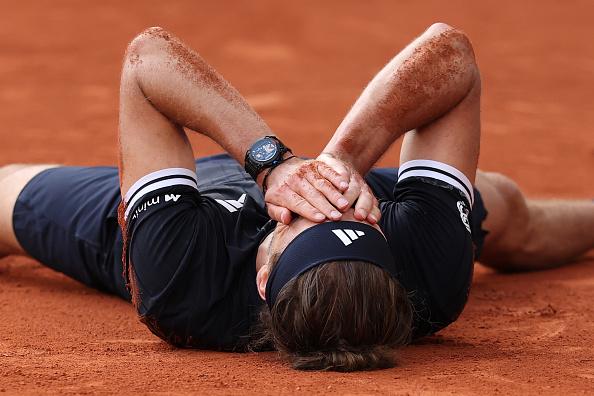
“He’s collapsed at the baseline,” noted Radio Roland Garros. “The tears are flowing – his head is in his hands. This is what he’s been aiming for, dreaming for. He is, and will ever be, a Grand Slam champion. Just think of all the pain and torture he’s put his fans through. Can you imagine the relief this must be?”
No kidding.
Oh, the delights of delayed gratification. Just ask any Chicago fan who had to endure 108 years of Cub shortfalls. And redemption is sweet. After suffering utter humiliation at Wimbledon, it took Jana Novotna five years to come back and erase her misery.
At the 1991 US Open, Jimmy Connors, with his No. 141 ranking, silenced all the haters who’d written him off. Now Sascha is the oldest player to win his first major since 2001.
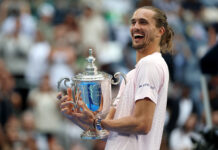
Yes, in arguably the craziest of Slams ever, the Red Sea did miraculously part for Sascha. And in the end, when his face was flooded with glee as he lifted the Coupe des Mousquetaires, it seemed as if tennis’ longest suffering warrior had finally emerged from the desert and at last was walking on water.
The man who four years ago broke four ligaments was now breaking hearts.
He told his team, “We’ve been through so much – we’ve been through injuries, we’ve been through heartbreak, we’ve been through losses. We’ve been losers at times…But at the end of the day, we’re Grand Slam champions now, and that’s what counts.”