
Bill Simons
“Never underestimate a Williams.” – Brad Gilbert
Stop the presses.
Sound the trumpets.
Break the internet.
Let the word spread – from tennis’ most humble valley to the game’s highest peak.
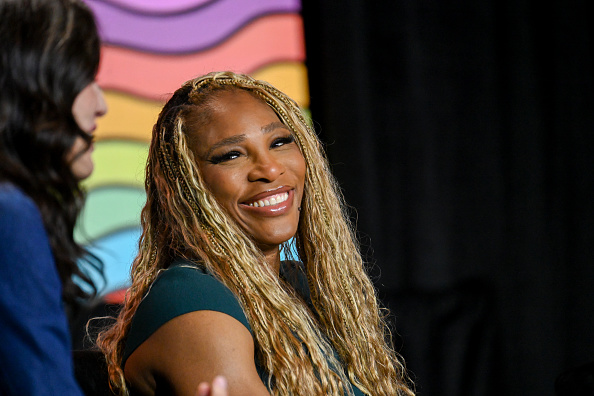
The queen is back. The GOAT is returning. Serena Williams will be playing doubles at the HSBC Championships at London’s Queen’s club, probably with the world No. 9, Canadian Victoria Mboko. The tourney starts on June 8.
The 44-year-old is almost certainly planning to play singles at Wimbledon, where she scored the last of her seven wins in 2016.
As for today, tennis is beside itself. As we noted in February, when we first started tracking this story, no one who’s ever picked up a tennis racket has ever stirred the pot like the female GOAT.
One year she has lunch with the Queen of England, then she steals the show at a princess’ wedding at a storybook castle. Last summer she crashed the induction ceremony at the Hall of Fame and showered her supposedly hated rival with adoration.
Come out on court in a biker suit. Why not? Pose for Sports Illustrated’s swimsuit issue, jaw-dropping Superbowl ads, the Met gala, red carpets and many a runway. The world has long been Serena’s oyster.
Time and again, Serena has given us her own benign kind of shock therapy. It’s in her DNA.
When all eyes were on her older sister making her 1994 Oakland debut, a reporter asked, “Who’s that kid in the shadows?” Soon Richard Williams was telling the world that the 12-year-old across the room, wide-eyed Serena, was going to be even better than Venus.
He nailed it. The shy kid with the broad shoulders turned out to be better than her older sister – and everyone else.
And who else has had more tennis adventures and misadventures than the volcanic Serena? In 2001, after Venus pulled out of a semifinal match in the desert, the packed arena let 19-year-old Serena have it, booing her for two hours. Serena wouldn’t go back for 14 years, until she returned as its prodigal daughter. In the meantime, she got the idea to go barefoot in a Munich restaurant, stepped on a glass and wrecked her foot. After winning Wimbledon in 2010, she was hospitalized with a pulmonary embolism and had a brush with death.
And there was that not-so-grand quartet of controversies at the US Open. The four wretched calls against her during a 2004 Capriatti match that soon led to the introduction of Hawkeye; a hindrance call at set point versus Sam Stosur, a verbal confrontation over a dicey, just-at-the-wrong time foot-fault call and her battle with an overzealous ump at the most controversial Grand Slam final ever, the infamous 2018, “I am not a cheat!” US Open final.
And we can’t forget to mention that after she won the Australian Open 2017 while eight weeks pregnant, Stephen A. Smith stated the obvious: “Serena just did what no man could do.”
Now she’s doing what only she (or perhaps Roger or Rafa) could do.
Never mind that Serena has been retired since the 2022 US Open, that she has two daughters and more business interests than your local equity billionaire.
Then again, let’s be real – it seems that tennis has had a billion comebacks. To come back, you need grit, resolve, resilience, and what coach Kamau Murray called “bounce-back-ability.” In recent years, Stan Wawrinka, Bob Bryan, Andy Murray, Caroline Wozniacki and Elina Svitolina are just some who’ve come back.
Few players had more bounce-back-ability than Lisa Raymond. The Floridian was down 0-6, 0-5, 0-30 to Lubomira Kuhajcova and thought to herself, “Great! I’ve got her just where I want her!” before staging an epic comeback.
Comebacks often have an existential twist. Retired players often ask, “Who am I if I don’t play?” After a 20-month retirement, Belgian Justine Henin confided, “I realized I need to move, I need to be free, I need to have adrenalin in my life. I’m still not ready to calm down and have a normal life.”
Monica Seles, who was stabbed in the back in 1993, felt unabashed glee as she battled her way to the 1995 US Open final. On a whim, she went shopping for hats at Barney’s. “No one was around,” she recalled. “Frank Sinatra was playing on the loudspeakers. I felt like Audrey Hepburn.”
Spaniard Felix Mantilla claimed that he began his comeback after seeing a vision of the Virgin Mary.
The 2001 return of Jennifer Capriati, who won two Slams after missing two seasons due to drug use and personal problems, also drew biblical references. A Dutch writer claimed, “Her comeback was the best since Lazarus.” The London Times contended that, after Muhammad Ali’s, Capriati’s was the second greatest in sports history.
After an eleven-month absence due to knee surgery, Federer beat Nadal in the 2017 Australian Open final. Then in 2018, the 38-year-old crafted two Houdini-like comebacks, saving seven match points against Tennys Sandgren and storming past John Millman.
But Nadal’s comebacks have been far mightier. He missed 17 Grand Slams due to injuries. No player pushed his body like the Spanish warrior.
On land or sea, tennis players have had to cope with almost every curveball imaginable. Dick Williams and Karl Behr leaped off the sinking Titanic and later entered the Hall of Fame. Don Budge returned after serving in World War II. Rod Laver came back after being banned for professionalism. Following an eleven-year absence due to injuries and a car wreck, Tracy Austin reemerged.
The often impassive Pete Sampras delivered a highly charged comeback win over Jim Courier at the 1995 Australian Open. After breaking down when a fan shouted, “Win it for your coach!” – a reference to the dying Tim Gullikson – Sampras gathered himself and prevailed in what Fred Stolle called the finest match he’d ever seen.
Mardy Fish fought anxiety and a racing heart to make a brief, brave return. Swiss Timea Bacsinszky overcame paternal abuse. She confided, “As a young girl, you can never go against the power of a dad. You have no money – nothing.” For her, tennis became a mode of defiance as well as an escape. American Corina Morariu returned after battling leukemia. Kim Clijsters, a mother of two, staged repeated comebacks.
Despite seven surgeries, Juan Martín del Potro offered inspiring returns before his unhappy fate was sealed. Brian Baker, who endured 15 surgeries, admitted, “I’m tired of being the comeback kid.”
As for comeback quips, few topped Andy Roddick. When Agassi asked, “Let’s see what you got, big boy!” Roddick retorted, “Hair!”
Comebacks have not always been applauded. Connors once scoffed at Agassi’s attempt to return at 29 – never mind that Connors himself had slipped to No. 174 before staging his own late-career revival at 39.
Comebacks don’t always work. Bjorn Borg staged ill-fated returns years after retiring at just 26. Michael Mewshaw described Borg as “unshaven, his long hair lank and dirty, wearing a rumpled velour warm-up.” Curry Kirkpatrick wrote that Borg’s return became “a tragicomic carnival. A phrase came to French lips: La mer s’est élevée avec les pleurs. The sea has risen with tears.”
To recapture their bliss, players have run up mountains, used panther tails, and played in braces and boots. To Agassi, comebacks are “symbolic of the battle we all go through, a testament to how strong the human spirit is.”
Serena’s return now feels familiar, and perhaps fitting. Comebacks are about refusing finality, disappearance, and the idea that time or expectations get the last word.
Tennis itself staged the ultimate comeback after Covid in 2021. Jon Wertheim noted, “If microbes have the advantage to create ruptures in the lives of billions, we humans have our own powers – our intelligence, empathy and our ability to cooperate.”
When it comes to theatrical returns, nothing tops Connors’ over-the-top, crotch-grabbing, operatic run to the 1991 US Open semis, which remains a treasure for those who dream of immortality.
While writer Bruce Jenkins contended that Jimmy’s run was “the most rollicking, tempestuous, unforgettable episode in Grand Slam history,” Robert Lipsyte focused on Connors’ shameless delight, saying, “Jimmy reminds us all how much we have given up by growing up. Lucky Jimmy. If only we could once again stop the party…make all the grownups applaud our naughty words, dance through the hors d’oeuvres, posture and preen and be a terrible two, the only time when a human being will be loved for conquering the world while crying.”
But, in the end, to capture the grit of sports comebacks, we call on LeBron James, who suggested: “We’ve all been underestimated and counted out…In those moments, we felt like it was over. But it’s when we’re given no chance that we did what no one thought we could, not even ourselves…We found a way. If we’ve learned anything from sports, it’s that no matter how far down we may be, we are never too far down to come back.”