
Bill Simons
At 35 I knew it was time to bring my free-form lifestyle in for a landing. There was value in being an idealistic kid. Working for civil rights in Mississippi in 1965 touched my soul and changed my life.
Living on beaches was idyllic. Meditating before dawn atop a Himalayan mountain brought serenity.
And here’s a newsflash: living life with one hand waving free is pretty joyous. Downward mobility does have its upsides. But there’s a hefty price to pay.
By 1980 I was off the grid, adrift and living in a tiny garret. My windowless attic room was as hot as my prospects were cool. What was I to do?
I hadn’t even made it to the first rung of the corporate ladder and my invitation to play at Wimbledon somehow got lost in the mail.
But I knew I knew two things – I was determined not to be bored and tennis was the sport I loved.
So I convinced my buddy to give me a freelance assignment to write an article called, “In Search of California’s Finest Tennis Courts.”
In an LA tennis shop, I picked up a magazine, Tennis Talk, and in a flash I had an earth-shattering, life-altering revelation. “Jeez,” I told myself, “I can do better than this.” On that warm, fateful June afternoon, Inside Tennis was born.
I’d soon learn a simple truth: never underestimate the power of an idea. Okay, I hadn’t gotten the memo that the ’70s tennis boom was on its deathbed, and there were already a glut of tennis publications.
But I had a vision, and soon came up with a game plan. Create something different: a regional tennis magazine that was free and free-thinking; a journal that covered the intrigue of international tennis while sharing the homespun details of the grassroots game.
I’d publish a nuanced magazine that would be a fun yet provocative read, with a good dose of spunk and guts, wrapped in compelling storytelling. Its voice would be direct. We’d tell it like it was and, now and then, even be a bit lyrical. Simply put, the magazine would explore life through tennis. What a challenge, sounds like fun.
But skeptics bristled: “Are you nuts? Forget it, buddy, that won’t fly.” Jake Steinman, the publisher of the well-established City Sports Magazine, informed me, “Hey pal, you’ve a 97% chance of failing.” After the USTA NorCal board voted to work with us, one crusty fellow mumbled, “Well, we’ll never see this guy again.” Forty-four years and 418 typos later, we’re still dissecting crosscourt forehands.
Sure, my first office was in a tiny Oakland flat. My first desk was a creaky kitchen table. But I gained gravitas through my specialty, winning tournaments that sounded impressive. (I’m the defending champion of the Super Bowl Tennis Classic and the California Open Pro-Am Mixed Doubles tourneys).
Even back in those stone age days, birthing a print magazine was a senseless exercise for dreamers. On the dance floor of life, humiliation regularly tapped publishers on the shoulder and cut in. (Yikes, we had to stop the presses on the first issue to correct a typo and once, also on the cover, we featured Jimmy Connors backwards).
But there were triumphs, too. Generous investors stepped up. I sold the back cover to Adidas for two years – they stayed for nine. Newfound friends welcomed the wide-eyed kid.
Yes, I experienced more rejection than a club finalist with a wimpy second serve. In publishing, you need the grit of an infantryman, the perspective of a general, the detachment of a Zen monk and the wit of a stand-up.
Along with my spunky young staff, we soldiered on while celebrating the claim of Hall of Fame journalist, Gianni Clerici, who insisted, “The greatest vulgarity is a lack of a sense of humor.” Laughter was our tonic.
But we’ll pass on sharing the moment I danced on top of a beer hall table in Munich during Octoberfest, but still managed to sober up enough the next day to barrel down an autobahn in Boris Becker’s Mercedes, as the German revealed that his mother was a Jew who’d survived a Hitler labor camp.
Speaking of such things, time and again I found myself in daunting sites of war and battle: Hitler’s mountain headquarters in Bavaria, Normandy’s fateful beaches, Hiroshima’s burnt-out remains and the 9/11 rubble at Ground Zero.
At our core, we are storytellers. And for decades we’ve been on a journey of discovery embraced by grace, an adventure that has never failed to excite.
The essence of tennis is ridiculously simple – see ball, hit ball. But the game’s genius is that, perhaps more than any other, it is so very human. Guys play it, so do gals. Both kids and elders enjoy it. It’s played in Topeka and Thailand, in grand English arenas with flawless petunias and on threadbare courts in scrappy parks.
Of course, there’s victory and the sting of defeat. You have to be physical and run all day – athletes welcome.
Tennis’ great gift is its ability to reveal, character and amplify life with an odd, almost uncanny ease. While covering the sport you soon encounter heroes and scoundrels, beauty, triumph, vulnerability and humiliation. And the dark sides of our lives don’t exactly vanish. Soon you reflect on what tennis demands: discipline, patience, character, creativity, perseverance, integrity, wisdom and resilience.
Reader Ray Senkowski suggested, “Tennis is the most amazing sport. Just the way the game flows. Each point is like a short story. I can tell all about a person after playing against him for five minutes, probably more than someone who’s known him for many years. Tennis is just like this.”
Former USTA National coach Jose Higueras added, “If somebody likes tennis, then likely, I like him or her. It doesn’t matter what language they speak.”
We love to reflect on character, explore nuance and muse on emotions. The tales of the game took us from local leafy clubs to leaky hockey arenas in Zimbabwe; from cracked courts in Soweto to village lawns in Fiji, packed with gleeful kids. Atop a mountain in Bali we talked about Navratilova with a gap-toothed hermit with a twinkle in his eye. We found ourselves lost in a massive Spanish Olympic stadium with 27,200 Davis Cup fans shrieking for some hunky teen they called Rafa.
From the outset, when our first issue rolled off a cranky old San Francisco press, we probed the wonders of tennis. And we hardly shied away from the controversies of the day as we reflected on issues of race, war and peace, gender and toxicity.
In 1996, just before the USTA was about to launch its new $263 million US Open stadium it was officially named the USTA Stadium. What a shame we thought. The biggest tennis arena in the world should honor the game’s great man of conscience – Arthur Ashe. So we initiated and sustained the ultimately successful effort to rename the stadium after Arthur. It was our greatest professional achievement. It still gives me goosebumps.
From the outset, interviews were our specialty – from conversations with “The Joker” Jack Nicholson to the “Djoker” Novak Djokovic. And there were celebrity chats too with Johnny Carson at Wimbledon and Robert Redford in Napa Valley. Barbra Streisand told us that Agassi was “a zen master.” We spoke with fellows from other sports, too, like Tiger, Michael Jordan, Jack Nicklaus, Beckham, Sugar Ray, Lance Armstrong and Mike Tyson. Bishop Tutu told us of the impact of Ashe and Jane Goodall mused on our African writings.
Over the years we interviewed virtually all of tennis’ immortals from Helen Wills-Moody, Don Budge, Rod Laver and Billie Jean to Chris Evert, Navratilova and McEnroe and Connors through to Agassi, Serena and Federer. And yeah, there were interviews with four different Presidents – Carter, Bush Sr., Clinton and Trump.
But our prime day-to-day passion was spicy player press conferences. Some people find their bliss by collecting cars or wine tasting. Call me odd, but press conferences are my thing.
Simply put they are tennis’ not-so secret garden, a kind of journey within the journey where the rubber hits the road. Here we see a player’s character and whims, soul and psyche.
Fasten your seat belts, anything goes: hails of laughter, tears of sorrow, rare insights, painful jealousy, bonehead unforced errors or pure banality. They reveal the pathos of a game that lifts souls, yet can even crush the mighty.
Naomi Osaka’s early pressers were whimsical delights, such a celebration of transparent innocence. Some players – like Ashe, Michael Chang, Todd Martin and Jannik Sinner – were deliberative and cerebral. Others were combative: Connors, McEnroe, Lleyton Hewitt and Reilly Opelka. Some (think Ms. Venus Williams) were sullen. And there were the comics – Goran Ivanisivec and Marat Safin. From one generation to the next, I relished the must-see press conferences: Billie Jean, McEnroe, Agassi, Andy Roddick, Marat Safin, Serena, Coco, Tiafoe and Nick Kyrgios.
As you can imagine, long ago the oh-so-sensible notion of work-life balance vanished. Members of the tennis circus find their lives shaped by a familiar rhythm.
Each year the fresh renewal of Melbourne’s Aussie Open gives way to Tennis Paradise in Indian Wells. The clay-incrusted style of Roland Garros and Wimbledon’s grace and grandeur set the foundation for the pulsating surge of the US Open.
Tournaments begin with a flush of anticipation and end with a flood of poignant moments – delight and tears. Phenoms emerge, stars shine, elders fade. The rush of meeting late night deadlines never dulls. The challenge of changing gears when a story breaks: the fall of an icon, a flash retirement, the shock death of a hero.
How thrilling it was being present at the game’s greatest happenings: Super Saturday at the US Open in 1984, Venus’ 1994 Oakland debut, Nadal over Federer at Wimbledon in 2008, and this year’s Alcaraz-Sinner French fantasia. And there were daunting moments too – the booing of the Williams clan at Indian Wells in 2001 to Serena’s meltdown at the 2018 US Open final. And COVID-interuptus was odd. Stadiums emptied, Djokovic was defiant, but due its social distancing the sport soon surged.
So is tennis journalism addictive? Hell yes!
I’m not sure which sentiment more truly captures my world. Steffi Graf said, “Tennis is my life. I have need of the fabulous emotions it gives me.” Or the confession of artist Ai Weiwei who confided, “Expressing oneself is like a drug, I am so addicted.”
It’s not just the challenge of crafting a cut to the chase question at a press conference or the thrill of being locked in with laser eye contact with Novak Djokovic as he offers a deep wisdom answer.
The creative process never loses its sizzle. How do you capture Alcaraz’s athletic genius, Coco’s poise, the heartbreak of Anisimova, the nuances of Sabalenka, the impact of Ashe or Billie Jean or the majesty of Centre Court? What will be the arc of your narrative? What kind of canvas will you paint?
How do you pick photos that capture the moment? Better yet, how do you put together an entire tennis magazine? Writer Christopher Clarey recently told me, “Make it sing.”
The boy who long ago had a simple idea would go on a 44-year journey of wonder. I’ve been astounded by the fury of Connors and uplifted by the grace of Federer. I’ve immersed myself in the poetry of McEnroe’s volleys and Federer’s footwork and been inspired by the mesmerizing athleticism and humility of Nadal. Billie Jean taught me her truths. Ashe’s quiet dignity inspired me.
Who knew the backpacker who slept in the backyard garden of a London townhouse would land up with a permanent seat in Wimbledon’s Centre Court press box?
Who knew that a bound for Shangri-La seeker, who late one night was in a cafe in a dusty village in the Himalayas when an Indian juke box blasted Aretha Franklin’s anthem “There is a rose in Spanish Harlem,” would then, 33 years later, interview her by the US Open players lounge and tell her the story of that dusty village.
Who knew that a college kid who’d obsessively listen alone in his room to Paul McCartney’s “Fool on the Hill,” 34 years later, during a US Open final, would approach the renowned Beatle for an interview, and after telling him that my daughter was named Abby Rose, as in Abbey Road, the iconic star said, “How wonderful!” and put his arm around my shoulder and we’d skip down an empty US Open corridor, Wizard of Oz style.
Many a love affair is brief. Mine lasted nearly a half century. But there is a season for everything under heaven. That boy who didn’t want to be bored, morphed into a man with countless friendships and a lifetime of memorable, quixotic and unique experiences.
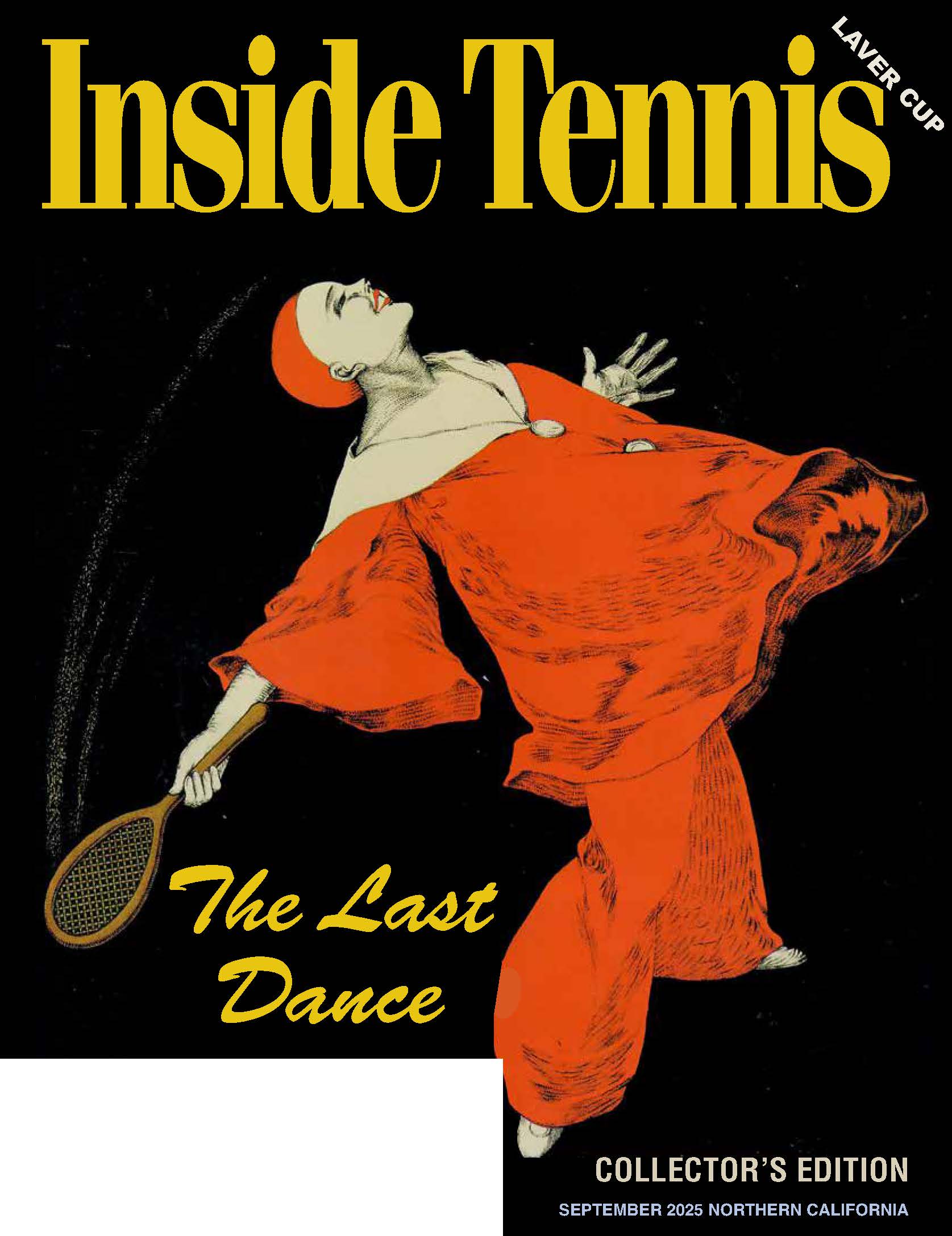
Now it’s time to end Inside Tennis as a print publication, while continuing online.
I’ve been blessed with grace. I’m filled with gratitude. Thanks and see we’ll see you at Insidetennis.com.
THANK YOU READERS AND BACKERS
Inside Tennis would have been nothing without you, our generous readers, who since 1981 have so graciously given us your time, input and encouragement.
We would have been nothing without you and the support of all the fine advertisers, writers, photographers, printers and staffers including our superb Managing Editor Steve Pratt, our talented Art director Earl Madden and, especially Frances Aubrey, who tirelessly has done so much, so often and with such good cheer.
Plus, over the years so many have helped: our gifted photographers and contributors, from Lucia Hoffman and Vinay Venkatesh to Edna Alvarez, the Doughertys, the Humphreys, Matt Cronin, Richard Osborn, Michael Mewshaw, Peter Grame, Dick Wright, Charlie Hoeveler, Bill Kellogg, Gordon Collins, Phil Cello, Carol Weyman, Wayne Bryan, Hugh Ditzler, Bill Gittens, Steve Contardi, Ray Benton, Kurt Kamperman, Mike Skinner, Lisa Beritzoff, Maggie Wise, Katie Dellich, Chip Moreland, Michael Baz, Jim Fawcette, Cynthia Lum, Joel Drucker, Bob Davis, John Saviano, Ryan Wolfington, Dennis Claus, Billy Martin, Trevor Kronemann, Jack Kramer, Bob Kramer, Peter Smith, Colleen Ferrell, Lesley Waite, Franklin Johnson, Liz Blum, Mary Caprielian, Logan Finnell, Bob Davis and Edna, Gus & Alice Simons.
And kudos to my two daughters, Claire and Abby, for all their patience and love and a final thank you to you, good readers, from our hearts. It’s been nothing but a wonder and a blessing.