
Bill Simons
Some called it a fairy tale, others insisted it was a Fery tale.
An unsung longshot, Arthur Fery, a 23-year-old from Wimbledon Village who’s No. 114, had the weight of his nation on his shoulders. After all, Britain’s two most electric players – Emma Raducanu and Jack Draper – hadn’t even made it to the starting line.
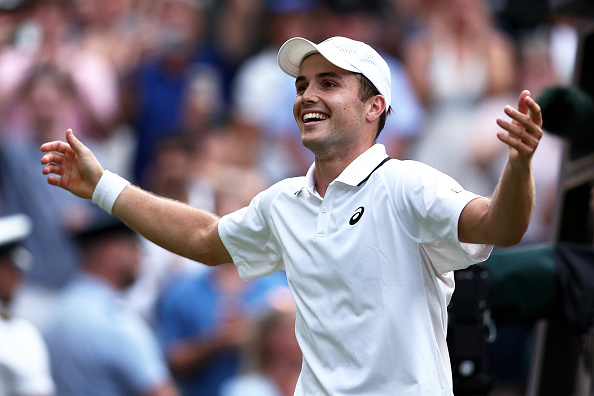
Oh, well, just 17 hours after England’s beloved soccer team shocked host Mexico in the World Cup, Fery stepped up, and in a fifth-set tiebreaker downed former world No. 3 Grigor Dimitrov 7-5, 3-6, 4-6, 6-4, 7-6(7) to become the first British wildcard to ever reach the quarterfinals in any Grand Slam.
Chris Eubanks gushed, “I saw magic happen. This is the reason sports is so special.” Radio Wimbledon let ‘er rip: “They’re dancing on Henman Hill. There are spectators throughout the grounds punching the air. He’s looking to give the light to so many on this magical Middle Monday.”
As Centre Court shook with celebration, 5,400 miles away, in the Bay Area, Stanford’s coach Paul Goldstein recalled the day six years ago when a British 11th-grader from Wimbledon’s King’s College School reached out. Arthur Fery was only the third best junior in Britain. But his French mom had played tennis in America and his dad owned a French soccer team.
Brits have long been attracted to America. Andy Murray lived in Miami. Cam Norrie went to TCU. But, sorry, UCLA, USC and Virginia – no other school has more Wimbledon cred than Stanford.
An American rebel, John McEnroe, shook the place to its core, won three Wimbledon titles and then broadcast matches for decades. The Bryan brothers won three men’s doubles titles. An array of Farm hands regularly orchestrated deep runs. Sandy and Gene Mayer, Pat McEnroe, Tim Mayotte, Dave Wheaton and Dan Goldie all come to mind. As for the women, Kathy Jordan shocked Chris Evert at Wimbledon, and Patty Fendick, Meredith McGrath and Alycia Moulton all have Wimbledon on their resumes.
Legendary coach Dick Gould recalled, “Back in the early 80s, one year at Wimbledon we had eight guys in the final 32. The next year we had four guys in the quarters.”
How grand – yes? But most dynasties can’t a avoid a pesky blemish or two. Roscoe Tanner reached the 1979 final, where he fell to Bjorn Borg in five sets. Then the hard-hitting Card fell on hard times and was imprisoned. And in 1995 Jeff Tarango, another Stanford southpaw, who was kind of hot tempered, let loose with an implosion for the ages.
But never mind all that. Today, Stanford coach Paul Goldstein told Inside Tennis, “I was bursting with joy. Arthur worked so hard and he was so composed. He stayed focused, played with humility and executed under pressure.”
In the third round, Fery repeatedly came from behind in his five-set battle against Belgium’s considerable Zizou Bergs.
Goldstein, who played on four Stanford NCAA championship teams, told us about having a long, reflective dinner with Fery, talking about how the Brit fell to Ben Shelton in the NCAA championships and how the All-American brought a certain English vibe to the Farm.
So why has Stanford had such success at Wimbledon?
Goldstein, who’s flying to London Tuesday, claimed, “It comes down to two things: the legacy of Dick Gould and his approach: don’t be reactive. Take play to your opponent. Dick’s approach was to compete fiercely but with class and integrity – and that’s just like Wimbledon.”
As for Fery’s future, Goldstein likes his chances against French Open finalist Flavio Cobolli in the quarterfinals. In January, Arthur beat the Italian in the first round of the Australian Open.
And Goldstein knows one other thing. The boy who learned to play tennis at a posh school a lob away from the Wimbledon tube station won’t be overwhelmed by his next Centre Court moment.
A RIDDLE WRAPPED IN A MYSTERY INSIDE AN ENIGMA: Wondrous British journalists can be adept masters of understatements, euphemism and propriety. For instance, today on court, the always restrained Reshmin Chowdhury told Fery, “I’m not allowed to repeat the words you whispered to your box when you won match point, but if I could elicit some of the sentiment and emotion that goes with those words perhaps that might help explain what you went through.” BTW: Just after Fery won, he turned to his box and blurted, “what the fuck!”
CHRIS CRAFTS: It seemed that if you were named Chris, you got a job as an ESPN tennis commentator. After all, the most beloved Chris in the game, Chris Evert, has long been on their airwaves. McEnroe whisperer Chris Fowler is a mainstay. Chris McKendry is a shining jewel, and, of late, Chris Eubanks has been displaying his expertise.
But sadly, a few days ago, Evert announced that she would be stepping aside to again battle ovarian cancer. Now the network has a new Chris on board – Kris Budden.
SPEAKING OF COMMENTATORS: Neither Federer or Nadal will ever become TV broadcasters – right?
WHY WEAR A TUXEDO TO STARBUCKS? Naomi Osaka has turned the 2026 Slams into runway extravaganzas. At the Australian Open, she unveiled a dramatic ocean-inspired look. At Roland Garros she embraced Parisian themes. At Wimbledon, she arrived in a long, flowing, ceremonial-style overgarment inspired by Japan’s traditional bridal attire before revealing her match dress. Osaka says she enjoys using tennis fashion to express herself and celebrate her Japanese heritage.
Many applaud her inventive looks. They’re stunning. They’re imaginative. Others see them as a frivolous, expensive indulgence. Why wear a tuxedo to Starbucks?
On the men’s side, Taylor Fritz strode onto Centre Court in a Hugo Boss white blazer and oversized scarf, drawing whistles from some Italian fans. Frances Tiafoe’s verdict was blunt: “If you come out on court looking like that, you’d better not lose.”
Novak Djokovic, who has also been sporting a stylish white blazer, couldn’t resist when he spotted Rory McIlroy in the Royal Box wearing his green Masters jacket. Djokovic jokingly challenged the golf star to a tennis match, with the winner claiming the other’s jacket.
FRITZ’S FURY: Taylor Fritz, the only American man left standing, downed the No. 10 seed Alexander Bublik in straight sets, to reach his third consecutive quarterfinal.
OUR FAVORITE PARENTS: Criticize Jannik Sinner all you want – he was suspended, his game is more than a tad robotic, his charisma is hardly off the charts. But now, he’s gone a notch up in our book. His parents just refused Wimbledon’s coveted invitation to sit next to dukes and duchesses in their rebel-resistant, peasants-need-not-apply Royal Box.
Jannik explained that his parents, who run a guesthouse in northern Italy, didn’t want to appear before cameras. Their decision brings to mind Pam Shriver’s comment: “Lindsay Davenport’s father is my favorite tennis father. I’ve never seen him.
MY CASA, MY RULES: Sam Querrey suggested that when Wimbledon referee Denise Parnell was about to signal the end of play today due to the curfew, she was thinking, “These are my courts, these are my rules.”
TRUTH BE TOLD: The departing Wimbledon crowds inconvenience only a handful of locals. But the curfew will never be changed.